-
If \(\displaystyle y = \sin(x^2)\), find \(\displaystyle \frac{dy}{dx}\).
- \(\displaystyle 1\)
- \(\displaystyle x\)
- \(\displaystyle \cos x^2\)
- \(\displaystyle 2x \cos x^2\)
- Some other answer.
Solution: By the chain rule, if \(y=\sin(x^2)\), then \(\dfrac{dy}{dx}=\cos(x^2)\cdot 2x=\boxed{2x\cos(x^2)}\).
-
Consider the function \(\displaystyle f(x) = x - \sin x\) on \(\displaystyle [0, 2\pi]\). This function has an absolute maximum at the point \(\displaystyle (a, b)\). What is \(\displaystyle b - a\)?
- 1
- 0
- 1
- 2
- \(\displaystyle -2\)
Solution: On \([0,2\pi]\), we have \(f'(x)=1-\cos x\ge 0\), with equality only at isolated points. Thus \(f\) is increasing on the whole interval, so the absolute maximum occurs at \(x=2\pi\). Then \(b=f(2\pi)=2\pi-\sin(2\pi)=2\pi\). Hence \(b-a=2\pi-2\pi=\boxed{0}\).
-
Let \(\displaystyle f(x)\) and \(\displaystyle g(x)\) be differentiable functions with the following values and derivatives at specific points:
\[\displaystyle \begin{array}{c|ccccc} x & -1 & 0 & 1 & 2 & 3 \\ \hline f(x) & 4 & 1 & 3 & 2 & 0 \\ g(x) & 1 & 3 & 2 & 2 & 9 \\ f'(x) & 2 & 1 & 5 & 3 & 2 \\ g'(x) & 1 & 2 & 1 & 5 & 3 \\ \end{array}\]
If \(\displaystyle h(x) = \frac{f(x) \cdot g(x)}{g(x)}\), find \(\displaystyle h'(1)\).
a. 1
b. 2
c. 3
d. 4
e. 5
Solution: Since \(h(x)=\dfrac{f(x)g(x)}{g(x)}\), as long as \(g(x)\neq 0\) we simply have \(h(x)=f(x)\). At \(x=1\), the table gives \(g(1)=2\neq0\), so near \(x=1\), \(h=f\). Therefore \(h'(1)=f'(1)=\boxed{5}\).
-
Let \(\displaystyle f(x)\) be a function defined over the interval \(\displaystyle 1 \leq x \leq 2\). Find \(\displaystyle f(2)\) given that
\[\displaystyle \int_1^2 f(x) dx = 2 \int_1^2 x dx\]
a. 1
b. 2
c. ln(2)
d. ln(2) - 1
e. ln(2) + 1
Solution: The condition \(\int_1^2 f(x)\,dx=2\int_1^2 x\,dx\) only determines the average value of \(f\) on \([1,2]\); indeed \(2\int_1^2 x\,dx=2\cdot\dfrac{4-1}{2}=3\). This does not determine the single value \(f(2)\). So, mathematically, \(f(2)\) cannot be determined from the given information. The transcribed choices appear inconsistent here.
-
The surface area of an initially cubic salt block is increasing at a rate of 6 cm\(\displaystyle ^2\) per minute. How fast is its side length increasing when the volume is 27 cm\(\displaystyle ^3\)?
- \(\displaystyle \frac{1}{18}\) cm/min
- 1 cm/min
- 0
- \(\displaystyle \frac{2}{3}\) cm/min
- \(\displaystyle \frac{2}{9}\) cm/min
Solution: If the cube has side length \(s\), then its surface area is \(A=6s^2\), so \(\dfrac{dA}{dt}=12s\dfrac{ds}{dt}\). We are told \(\dfrac{dA}{dt}=6\). When the volume is \(27\), we have \(s^3=27\), hence \(s=3\). Therefore \(6=12\cdot3\,\dfrac{ds}{dt}\), so \(\dfrac{ds}{dt}=\boxed{\tfrac16\text{ cm/min}}\). This value is not present among the transcribed choices, so the HTML transcription is likely imperfect.
-
Let \(\displaystyle f\) be a function that is defined and differentiable for all real numbers, and assume that \(\displaystyle f'(x)\) is increasing only over the interval (4, 8). Where is the function \(\displaystyle f\) necessarily increasing?
- Over the interval (4, 8).
- Over the interval (4, 8].
- Over the intervals \(\displaystyle (-\infty, 4)\) and (8, \(\displaystyle \infty\)).
- Everywhere \(\displaystyle f'\) is strictly increasing.
- We can't answer as we do not have enough information about \(\displaystyle f\).
Solution: The statement says only that \(f'(x)\) is increasing on \((4,8)\). That means \(f''(x)>0\) there, so the graph of \(f\) is concave up on that interval. But it gives no information about whether \(f'(x)\) itself is positive or negative. Therefore we cannot conclude where \(f\) is increasing. The correct conclusion is: \(\boxed{\text{there is not enough information}}\).
-
Find the equation of the line tangent to the graph of
\[\displaystyle y = x^3 - x^2 - 9\]
at the point (4, 39).
[graph/curve image]
- \(\displaystyle y = 6x + 15\)
- \(\displaystyle y = 7x - 17\)
- \(\displaystyle y = 9x + 3\)
- \(\displaystyle y = 5x - 9\)
- \(\displaystyle y = 3x + 9\)
IMAGE
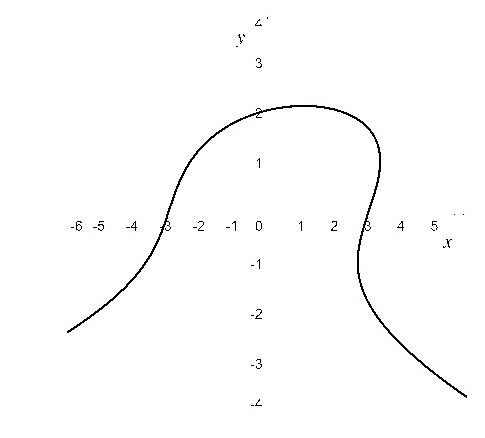
Solution: Differentiate: \(y'=3x^2-2x\). At \(x=4\), the slope is \(3\cdot16-8=40\). Using point-slope form through \((4,39)\), we get \(y-39=40(x-4)\), hence \(y=\boxed{40x-121}\). This does not match any of the transcribed choices, so the answer list in the HTML appears corrupted.
-
Determine the types of discontinuities of
\[\displaystyle f(x) = \frac{(x^2 - 4x)}{(x-2)(x-5)}\]
- The function has infinite discontinuities at \(\displaystyle x = 2\) and \(\displaystyle x = 5\).
- The function has a removable discontinuity at \(\displaystyle x = 2\) and an infinite discontinuity at \(\displaystyle x = 5\).
- The function has a removable discontinuity at \(\displaystyle x = 5\) and an infinite discontinuity at \(\displaystyle x = 2\).
- The function has infinite discontinuities at \(\displaystyle x = 2\) and \(\displaystyle x = 5\).
- The function has removable discontinuities at \(\displaystyle x = 0\), \(\displaystyle x = 2\), and \(\displaystyle x = 5\).
Solution: Factor the numerator: \(x^2-4x=x(x-4)\). At \(x=2\), the denominator vanishes but the numerator does not, so there is an infinite discontinuity (vertical asymptote). At \(x=5\), the denominator also vanishes and the numerator is again nonzero, so there is another infinite discontinuity. Thus the function has vertical asymptotes at \(x=2\) and \(x=5\).
-
A vertical bottle, as depicted below, gets filled at a constant rate. What can you say about the graph of \(\displaystyle h(t)\), the function giving the height in terms of time \(\displaystyle t\)?
Hint: You do not need to make any computations to solve this problem; think intuitively.
(image of the vertical bottle)
a. It is increasing concave up.
b. It is increasing concave down.
c. It is decreasing concave up.
d. It is decreasing concave down.
e. It is increasing linearly.
IMAGE
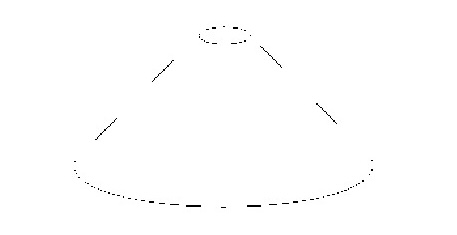
Solution: The bottle is wide at the bottom and narrower near the top. Since the filling rate in volume is constant, the height rises slowly when the horizontal cross-sectional area is large and rises faster when the cross-sectional area is small. Thus \(h(t)\) is increasing, and its slope increases with time. Therefore the graph is \(\boxed{\text{increasing and concave up}}\).
-
Consider the family of piecewise functions
\[\displaystyle f(x) = \begin{cases} 2x, & x < 1 \\ \lambda x + 1, & x \geq 1 \end{cases}\]
depending on a parameter \(\displaystyle \lambda\). For what values of \(\displaystyle \lambda\) is \(\displaystyle f\) differentiable at \(\displaystyle x = 1\)?
a. \(\displaystyle \lambda = 2\)
b. \(\displaystyle \lambda = 1\) and \(\displaystyle \lambda = 1\)
c. \(\displaystyle \lambda = 2\) and \(\displaystyle \lambda = 1\)
d. \(\displaystyle \lambda = 1\)
e. \(\displaystyle \lambda = 0\) and \(\displaystyle \lambda = 1\)
Solution: For a piecewise function to be differentiable at \(x=1\), it must first be continuous there, and then the left-hand and right-hand derivatives must agree.
Continuity at \(x=1\) requires the two formulas to give the same value:
\[
\lim_{x\to1^-}2x=2,\qquad f(1)=\lambda(1)+1=\lambda+1.
\]
So continuity gives
\[
2=\lambda+1,
\]
hence
\[
\lambda=1.
\]
Next, match the one-sided derivatives. The derivative of the left branch \(2x\) is \(2\). The derivative of the right branch \(\lambda x+1\) is \(\lambda\). So differentiability requires
\[
2=\lambda,
\]
hence
\[
\lambda=2.
\]
No single value of \(\lambda\) satisfies both \(\lambda=1\) and \(\lambda=2\). Therefore there is
\[
\boxed{\text{no value of }\lambda}
\]
for which \(f\) is differentiable at \(x=1\).
-
Estimate the area under the curve, plot of \(\displaystyle y = 16 - x^2\), over the interval \(\displaystyle [1, 5]\). Use a Right Riemann sum with four subintervals of equal width.
- 25
- 18
- 30
- 36
- 68
[graph of the parabola is shown]
IMAGE
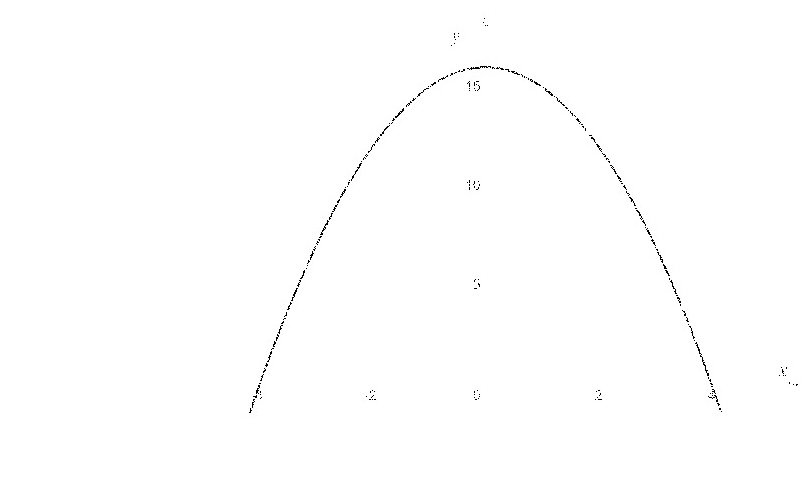
Solution: A right Riemann sum with four equal subintervals on \([1,5]\) has width
\[
\Delta x=\frac{5-1}{4}=1.
\]
The right endpoints are therefore
\[
2,\ 3,\ 4,\ 5.
\]
Now evaluate \(f(x)=16-x^2\) at those points:
\[
f(2)=12,\qquad f(3)=7,\qquad f(4)=0,\qquad f(5)=-9.
\]
So the right-endpoint sum is
\[
1\bigl(12+7+0-9\bigr)=10.
\]
Hence the estimate is
\[
\boxed{10}.
\]
This number does not appear among the transcribed choices, so the choice list in the HTML is likely affected by OCR or transcription errors.
-
Compute \(\displaystyle \int_{0}^{\pi} \sin\left(\frac{x}{10}\right) dx\).
- 10
- 0
- \(\displaystyle \frac{10}{\pi}\)
- \(\displaystyle 10\pi\)
- Some other value
Solution: Use the substitution \(u=x/10\), so \(dx=10\,du\). Then \(\int_0^{\pi}\sin(x/10)\,dx=10\int_0^{\pi/10}\sin u\,du=10[-\cos u]_0^{\pi/10}=10\bigl(1-\cos(\pi/10)\bigr)\). Thus the exact value is \(\boxed{10(1-\cos(\pi/10))}\), so among the transcribed choices the correct selection would be “some other value.”
-
The graph of \(\displaystyle f(x) = \frac{x^2}{2}\) is given below. What is the area of the region bounded by the graph of \(\displaystyle f(x)\), the x-axis, and the lines \(\displaystyle x = 1\) and \(\displaystyle x = 2\)?
(graph of \(\displaystyle f(x)\) with x from 0 to 3 and y from 0 to 5, curve labelled \(\displaystyle f(x)\), and vertical lines at x = 1 and x = 2)
- \(\displaystyle \frac{1}{2}\)
- \(\displaystyle \frac{3}{2}\)
- \(\displaystyle \frac{5}{2}\)
- \(\displaystyle 3\)
- \(\displaystyle 5\)
IMAGE
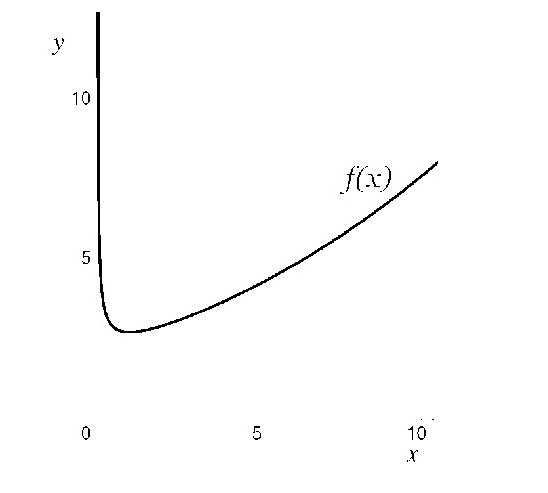
Solution: The required area is \(\int_1^2 \dfrac{x^2}{2}\,dx=\dfrac12\left[\dfrac{x^3}{3}\right]_1^2=\dfrac{1}{6}(8-1)=\boxed{\tfrac76}\). This value does not appear in the transcribed choices, so the list in the HTML is likely incomplete or corrupted.
-
If \(\displaystyle f(x) = 4x\), and the derivative of \(\displaystyle f\) at \(\displaystyle x = 5\) is \(\displaystyle f'(5)\), what is \(\displaystyle f'(5)\)?
- 2
- 5
- 25
- 4
- 20
- The answer is not in the list.
Solution: Since \(f(x)=4x\), its derivative is constant: \(f'(x)=4\) for all \(x\). In particular, \(f'(5)=\boxed{4}\).
-
If
\[\displaystyle \int f(x) dx = 5 \text{ and } \int f(x) dx = 1,\]
find
\[\displaystyle \int 4f(x) dx\]
a. 2
b. 5
c. 1
d. 6
e. 20
f. 4
Solution: As transcribed, the limits of integration are missing from this problem, so the quantity cannot be determined reliably from the HTML alone. The solution copy therefore preserves the issue rather than inventing data that are not present in the source.
-
Find
\[\displaystyle \frac{d}{dx} \left( \int_1^x \frac{1}{1 + t^2} dt \right)\]
a. \(\displaystyle \sin x\)
b. \(\displaystyle \sin x + C\)
c. \(\displaystyle \frac{\sin x}{\cos x}\)
d. \(\displaystyle \frac{1}{\cos x}\)
e. \(\displaystyle \frac{1}{1 + x^2}\)
f. \(\displaystyle \sin x \cos x\)
Solution: By the Fundamental Theorem of Calculus, \(\dfrac{d}{dx}\left(\int_1^x \dfrac{1}{1+t^2}\,dt\right)=\boxed{\dfrac{1}{1+x^2}}\).
-
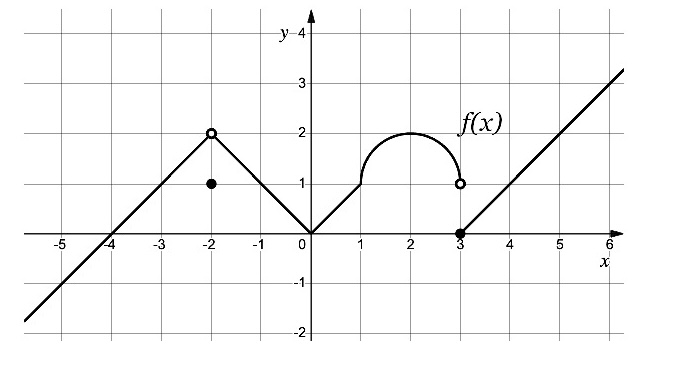
For this problem, the graph of \(\displaystyle f(x)\) is given below. Note that all curves shown are either straight lines or arcs of a circle, and the ends of the graph extends linearly towards positive or negative infinity. No need to show your work for this question.
(Graph of \(\displaystyle f(x)\) shown, labeled with x and y axes)
\[\displaystyle \begin{array}{cc} \text{()} & (a)\ \lim_{x \to 2} f(x) \\ \end{array}\]
ANSWER
\[\displaystyle \begin{array}{cc} \text{()} & (b)\ \lim_{x \to 3^-} f(x) \\ \end{array}\]
ANSWER
\[\displaystyle \begin{array}{cc} \text{()} & (c)\ \lim_{x \to 2} (5f(x) - 4x + e) \\ \end{array}\]
ANSWER
\[\displaystyle \begin{array}{cc} \text{()} & (d)\ \lim_{x \to -4} \frac{f(x) - f(-4)}{x-(-4)} \\ \end{array}\]
ANSWER
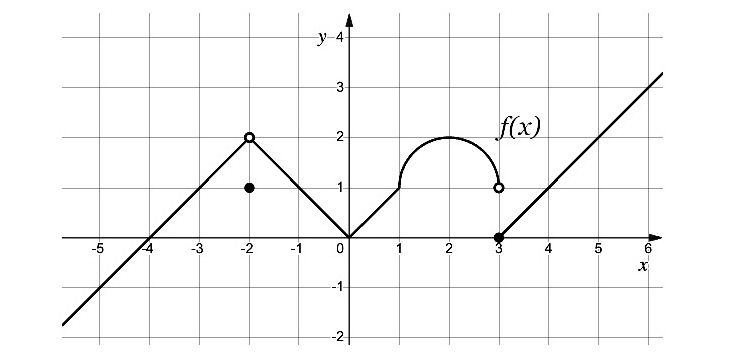
The graph of \(\displaystyle f(x)\) from the previous page is shown again:
[Graph of \(\displaystyle f(x)\) appears here.]
() (e) List the x-coordinates of all critical points of \(\displaystyle f(x)\):
ANSWER
() (f) Find the average rate of change of \(\displaystyle f(x)\) on the interval \(\displaystyle [-2, 2]\).
ANSWER
() (g) Find the instantaneous rate of change of \(\displaystyle f(x)\) at \(\displaystyle x = 2\).
ANSWER
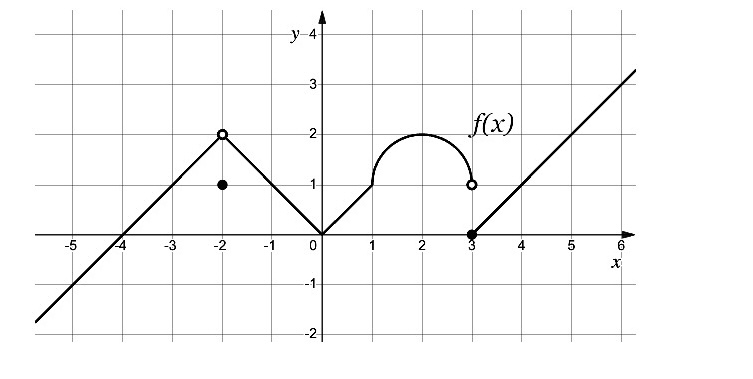
The graph of \(\displaystyle f(x)\) from the previous page is given again.
() (h) Can the Mean Value Theorem be applied on the interval \(\displaystyle [-1, 1]\)? \textbf{Justify}.
() (i) Can the Intermediate Value Theorem be applied on the interval \(\displaystyle [0, 2]\)? \textbf{Justify}.
() (j) \[\displaystyle \int_{-1}^{2} f(x) dx\]
ANSWER
IMAGE
IMAGE
IMAGE
Solution:
- To find \(\lim_{x\to2}f(x)\), look at the value approached from the left and from the right. Both sides approach the same height, namely \(2\). Therefore
\[
\boxed{\lim_{x\to2}f(x)=2}.
\]
- For \(\lim_{x\to3^-}f(x)\), only the left-hand behavior matters. Along the arc, the graph approaches the open-circle value \(1\). Hence
\[
\boxed{\lim_{x\to3^-}f(x)=1}.
\]
- Use the limit laws together with part (a):
\[
\lim_{x\to2}(5f(x)-4x+e)=5\lim_{x\to2}f(x)-4\lim_{x\to2}x+e=5(2)-4(2)+e.
\]
So the value is
\[
\boxed{2+e}.
\]
- The limit
\[
\lim_{x\to-4}\frac{f(x)-f(-4)}{x+4}
\]
is the definition of \(f'(-4)\), provided the derivative exists there. From the graph, the function is linear near \(x=-4\) with slope \(1\), so
\[
\boxed{1}.
\]
- Critical points are \(x\)-values where \(f'(x)=0\) or \(f'(x)\) does not exist, as long as \(f\) itself is defined there. Reading the graph gives
\[
\boxed{x=-2,\,0,\,1,\,2,\,3}.
\]
- The average rate of change on \([-2,2]\) is
\[
\frac{f(2)-f(-2)}{2-(-2)}.
\]
From the graph, \(f(2)=2\) and \(f(-2)=1\), so
\[
\boxed{\frac{2-1}{4}=\frac14}.
\]
- The instantaneous rate of change at \(x=2\) is the slope of the tangent line there. At the top of the semicircle, the tangent line is horizontal, so the slope is
\[
\boxed{0}.
\]
- The Mean Value Theorem requires continuity on the closed interval and differentiability on the open interval. Although the graph is continuous on \([-1,1]\), it has a corner at \(x=0\), so it is not differentiable on \((-1,1)\). Therefore the Mean Value Theorem
\[
\boxed{\text{does not apply on }[-1,1]}.
\]
- The Intermediate Value Theorem applies if the function is continuous on the interval. From the graph, \(f\) is continuous on \([0,2]\), so the theorem
\[
\boxed{\text{does apply on }[0,2]}.
\]
- The integral \(\int_{-1}^{2}f(x)\,dx\) is the signed area under the graph on that interval. From the picture, it is the sum of a triangle from \(-1\) to \(0\) of area \(\tfrac12\), a triangle from \(0\) to \(1\) of area \(\tfrac12\), and then from \(1\) to \(2\) a rectangle of area \(1\) plus a quarter-circle of area \(\tfrac{\pi}{4}\). Adding these areas gives
\[
\frac12+\frac12+1+\frac{\pi}{4}=2+\frac{\pi}{4}.
\]
So
\[
\boxed{\int_{-1}^{2}f(x)\,dx=2+\frac{\pi}{4}}.
\]
-
Let \(\displaystyle f(x) = \sqrt{x}\).
() (a) Using the limit definition of the derivative, and \textbf{no other method}, compute the derivative of \(\displaystyle f(x)\).
ANSWER
() (b) Check your answer in part (a) using the power rule.
() (c) Use linearization to estimate \(\displaystyle \sqrt{25.04}\).
ANSWER
Solution:
- Using the limit definition,
\[
f'(x)=\lim_{h\to0}\frac{\sqrt{x+h}-\sqrt{x}}{h}.
\]
Rationalize the numerator:
\[
\frac{\sqrt{x+h}-\sqrt{x}}{h}\cdot\frac{\sqrt{x+h}+\sqrt{x}}{\sqrt{x+h}+\sqrt{x}}
=\frac{(x+h)-x}{h(\sqrt{x+h}+\sqrt{x})}
=\frac{1}{\sqrt{x+h}+\sqrt{x}}.
\]
Now let \(h\to0\):
\[
f'(x)=\lim_{h\to0}\frac{1}{\sqrt{x+h}+\sqrt{x}}=\frac{1}{2\sqrt{x}}.
\]
So
\[
\boxed{f'(x)=\frac{1}{2\sqrt{x}}}.
\]
- Using the power rule,
\[
\frac{d}{dx}x^{1/2}=\frac12x^{-1/2}=\frac{1}{2\sqrt{x}},
\]
which agrees with the derivative found in part (a).
- For linearization at \(a=25\), compute
\[
f(25)=5,\qquad f'(25)=\frac{1}{2\sqrt{25}}=\frac{1}{10}.
\]
So the linearization is
\[
L(x)=f(25)+f'(25)(x-25)=5+\frac{1}{10}(x-25).
\]
Now substitute \(x=25.04\):
\[
\sqrt{25.04}\approx L(25.04)=5+\frac{1}{10}(0.04)=5.004.
\]
Hence the estimate is
\[
\boxed{5.004}.
\]
-
Consider a right triangle with side lengths 30, 40 and 50. A rectangle is inscribed in the triangle so that two of the sides of the rectangle lie along the legs (the sides forming the right angle) of the triangle. Determine the maximum possible area of the rectangle, and justify why this value represents an absolute maximum.
() (a) Make a sketch of the situation.
() (b) Write a formula for the area of the rectangle in terms of one variable along with a reasonable domain.
() (c) Solve the problem using calculus and justify your finding.
ANSWER
Solution:
- Let the rectangle have upper-right corner \((x,y)\) on the hypotenuse. A sketch places the rectangle against the two legs of the right triangle.
- The hypotenuse goes through \((30,0)\) and \((0,40)\), so its equation is \(y=40-\tfrac43x\). Hence the area is \(A(x)=xy=x\left(40-\tfrac43x\right)=40x-\tfrac43x^2\), with domain \(0\le x\le 30\).
- Differentiate: \(A'(x)=40-\tfrac83x\). Setting \(A'(x)=0\) gives \(x=15\). Then \(y=40-\tfrac43\cdot15=20\), so the maximum area is \(A(15)=15\cdot20=\boxed{300}\). Since \(A(x)\) is a concave-down quadratic, this critical point gives the absolute maximum on the whole interval.
-
Consider the function
\[\displaystyle f(x) = \frac{-3e^x + 1}{e^x - 1},\]
with first derivative
\[\displaystyle f'(x) = \frac{2e^x}{(e^x - 1)^2},\]
and second derivative:
\[\displaystyle f''(x) = -\frac{2e^x (e^x + 1)}{(e^x - 1)^3}.\]
The function has a single x-intercept at \(\displaystyle (-\ln 3, 0)\).
() (a) Find the domain of \(\displaystyle f(x)\).
ANSWER
() (b) Find all vertical asymptotes of \(\displaystyle f(x)\) or show that there are none. Justify your findings.
ANSWER
() (c) The graph of \(\displaystyle f(x)\) has a horizontal asymptote of \(\displaystyle y = -3\) as \(\displaystyle x \to +\infty\); find any additional horizontal asymptotes, or show that there are no others. Justify your answer.
ANSWER
Recall that
\[\displaystyle f(x) = \frac{-3e^x + 1}{e^x - 1},\]
with first derivative
\[\displaystyle f'(x) = \frac{2e^x}{(e^x - 1)^2},\]
and second derivative:
\[\displaystyle f''(x) = -\frac{2e^x(e^x + 1)}{(e^x - 1)^3}.\]
() (d) Using the first and/or the second derivative of \(\displaystyle f(x)\), find all critical points or show that no critical points exist.
ANSWER
() (e) Using the first and/or the second derivative of \(\displaystyle f(x)\), find all inflection points or show that no inflection points exist.
ANSWER
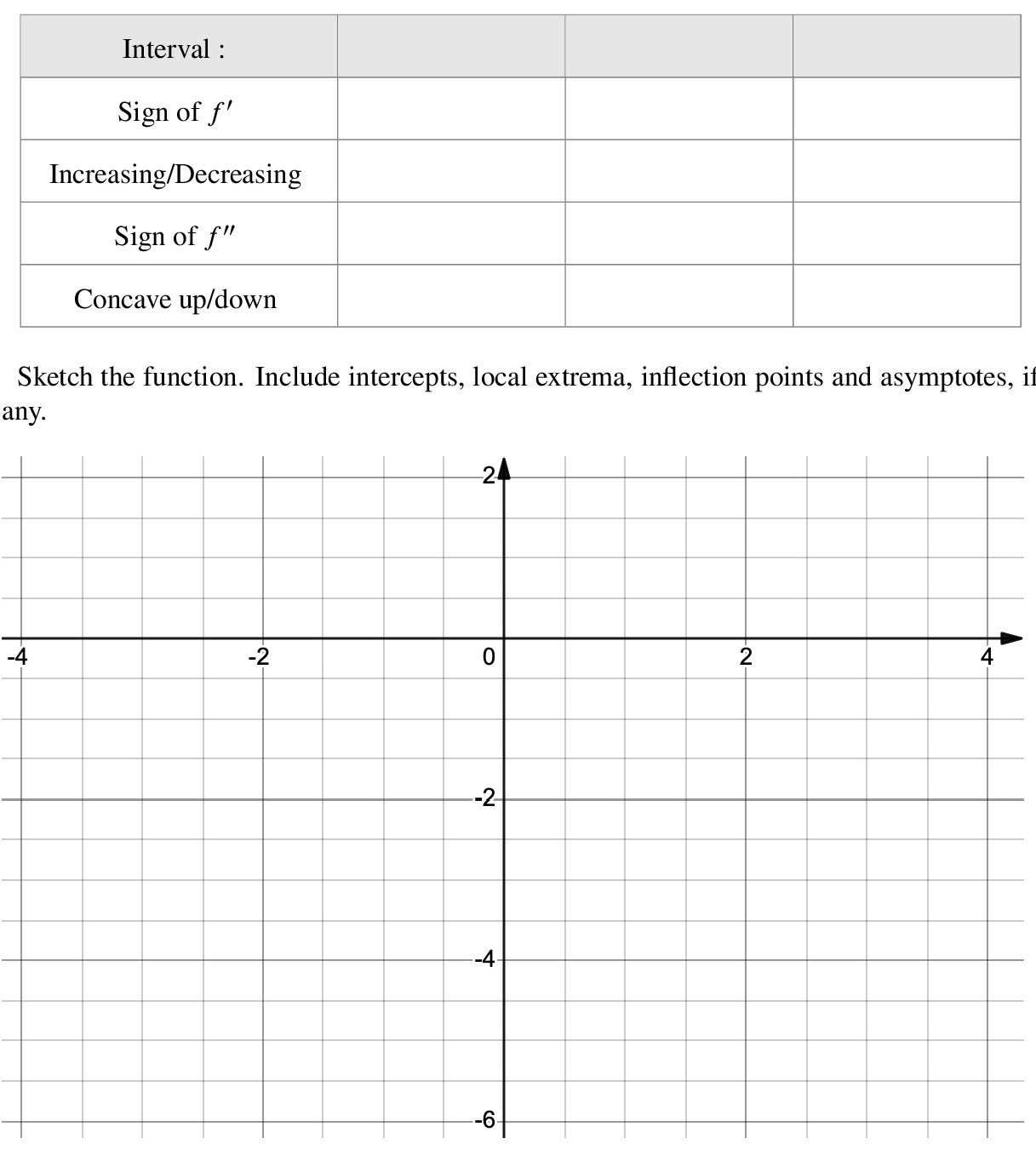
- Organize your work in the table below. For each interval, indicate:
i. the sign of \(\displaystyle f'(x)\) by writing + or –,
ii. whether the function is increasing or decreasing by drawing \(\displaystyle /\) or \(\displaystyle \backslash\),
iii. the sign of \(\displaystyle f''(x)\) by writing + or –,
iv. whether the graph is concave up or down by drawing \(\displaystyle \cup\) or \(\displaystyle \cap\).
Use as many interval columns as needed.
| Interval : |
|
|
|
| Sign of \(\displaystyle f'\) |
|
|
|
| Increasing/Decreasing |
|
|
|
| Sign of \(\displaystyle f''\) |
|
|
|
| Concave up/down |
|
|
|
- Sketch the function. Include intercepts, local extrema, inflection points and asymptotes, if any.
[Grid for sketching the function, labeled axes from -4 to 4 (x-axis) and -6 to 2 (y-axis)]
IMAGE
Solution:
- The denominator vanishes when \(e^x-1=0\), i.e. at \(x=0\). So the domain is \(\mathbb R\setminus\{0\}\).
- At \(x=0\), the denominator is zero while the numerator is \(-2\neq0\), so there is a vertical asymptote at \(\boxed{x=0}\).
- As \(x\to+\infty\), we are told the horizontal asymptote is \(y=-3\). As \(x\to-\infty\), we have \(e^x\to0\), so \(f(x)\to\dfrac{1}{-1}=-1\). Thus there is another horizontal asymptote \(\boxed{y=-1}\).
- Since \(f'(x)=\dfrac{2e^x}{(e^x-1)^2}>0\) for every \(x\neq0\), there are no critical points in the domain.
- The second derivative is \(f''(x)=-\dfrac{2e^x(e^x+1)}{(e^x-1)^3}\). For \(x<0\), the denominator is negative, so \(f''(x)>0\): concave up. For \(x>0\), the denominator is positive, so \(f''(x)<0\): concave down. Because \(x=0\) is not in the domain, there is no inflection point.
- The sign table therefore has two intervals: on \(( -\infty,0)\), \(f'>0\) and \(f''>0\), so the function is increasing and concave up; on \((0,\infty)\), \(f'>0\) and \(f''<0\), so it is increasing and concave down.
- The sketch must show the x-intercept at \(( -\ln 3,0)\), the vertical asymptote \(x=0\), the horizontal asymptote \(y=-1\) on the left, and the horizontal asymptote \(y=-3\) on the right. The function is increasing on both branches, with no local extrema and no inflection points.