Spring 25 Final Solution

Part I: Multiple Choice

  1. If \(\displaystyle y = 2x^3 + 3x^2 - 12x - 10\), find \(\displaystyle y'(-1)\).

    1. \(\displaystyle -18\)
    2. \(\displaystyle -12\)
    3. \(\displaystyle -6\)
    4. \(\displaystyle 0\)
    5. \(\displaystyle 6\)

    Solution: We differentiate: \(y'(x)=6x^2+6x-12\). Hence \(y'(-1)=6(1)+6(-1)-12=-12\). The correct choice is \(\boxed{-12}\).

  2. If \(\displaystyle f(\theta) = \sin \theta\), find \(\displaystyle f^{(11)}(\pi)\), the 11th derivative of \(\displaystyle f(\theta)\) at \(\displaystyle \theta = \pi\).

    1. \(\displaystyle -\pi\)
    2. \(\displaystyle -1\)
    3. \(\displaystyle 0\)
    4. \(\displaystyle 1\)
    5. \(\displaystyle \pi\)

    Solution: The derivatives of \(\sin\theta\) cycle every four steps: \(\sin,\cos,-\sin,-\cos\). Since \(11\equiv 3\pmod 4\), the 11th derivative is \(-\cos\theta\). Therefore \(f^{(11)}(\pi)=-\cos\pi=-(-1)=\boxed{1}\).

  3. How many critical points of \(\displaystyle y = x^5 - \frac{20}{3}x^3\) are NOT local extrema?

    1. 0
    2. 1
    3. 2
    4. 3
    5. 5

    Solution: We compute \(y'(x)=5x^4-20x^2=5x^2(x^2-4)\). The critical points are \(x=-2,0,2\). At \(x=\pm2\), the sign of \(y'\) changes, so those are local extrema. At \(x=0\), the factor \(x^2\) does not change sign, so \(x=0\) is critical but not an extremum. Thus exactly \(\boxed{1}\) critical point is not a local extremum.

  4. If \(\displaystyle y(x) = \sqrt{1-x^2} + x \arcsin{x}\), compute \(\displaystyle y'(x)\).

    1. \(\displaystyle \frac{x}{\sqrt{1-x^2}}\)
    2. \(\displaystyle \frac{1}{\sqrt{1-x^2}}\)
    3. \(\displaystyle \arcsin{x} - \frac{2x}{\sqrt{1-x^2}}\)
    4. \(\displaystyle \arcsin{x} - \frac{x}{\sqrt{1-x^2}}\)
    5. \(\displaystyle \arcsin{x}\)

    Solution: Differentiate term by term. First, \(\dfrac{d}{dx}\sqrt{1-x^2}=\dfrac{-x}{\sqrt{1-x^2}}\). Next, by the product rule, \(\dfrac{d}{dx}\bigl(x\arcsin x\bigr)=\arcsin x+\dfrac{x}{\sqrt{1-x^2}}\). The rational terms cancel, so \(y'(x)=\boxed{\arcsin x}\).

  5. A person walks away from a lamp post at a rate of 3 ft/sec. The lamp post is 10 ft tall, and the person is 5 ft tall. How fast is the length of the person's shadow increasing when the person is 15 ft from the lamp post?

    1. \(\displaystyle \frac{3}{10}\) ft/sec
    2. \(\displaystyle \frac{10}{3}\) ft/sec
    3. \(\displaystyle \frac{5}{2}\) ft/sec
    4. 2 ft/sec
    5. 3 ft/sec

    Solution: Let \(x\) be the distance from the lamp post to the person and \(s\) the shadow length. By similar triangles, \(\dfrac{10}{x+s}=\dfrac{5}{s}\), hence \(10s=5x+5s\), so \(s=x\). Differentiating gives \(\dfrac{ds}{dt}=\dfrac{dx}{dt}=3\) ft/sec. Therefore the shadow length is increasing at \(\boxed{3\text{ ft/sec}}\).

  6. What is the slope of the tangent line to \(\displaystyle x y^2 + e^y = x^2\) at the point \(\displaystyle (1, 0)\)?

    1. \(\displaystyle -1\)
    2. 0
    3. \(\displaystyle \frac{1}{2}\)
    4. 1
    5. 2

    Solution: Differentiate implicitly: \(\dfrac{d}{dx}(xy^2)+\dfrac{d}{dx}(e^y)=\dfrac{d}{dx}(x^2)\). Thus \(y^2+2xyy'+e^y y'=2x\). At \((1,0)\), this becomes \(0+(0+1)y'=2\), so \(y'=\boxed{2}\).

  7. Consider the function

    \[\displaystyle f(x) = \begin{cases} x^{2} + ax - 3x + 3 - a, & \text{if } x \leq 1 \\ \frac{2x}{x^{2} + 1}, & \text{if } x > 1 \end{cases}\]

    What should \(\displaystyle a\) be so that the function is differentiable everywhere?

    1. \(\displaystyle a = 0\)
    2. \(\displaystyle a = \frac{1}{2}\)
    3. \(\displaystyle a = \frac{1}{3}\)
    4. \(\displaystyle a = \frac{1}{4}\)
    5. \(\displaystyle a = 1\)

    Solution: For differentiability at \(x=1\), we need continuity and matching one-sided derivatives. The left branch gives \(f(1)=1+a-3+3-a=1\), while the right branch gives \(\dfrac{2}{2}=1\), so continuity is automatic. The left derivative is \(2x+a-3\), hence at \(x=1\) it is \(a-1\). The right derivative of \(\dfrac{2x}{x^2+1}\) is \(\dfrac{2(1-x^2)}{(x^2+1)^2}\), which equals \(0\) at \(x=1\). Therefore \(a-1=0\), so \(\boxed{a=1}\).

  8. If \(\displaystyle f(x) = x^{3} + 8x + \cos(3x)\) and \(\displaystyle g(x) = f^{-1}(x)\), find the slope of the tangent line to \(\displaystyle g(x)\) at the point \(\displaystyle (1, 0)\).

    1. \(\displaystyle \frac{1}{11}\)
    2. \(\displaystyle \frac{1}{8}\)
    3. \(\displaystyle -\frac{1}{8}\)
    4. \(\displaystyle \frac{1}{11 + 3 \sin 3}\)
    5. \(\displaystyle 8\)

    Solution: Since \(g=f^{-1}\), we use \(g'(y)=\dfrac{1}{f'(x)}\) where \(y=f(x)\). The point \((1,0)\) on \(g\) means \(g(1)=0\), so \(f(0)=1\), which is true. Now \(f'(x)=3x^2+8-3\sin(3x)\), hence \(f'(0)=8\). Therefore \(g'(1)=\dfrac{1}{8}\), so the slope is \(\boxed{\tfrac18}\).

  9. Let \(\displaystyle f\) and \(\displaystyle g\) be differentiable functions, and suppose the following values are known:

    \[\displaystyle \begin{aligned} &f(a) = -4, f'(a) = 8, g(a) = c, g'(a) = b, \\ &f(c) = 3, f'(c) = 2, g(c) = 5, g'(c) = 1. \end{aligned}\]

    Define \(\displaystyle h(x) = [ f(g(x)) ]^2\). What is the value of \(\displaystyle h'(a)\)?

    1. \(\displaystyle 4b\)
    2. \(\displaystyle 6b\)
    3. \(\displaystyle 12b\)
    4. \(\displaystyle 15b\)
    5. \(\displaystyle 24b\)
    6. \(\displaystyle 36b\)

    Solution: We have \(h(x)=[f(g(x))]^2\). By the chain rule, \(h'(x)=2f(g(x))\,f'(g(x))\,g'(x)\). At \(x=a\), we know \(g(a)=c\), \(f(c)=3\), \(f'(c)=2\), and \(g'(a)=b\). Hence \(h'(a)=2\cdot3\cdot2\cdot b=\boxed{12b}\).

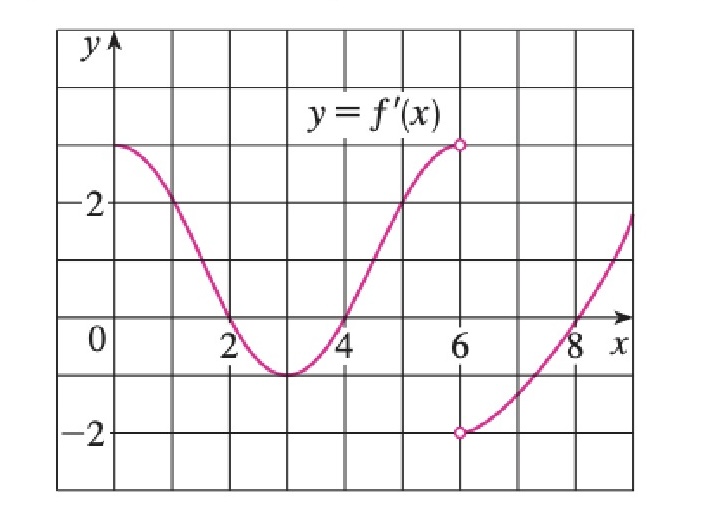
  10. Below is the graph of the derivative \(\displaystyle f'\) of a continuous function \(\displaystyle f\).

    Below is the graph of the derivative \(\displaystyle f'\) of a continuous function \(\displaystyle f\).

    At what value(s) of \(\displaystyle x\) does \(\displaystyle f\) have a local maximum?

    1. 0 only
    2. 2 only
    3. 4 only
    4. 0 and 6
    5. 2 and 4
    6. 4 and 6
    7. 2 and 6
    8. 4 and 8

    IMAGE

    Graph of the derivative of a function

    Solution: A local maximum of \(f\) occurs where \(f'\) changes sign from positive to negative. From the graph, this happens at \(x=2\), where the curve crosses the axis from above to below, and also at \(x=6\), where the left-hand values of \(f'\) are positive and the right-hand values are negative. Thus the local maxima occur at \(\boxed{x=2\text{ and }x=6}\).

  11. If \(\displaystyle H(x) = \int_{0}^{2x} e^{3t^2} dt\), find \(\displaystyle H'(1)\).

    1. \(\displaystyle e^3\)
    2. \(\displaystyle e^6\)
    3. \(\displaystyle e^{12}\)
    4. \(\displaystyle 2e^6\)
    5. \(\displaystyle 2e^{12}\)

    Solution: By the Fundamental Theorem of Calculus and the chain rule, \(H'(x)=e^{3(2x)^2}\cdot 2=2e^{12x^2}\). Evaluating at \(x=1\) gives \(H'(1)=\boxed{2e^{12}}\).

  12. Let \(\displaystyle f(x)\) be a continuous function defined for all real numbers. We are given that

    \[\displaystyle \int_{-1}^{1} f(x) dx = 3, \text{and} \int_{-1}^{2} f(x) dx = 5.\]

    Calculate \(\displaystyle \int_{1}^{2} (3 - 2f(x)) dx\).

    1. \(\displaystyle -1\)
    2. \(\displaystyle 0\)
    3. \(\displaystyle 1\)
    4. \(\displaystyle 5\)
    5. \(\displaystyle 7\)

    Solution: First compute \(\int_1^2 f(x)\,dx=\int_{-1}^2 f(x)\,dx-\int_{-1}^1 f(x)\,dx=5-3=2\). Then \(\int_1^2 (3-2f(x))\,dx=\int_1^2 3\,dx-2\int_1^2 f(x)\,dx=3-4=\boxed{-1}\).

  13. Compute \(\displaystyle \int_{-2}^{0} 1 + \sqrt{4 - x^2} dx\) by recognizing it as the area of a region made up of simple geometric shapes.

    1. \(\displaystyle \pi + 2\)
    2. \(\displaystyle -\pi - 2\)
    3. \(\displaystyle 2\pi\)
    4. \(\displaystyle \pi + 4\)
    5. \(\displaystyle -\pi\)

    Solution: On \([-2,0]\), the graph of \(y=\sqrt{4-x^2}\) is a quarter-circle of radius \(2\), so its area is \(\pi\). The term \(1\) contributes a rectangle of width \(2\) and height \(1\), hence area \(2\). Therefore \(\int_{-2}^{0}(1+\sqrt{4-x^2})dx=2+\pi=\boxed{\pi+2}\).

  14. Compute the area bounded by \(\displaystyle y = e^x\), \(\displaystyle x = 0\), and \(\displaystyle y = 2\).

    1. \(\displaystyle 2 \ln(2) - 1\)
    2. \(\displaystyle 2 \ln(2) + 1\)
    3. \(\displaystyle \ln(2) - 1\)
    4. \(\displaystyle 2 - \ln(2)\)
    5. \(\displaystyle 2 \ln(2)\)

    Solution: The region is bounded above by \(y=2\), below by \(y=e^x\), and on the left by \(x=0\). The curves meet when \(e^x=2\), i.e. at \(x=\ln 2\). Hence \(A=\int_0^{\ln 2}(2-e^x)\,dx=[2x-e^x]_0^{\ln 2}=2\ln 2-1\). So the area is \(\boxed{2\ln 2-1}\).

  15. A scientist is studying how the concentration of a chemical in a solution changes with temperature. The concentration \(\displaystyle C\), measured in moles per liter, is modeled by the function

    \[\displaystyle C(T) = \ln(T^2 + 5)\]

    where \(\displaystyle T\) is the temperature in degrees Celsius. To make quick predictions without using a calculator, the scientist wants to use a linear approximation of \(\displaystyle C(T)\) near \(\displaystyle T = 2^\circ C\). Estimate the concentration at \(\displaystyle T = 2.1^\circ C\).

    1. \(\displaystyle C(2.1) \approx \ln(9) + \frac{1}{45}\)
    2. \(\displaystyle C(2.1) \approx \ln(9) + \frac{1}{90}\)
    3. \(\displaystyle C(2.1) \approx \ln(9) + \frac{2}{45}\)
    4. \(\displaystyle C(2.1) \approx \ln(9) + \frac{4}{81}\)
    5. \(\displaystyle C(2.1) \approx \ln(9) + \frac{1}{9}\)

    Solution: Let \(C(T)=\ln(T^2+5)\). Then \(C'(T)=\dfrac{2T}{T^2+5}\), so \(C'(2)=\dfrac49\). The linearization at \(T=2\) is \(L(T)=\ln 9+\dfrac49(T-2)\). At \(T=2.1\), we get \(C(2.1)\approx L(2.1)=\ln 9+\dfrac49(0.1)=\ln 9+\dfrac{2}{45}\). Therefore the estimate is \(\boxed{\ln 9+\tfrac{2}{45}}\).

  16. \(\displaystyle \int_{0}^{2} e^{-x^2} dx\) is to be approximated using a Riemann sum with 8 subintervals of equal width, where the height of each rectangle is determined by the right endpoint of the subinterval. If \(\displaystyle i\) is an integer between 1 and 8, what is the area of the \(\displaystyle i\)th rectangle?

    1. \(\displaystyle \frac{1}{8} e^{-\frac{i}{4}}\)
    2. \(\displaystyle \frac{1}{8} e^{-\frac{i^2}{4}}\)
    3. \(\displaystyle \frac{1}{4} e^{-\frac{i^2}{4}}\)
    4. \(\displaystyle \frac{1}{4} e^{-(\frac{i}{4})^2}\)
    5. \(\displaystyle e^{-\frac{i}{4}}\)

    Solution: The interval \([0,2]\) is split into 8 equal parts, so \(\Delta x=\dfrac14\). The right endpoint of the \(i\)-th subinterval is \(x_i=\dfrac{i}{4}\). Therefore the area of the \(i\)-th rectangle is \(\Delta x\,e^{-x_i^2}=\dfrac14 e^{-(i/4)^2}\). Thus the answer is \(\boxed{\dfrac14 e^{-(i/4)^2}}\).

  17. Evaluate \(\displaystyle \int_{0}^{1} \frac{x}{1 + x^2} dx\).

    1. \(\displaystyle \ln(2)\)
    2. \(\displaystyle \frac{1}{2}\)
    3. \(\displaystyle \frac{1}{4} \ln(2)\)
    4. \(\displaystyle \arctan(1) = \frac{\pi}{4}\)
    5. \(\displaystyle \frac{1}{2} \ln(2)\)

    Solution: Use the substitution \(u=1+x^2\), so \(du=2x\,dx\) and \(x\,dx=\dfrac12du\). Then \(\int_0^1 \dfrac{x}{1+x^2}dx=\dfrac12\int_1^2 \dfrac{1}{u}du=\dfrac12[\ln u]_1^2=\boxed{\dfrac12\ln 2}\).

  18. If \(\displaystyle f(x)\) is continuous and it is known that \(\displaystyle \int_{0}^{2} f(x) dx = 6\), evaluate \(\displaystyle \int_{0}^{\frac{\pi}{2}} f(2 \sin t) \cos t dt\).

    1. \(\displaystyle 0\)
    2. \(\displaystyle \frac{3}{2}\)
    3. \(\displaystyle 2\)
    4. \(\displaystyle 3\)
    5. \(\displaystyle 4\)

    Solution: Set \(u=2\sin t\). Then \(du=2\cos t\,dt\), so \(\cos t\,dt=\dfrac12du\). As \(t\) runs from \(0\) to \(\pi/2\), \(u\) runs from \(0\) to \(2\). Therefore \(\int_0^{\pi/2} f(2\sin t)\cos t\,dt=\dfrac12\int_0^2 f(u)\,du=3\). So the value is \(\boxed{3}\).
Part II: Free Response

  1. Compute the following limits:

    1. \(\displaystyle \lim_{t \to 1^-} \sqrt{2t + 5}\)
    2. \(\displaystyle \lim_{x \to 2} \frac{x^2 - 7x + 10}{x^2 - 4}\)
    3. \(\displaystyle \lim_{x \to 1} \frac{3^x - 3}{x - 1}\)
    4. \(\displaystyle \lim_{y \to +\infty} \sqrt{y^2 + 6y - 1} - y\)

    Solution:

    1. The function \(\sqrt{2t+5}\) is continuous wherever it is defined, and \(t=1\) is in its domain. Therefore we may evaluate the left-hand limit by direct substitution: \[ \lim_{t\to1^-}\sqrt{2t+5}=\sqrt{2(1)+5}=\sqrt7. \] So the limit is \(\boxed{\sqrt7}\).
    2. As \(x\to2\), both numerator and denominator go to \(0\), so we factor: \[ x^2-7x+10=(x-5)(x-2),\qquad x^2-4=(x-2)(x+2). \] For \(x\neq2\), the fraction simplifies to \[ \frac{x^2-7x+10}{x^2-4}=\frac{x-5}{x+2}. \] Now substitute \(x=2\): \[ \lim_{x\to2}\frac{x-5}{x+2}=\frac{2-5}{2+2}=-\frac34. \] Hence the limit is \(\boxed{-\dfrac34}\).
    3. This limit matches the definition of the derivative of \(3^x\) at \(x=1\): \[ \lim_{x\to1}\frac{3^x-3}{x-1}=(3^x)'\big|_{x=1}. \] Since \[ \frac{d}{dx}3^x=3^x\ln 3, \] we obtain \[ (3^x)'\big|_{x=1}=3^1\ln 3=3\ln 3. \] Therefore the limit is \(\boxed{3\ln 3}\).
    4. Rationalize the expression: \[ \sqrt{y^2+6y-1}-y =\frac{\bigl(\sqrt{y^2+6y-1}-y\bigr)\bigl(\sqrt{y^2+6y-1}+y\bigr)}{\sqrt{y^2+6y-1}+y} =\frac{y^2+6y-1-y^2}{\sqrt{y^2+6y-1}+y}. \] So \[ \sqrt{y^2+6y-1}-y=\frac{6y-1}{\sqrt{y^2+6y-1}+y}. \] Now divide numerator and denominator by \(y\): \[ \frac{6-\frac1y}{\sqrt{1+\frac6y-\frac1{y^2}}+1}. \] As \(y\to+\infty\), the fractions involving \(1/y\) go to \(0\). Therefore the limit becomes \[ \frac{6}{1+1}=3. \] Hence the limit is \(\boxed{3}\).
    1. Write the limit definition of the derivative of a function \(\displaystyle f(x)\).
    2. Use that definition to compute the derivative of \(\displaystyle f(x) = \frac{1}{x+5}\). (No credit will be awarded for any other method.)

    Solution:

    1. The limit definition of the derivative is \[ f'(x)=\lim_{h\to0}\frac{f(x+h)-f(x)}{h}, \] provided the limit exists.
    2. Here \[ f(x)=\frac{1}{x+5}. \] Substitute into the definition: \[ f'(x)=\lim_{h\to0}\frac{\frac{1}{x+h+5}-\frac{1}{x+5}}{h}. \] Combine the two fractions in the numerator: \[ \frac{1}{x+h+5}-\frac{1}{x+5} =\frac{(x+5)-(x+h+5)}{(x+h+5)(x+5)} =\frac{-h}{(x+h+5)(x+5)}. \] So the difference quotient becomes \[ \frac{\frac{-h}{(x+h+5)(x+5)}}{h}. \] For \(h\neq0\), cancel the factor of \(h\): \[ \frac{-1}{(x+h+5)(x+5)}. \] Now let \(h\to0\): \[ f'(x)=\lim_{h\to0}\frac{-1}{(x+h+5)(x+5)} =-\frac{1}{(x+5)^2}. \] Therefore \[ \boxed{f'(x)=-\frac{1}{(x+5)^2}}. \]
  2. Consider the function

    \[\displaystyle f(x) = \frac{x}{x^2+1}\]

    with first derivative

    \[\displaystyle f'(x) = \frac{1-x^2}{(x^2+1)^2}\]

    and second derivative:

    \[\displaystyle f''(x) = \frac{2x(x^2-3)}{(x^2+1)^3}.\]
    1. Find the domain of \(\displaystyle f(x)\).
    2. Find the \(\displaystyle x\)- and \(\displaystyle y\)- intercepts of \(\displaystyle f(x)\).
    3. Does \(\displaystyle f(x)\) possess any symmetry? (Even/Odd/Neither)
    4. Does \(\displaystyle f(x)\) have any vertical or horizontal asymptotes? Justify.
    5. Using the first and/or the second derivative of \(\displaystyle f(x)\), find all critical points.
    6. Using the first and/or the second derivative of \(\displaystyle f(x)\), find all inflection points.
    7. Organize the above findings in a table that encodes the signs of the first and second derivative of \(\displaystyle f(x)\). Clearly state the interval(s) where the function is increasing, decreasing, concave up or concave down. If not applicable, state “none”.
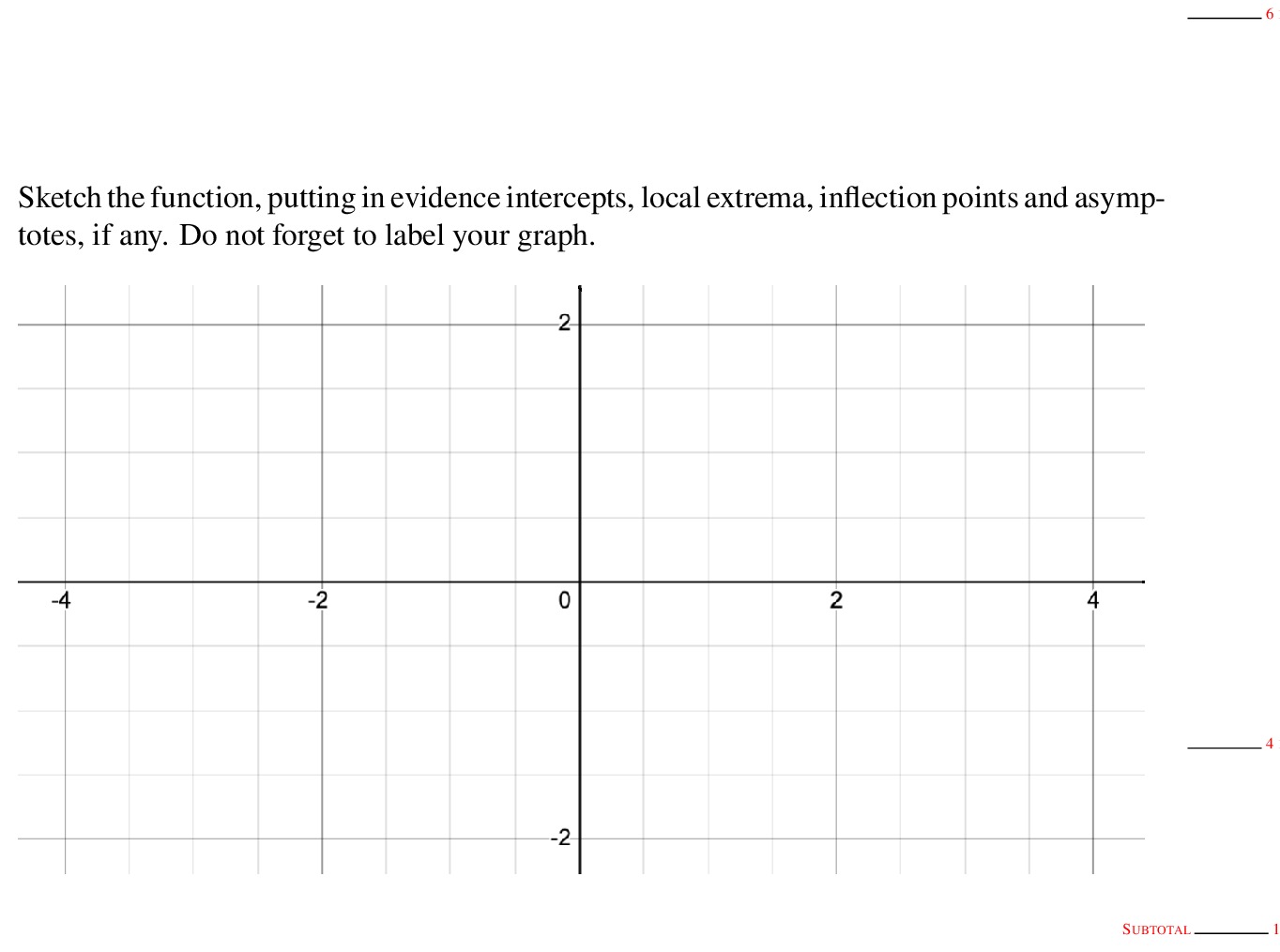
    8. Sketch the function, putting in evidence intercepts, local extrema, inflection points and asymptotes, if any. Do not forget to label your graph.

    (Graph with labeled axes from -4 to 4 on x and -2 to 2 on y)

    IMAGE

    Diagram of a box with labeled dimensions

    Solution:

    1. The denominator is \(x^2+1\). Since \(x^2+1>0\) for every real \(x\), the denominator never vanishes. Therefore the domain is \[ \boxed{(-\infty,\infty)}. \]
    2. To find the intercepts, first solve \(f(x)=0\): \[ \frac{x}{x^2+1}=0. \] A rational function is zero when its numerator is zero and its denominator is nonzero. So \(x=0\). Hence the \(x\)-intercept is \((0,0)\). The \(y\)-intercept is also found by setting \(x=0\): \[ f(0)=\frac{0}{1}=0. \] So both intercepts are \(\boxed{(0,0)}\).
    3. Check symmetry: \[ f(-x)=\frac{-x}{(-x)^2+1}=\frac{-x}{x^2+1}=-f(x). \] Therefore \(f\) is an \(\boxed{\text{odd}}\) function.
    4. A vertical asymptote can occur only where the denominator is zero, but \(x^2+1\neq0\) for real \(x\), so there are no vertical asymptotes. For horizontal asymptotes, compute the limit as \(x\to\pm\infty\): \[ f(x)=\frac{x}{x^2+1}. \] The denominator grows faster than the numerator, so \(f(x)\to0\) as \(|x|\to\infty\). Thus the horizontal asymptote is \(\boxed{y=0}\).
    5. Critical points occur where \(f'(x)=0\) or \(f'(x)\) is undefined. We are given \[ f'(x)=\frac{1-x^2}{(x^2+1)^2}. \] Since \((x^2+1)^2>0\) for every real \(x\), the derivative is never undefined. So set the numerator equal to zero: \[ 1-x^2=0 \quad\Longrightarrow\quad x=\pm1. \] Now classify them using the sign of \(f'\). Because the denominator is always positive, the sign of \(f'\) is the sign of \(1-x^2\). Thus \(f'(x)<0\) for \(|x|>1\) and \(f'(x)>0\) for \(|x|<1\). So \(f\) changes from decreasing to increasing at \(x=-1\), giving a local minimum there, and from increasing to decreasing at \(x=1\), giving a local maximum there. Their coordinates are \[ f(-1)=-\frac12,\qquad f(1)=\frac12. \] So the critical points are a local minimum at \(\boxed{(-1,-1/2)}\) and a local maximum at \(\boxed{(1,1/2)}\).
    6. Inflection points occur where concavity changes. We are given \[ f''(x)=\frac{2x(x^2-3)}{(x^2+1)^3}. \] Since the denominator is always positive, the sign of \(f''\) is determined by \[ 2x(x^2-3)=2x(x-\sqrt3)(x+\sqrt3). \] So possible inflection points occur at \[ x=-\sqrt3,\quad x=0,\quad x=\sqrt3. \] A sign check shows that \(f''\) changes sign at each of these values, so all three are inflection points. Their coordinates are \[ f(-\sqrt3)=\frac{-\sqrt3}{4},\qquad f(0)=0,\qquad f(\sqrt3)=\frac{\sqrt3}{4}. \] Thus the inflection points are \[ \boxed{\left(-\sqrt3,-\frac{\sqrt3}{4}\right),\ (0,0),\ \left(\sqrt3,\frac{\sqrt3}{4}\right)}. \]
    7. From the sign analysis above: \[ f'(x)<0 \text{ on }(-\infty,-1)\cup(1,\infty),\qquad f'(x)>0 \text{ on }(-1,1). \] Therefore \(f\) is decreasing on \((-\infty,-1)\cup(1,\infty)\) and increasing on \((-1,1)\). For concavity, using the sign of \(f''\), \[ f''(x)<0 \text{ on }(-\infty,-\sqrt3)\cup(0,\sqrt3), \] and \[ f''(x)>0 \text{ on }(-\sqrt3,0)\cup(\sqrt3,\infty). \] So \(f\) is concave down on \((-\infty,-\sqrt3)\cup(0,\sqrt3)\) and concave up on \((-\sqrt3,0)\cup(\sqrt3,\infty)\).
    8. The sketch should reflect all of the information above: the graph passes through the origin, is odd, approaches the horizontal asymptote \(y=0\) as \(x\to\pm\infty\), has a local minimum at \((-1,-1/2)\), a local maximum at \((1,1/2)\), and inflection points at \(x=-\sqrt3,0,\sqrt3\).
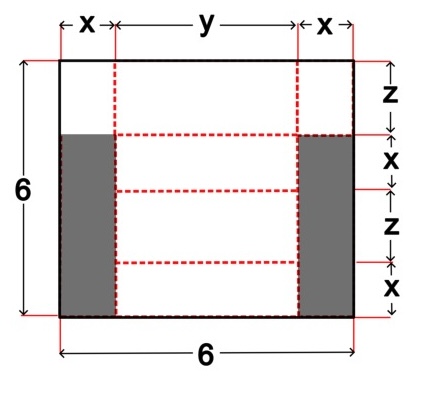
  3. A closed box with a lid is to be formed by trimming identical rectangles (shaded below) from two adjacent corners of a flat, 6-foot by 6-foot cardboard sheet with negligible thickness. The sides are then folded up to form the box. A diagram is provided here:

    1. Write a formula for the volume of the box in terms of \(\displaystyle x\) along with a reasonable domain. Simplify the volume formula as much as you can.
    2. Use calculus to find the value of \(\displaystyle x\) that gives the largest volume and justify your finding.

    IMAGE

    Diagram of a box with labeled dimensions

    Solution:

    1. From the diagram, the height of the box is \(x\). The base dimensions are \(6-2x\) and \(3-x\). Therefore the volume is \[ V(x)=x(6-2x)(3-x). \] Factor out the \(2\): \[ V(x)=2x(3-x)^2. \] For the box to make physical sense, all dimensions must be positive. So we need \[ x>0,\qquad 6-2x>0,\qquad 3-x>0. \] The last two inequalities both give \(x<3\). Hence a reasonable domain is \[ \boxed{0<x<3}. \] So the volume formula is \[ \boxed{V(x)=2x(3-x)^2},\qquad \boxed{0<x<3}. \]
    2. To maximize the volume, differentiate: \[ V(x)=2x(3-x)^2. \] Using the product rule, \[ V'(x)=2(3-x)^2+2x\cdot2(3-x)(-1). \] Factor: \[ V'(x)=2(3-x)\bigl((3-x)-2x\bigr)=2(3-x)(3-3x)=6(3-x)(1-x). \] Critical points occur where \(V'(x)=0\), so \[ 6(3-x)(1-x)=0. \] This gives \(x=3\) or \(x=1\). Since \(x=3\) is not in the interior of the domain, the interior critical point is \(x=1\). To determine whether this gives the maximum, compare the endpoint behavior and the critical value. On the boundary of the domain, the volume goes to \(0\): \[ V(0)=0,\qquad V(3)=0. \] At \(x=1\), \[ V(1)=2(1)(3-1)^2=2\cdot4=8. \] Since \(8>0\), this is larger than the endpoint values, so the maximum volume occurs at \(x=1\). Therefore \[ \boxed{x=1} \] gives the largest volume, and the maximum volume is \[ \boxed{8\text{ ft}^3}. \]