If \(\displaystyle y = 2x^3 + 3x^2 - 12x - 10\), find \(\displaystyle y'(-1)\).
If \(\displaystyle f(\theta) = \sin \theta\), find \(\displaystyle f^{(11)}(\pi)\), the 11th derivative of \(\displaystyle f(\theta)\) at \(\displaystyle \theta = \pi\).
How many critical points of \(\displaystyle y = x^5 - \frac{20}{3}x^3\) are NOT local extrema?
If \(\displaystyle y(x) = \sqrt{1-x^2} + x \arcsin{x}\), compute \(\displaystyle y'(x)\).
A person walks away from a lamp post at a rate of 3 ft/sec. The lamp post is 10 ft tall, and the person is 5 ft tall. How fast is the length of the person's shadow increasing when the person is 15 ft from the lamp post?
What is the slope of the tangent line to \(\displaystyle x y^2 + e^y = x^2\) at the point \(\displaystyle (1, 0)\)?
Consider the function
What should \(\displaystyle a\) be so that the function is differentiable everywhere?
If \(\displaystyle f(x) = x^{3} + 8x + \cos(3x)\) and \(\displaystyle g(x) = f^{-1}(x)\), find the slope of the tangent line to \(\displaystyle g(x)\) at the point \(\displaystyle (1, 0)\).
Let \(\displaystyle f\) and \(\displaystyle g\) be differentiable functions, and suppose the following values are known:
Define \(\displaystyle h(x) = [ f(g(x)) ]^2\). What is the value of \(\displaystyle h'(a)\)?
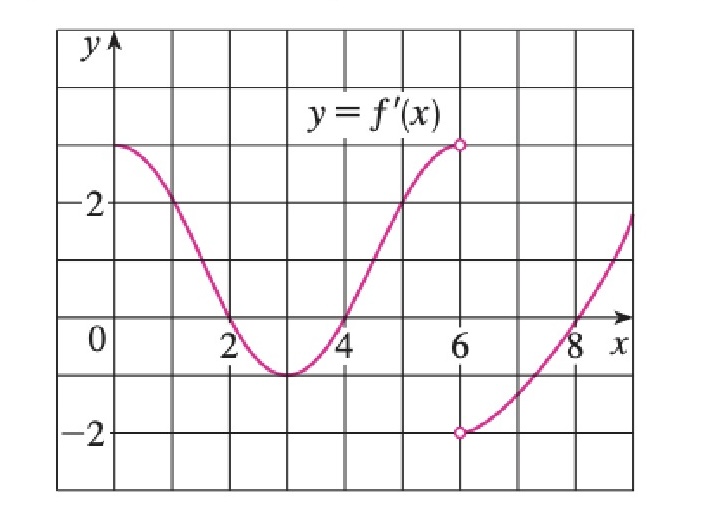
Below is the graph of the derivative \(\displaystyle f'\) of a continuous function \(\displaystyle f\).
Below is the graph of the derivative \(\displaystyle f'\) of a continuous function \(\displaystyle f\).
At what value(s) of \(\displaystyle x\) does \(\displaystyle f\) have a local maximum?
IMAGE
If \(\displaystyle H(x) = \int_{0}^{2x} e^{3t^2} dt\), find \(\displaystyle H'(1)\).
Let \(\displaystyle f(x)\) be a continuous function defined for all real numbers. We are given that
Calculate \(\displaystyle \int_{1}^{2} (3 - 2f(x)) dx\).
Compute \(\displaystyle \int_{-2}^{0} 1 + \sqrt{4 - x^2} dx\) by recognizing it as the area of a region made up of simple geometric shapes.
Compute the area bounded by \(\displaystyle y = e^x\), \(\displaystyle x = 0\), and \(\displaystyle y = 2\).
A scientist is studying how the concentration of a chemical in a solution changes with temperature. The concentration \(\displaystyle C\), measured in moles per liter, is modeled by the function
where \(\displaystyle T\) is the temperature in degrees Celsius. To make quick predictions without using a calculator, the scientist wants to use a linear approximation of \(\displaystyle C(T)\) near \(\displaystyle T = 2^\circ C\). Estimate the concentration at \(\displaystyle T = 2.1^\circ C\).
\(\displaystyle \int_{0}^{2} e^{-x^2} dx\) is to be approximated using a Riemann sum with 8 subintervals of equal width, where the height of each rectangle is determined by the right endpoint of the subinterval. If \(\displaystyle i\) is an integer between 1 and 8, what is the area of the \(\displaystyle i\)th rectangle?
Evaluate \(\displaystyle \int_{0}^{1} \frac{x}{1 + x^2} dx\).
If \(\displaystyle f(x)\) is continuous and it is known that \(\displaystyle \int_{0}^{2} f(x) dx = 6\), evaluate \(\displaystyle \int_{0}^{\frac{\pi}{2}} f(2 \sin t) \cos t dt\).