-
Find the derivative of \(\displaystyle y = \ln(5 + \arcsin(3x))\).
- \(\displaystyle y' = \frac{\sqrt{1-9x^2}}{2}\)
- \(\displaystyle y' = \frac{3}{(5 + \arcsin(3x))\sqrt{1-9x^2}}\)
- \(\displaystyle y' = \frac{3}{5 + \sqrt{1-9x^2}}\)
- \(\displaystyle y' = \frac{3}{5 + \sqrt{9x^2 - 1}}\)
- \(\displaystyle y' = 3\left(5+\sqrt{9x^2-1}\right)\)
Solution: Apply the chain rule twice. If \(y=\ln(5+\arcsin(3x))\), then \(y'=\dfrac{1}{5+\arcsin(3x)}\cdot \dfrac{3}{\sqrt{1-9x^2}}=\boxed{\dfrac{3}{(5+\arcsin(3x))\sqrt{1-9x^2}}}\).
-
In which of the following intervals is the function \(\displaystyle f(x) = \frac{1}{2}x^4 - x^3 + 5x + 1\) concave down?
- \(\displaystyle (-\infty, \infty)\)
- \(\displaystyle (-\infty, 0)\)
- \(\displaystyle (0, \frac{1}{2})\)
- \(\displaystyle (0, 1)\)
- \(\displaystyle (1, \infty)\)
Solution: Compute \(f''(x)=6x^2-6x=6x(x-1)\). This is negative exactly when \(0
-
The graph of \(\displaystyle y = \frac{x+2}{x^2 - 3x - 10}\) has
- vertical asymptotes at \(\displaystyle x = -2\) and \(\displaystyle x = 5\).
- a vertical asymptote at \(\displaystyle x = 2\) and a removable discontinuity at \(\displaystyle x = -5\).
- a vertical asymptote at \(\displaystyle x = -2\) and a removable discontinuity at \(\displaystyle x = 5\).
- a vertical asymptote at \(\displaystyle x = 5\) and a removable discontinuity at \(\displaystyle x = -2\).
- removable discontinuities at \(\displaystyle x = -2\) and \(\displaystyle x = 5\).
Solution: Factor the denominator: \(x^2-3x-10=(x-5)(x+2)\). Thus \(y=\dfrac{x+2}{(x-5)(x+2)}=\dfrac{1}{x-5}\) for \(x\neq -2,5\). So \(x=-2\) is a removable discontinuity, while \(x=5\) is a vertical asymptote.
-
The largest interval over which the function \(\displaystyle f(x) = \sqrt{12x + 12} - x\) is increasing is \(\displaystyle (-1, a)\). What is \(\displaystyle a\)?
- \(\displaystyle -\frac{1}{2}\)
- \(\displaystyle 0\)
- \(\displaystyle 1\)
- \(\displaystyle \frac{3}{2}\)
- \(\displaystyle 2\)
- \(\displaystyle +\infty\)
Solution: Differentiate: \(f'(x)=\dfrac{6}{\sqrt{12x+12}}-1\). We want \(f'(x)>0\), so \(\dfrac{6}{\sqrt{12x+12}}>1\), hence \(\sqrt{12x+12}<6\), so \(12x+12<36\), i.e. \(x<2\). Since the domain begins at \(-1\), the largest interval of increase is \(\boxed{(-1,2)}\).
-
Which of these lines is parallel to the line tangent to the graph of \(\displaystyle f(x) = \ln(\pi) + xe^{2x}\) at the point \(\displaystyle x = -1\)?
- \(\displaystyle y = -x + \pi\)
- \(\displaystyle y = \ln(\pi)\)
- \(\displaystyle y = -\frac{x}{e^2} + 2\ln(\pi)\)
- \(\displaystyle y = 3e^{2}x + \ln(\pi)\)
- \(\displaystyle\) None of those.
Solution: The derivative of \(f(x)=\ln(\pi)+xe^{2x}\) is \(f'(x)=e^{2x}+2xe^{2x}=e^{2x}(1+2x)\). At \(x=-1\), this gives \(f'(-1)=-e^{-2}\). So we need a line of slope \(-1/e^2\), namely \(\boxed{y=-\dfrac{x}{e^2}+2\ln(\pi)}\).
-
Consider the two functions defined below:
\[\displaystyle f(x) = \frac{1}{1+e^{x}} g(x) = \frac{5x^{7} + 4x^{3} + 9}{4x^{7} - 1}.\]
Which of the following describes the number of horizontal asymptotes of the graph of each function?
- The graph of \(\displaystyle f(x)\) contains \textbf{two horizontal asymptotes}, while the graph of \(\displaystyle g(x)\) contains \textbf{one horizontal asymptote}.
- The graph of \(\displaystyle f(x)\) contains \textbf{one horizontal asymptote}, while the graph of \(\displaystyle g(x)\) contains \textbf{two horizontal asymptotes}.
- The graphs of both \(\displaystyle f(x)\) and \(\displaystyle g(x)\) contain exactly \textbf{one horizontal asymptote}.
- The graphs of both \(\displaystyle f(x)\) and \(\displaystyle g(x)\) contain exactly \textbf{zero horizontal asymptote}.
- None of the above are correct.
Solution: For \(f(x)=\dfrac{1}{1+e^x}\), we have \(f(x)\to 1\) as \(x\to -\infty\) and \(f(x)\to 0\) as \(x\to +\infty\), so it has two horizontal asymptotes. For \(g(x)=\dfrac{5x^7+4x^3+9}{4x^7-1}\), the degrees match, so \(g(x)\to \dfrac54\) at both ends, hence one horizontal asymptote. Therefore the correct description is \(\boxed{f\text{ has two, }g\text{ has one}}\).
-
Given the function \(\displaystyle f(x)\) defined as
\[\displaystyle f(x) = \begin{cases} \ln(x + k), & \text{if } x \geq 0, \\ \frac{\sin(2x)}{x}, & \text{if } x < 0 \end{cases}\]
find the value of \(\displaystyle k\) such that \(\displaystyle f(x)\) is continuous for all \(\displaystyle x\).
\(\displaystyle \bigcirc\) A 1
\(\displaystyle \bigcirc\) B \(\displaystyle e\)
\(\displaystyle \bigcirc\) C \(\displaystyle e^2\)
\(\displaystyle \bigcirc\) D 2
\(\displaystyle \bigcirc\) E \(\displaystyle -\infty\)
Solution: Each branch is continuous on its own interval, so the only point to check is the junction point \(x=0\).
For continuity at \(x=0\), we need
\[
\lim_{x\to0^-}f(x)=f(0)=\lim_{x\to0^+}f(x).
\]
From the right-hand branch,
\[
f(0)=\ln(0+k)=\ln k.
\]
From the left-hand branch,
\[
\lim_{x\to0^-}\frac{\sin(2x)}{x}=2
\]
by the standard sine limit. Therefore continuity requires
\[
\ln k=2.
\]
Exponentiating both sides gives
\[
k=e^2.
\]
So the required value is
\[
\boxed{e^2}.
\]
-
Find the following limit provided that \(\displaystyle \lim_{x \to (-2)^-} f(x) = 0\) and \(\displaystyle \lim_{x \to (-2)^-} f'(x) = 2\).
\[\displaystyle \lim_{x \to (-2)^-} \frac{\sin(\pi x)}{f(x)}\]
\(\displaystyle \bigcirc\) A \(\displaystyle \frac{1}{2}\)
\(\displaystyle \bigcirc\) B \(\displaystyle \frac{\pi}{2}\)
\(\displaystyle \bigcirc\) C \(\displaystyle -\frac{\pi}{2}\)
\(\displaystyle \bigcirc\) D None of the above, but the limit is well defined.
\(\displaystyle \bigcirc\) E The limit does not exist.
Solution: As \(x\to-2^-\), the numerator satisfies
\[
\sin(\pi x)\to \sin(-2\pi)=0,
\]
and we are told that
\[
f(x)\to0.
\]
So the limit is of the indeterminate form \(0/0\).
Use linear approximations near \(x=-2\). Since the derivative of \(\sin(\pi x)\) is \(\pi\cos(\pi x)\), we have
\[
\sin(\pi x)\approx \sin(-2\pi)+\pi\cos(-2\pi)(x+2)=\pi(x+2).
\]
Also, since \(\lim_{x\to(-2)^-}f'(x)=2\) and \(f(x)\to0\), the function \(f(x)\) behaves like
\[
f(x)\approx 2(x+2)
\]
near \(x=-2\). Therefore
\[
\frac{\sin(\pi x)}{f(x)}\approx \frac{\pi(x+2)}{2(x+2)}=\frac{\pi}{2}.
\]
Hence the limit is
\[
\boxed{\frac{\pi}{2}}.
\]
-
Let \(\displaystyle f(x) = x^{4/3} - 24x^{1/3}\). Which of the following best describes the critical points of \(\displaystyle f\)? Show your work in computing and labeling the critical points of \(\displaystyle f\).
- The graph of \(\displaystyle f(x)\) attains a local maximum at \(\displaystyle x = 0\) and a local minimum at \(\displaystyle x = 3\).
- The graph of \(\displaystyle f(x)\) attains a local minimum at \(\displaystyle x = 0\) and a local maximum at \(\displaystyle x = 3\).
- The graph of \(\displaystyle f(x)\) attains a local minimum at \(\displaystyle x = 0\) and a local minimum at \(\displaystyle x = 6\).
- The graph of \(\displaystyle f(x)\) attains a local maximum at \(\displaystyle x = 0\) and a local minimum at \(\displaystyle x = 6\).
- None of the above are correct.
Solution: Differentiate: \(f'(x)=\dfrac43x^{1/3}-8x^{-2/3}=\dfrac43x^{-2/3}(x-6)\). Critical points occur at \(x=0\) and \(x=6\). Since \(x^{-2/3}>0\) for \(x\neq0\), the sign of \(f'\) is determined by \(x-6\): negative for \(x<6\), positive for \(x>6\). Thus \(x=6\) is a local minimum, while \(x=0\) is not an extremum. So none of the listed descriptions is correct.
-
Determine the absolute maximum and minimum values of \(\displaystyle f(x) = \frac{\ln(x)}{x}\) on \(\displaystyle [1, e^4]\).
- This function does not attain a maximum value but has minimum value \(\displaystyle \frac{1}{e}\).
- This function has maximum value \(\displaystyle \frac{1}{e}\) and minimum value of \(\displaystyle \frac{4}{e^4}\).
- This function has maximum value \(\displaystyle \frac{1}{e}\) and minimum value 0.
- This function has maximum value 1 and minimum value \(\displaystyle e\).
- This function does not attain a maximum or minimum value.
Solution: Let \(f(x)=\dfrac{\ln x}{x}\). Then \(f'(x)=\dfrac{1-\ln x}{x^2}\), so the only interior critical point is \(x=e\). Evaluate at the candidates: \(f(1)=0\), \(f(e)=1/e\), and \(f(e^4)=4/e^4\). Therefore the absolute maximum is \(\boxed{1/e}\) and the absolute minimum is \(\boxed{0}\).
-
A car’s position along a straight road is modeled by the equation:
\[\displaystyle e^{z} + \int_{3}^{z} v(t) dt = z^{3} + 5z\]
where \(\displaystyle v(t)\) is the velocity of the car at time \(\displaystyle t\). Find the value of \(\displaystyle v(0)\).
- 0
- 1
- 3
- 4
- 5
Solution: Differentiate both sides with respect to \(z\): \(e^z+v(z)=3z^2+5\). At \(z=0\), this becomes \(1+v(0)=5\), hence \(v(0)=\boxed{4}\).
-
Lisa has plotted the graphs of \(\displaystyle f\), \(\displaystyle f'\) and \(\displaystyle f''\). Unfortunately, she accidentally lost track of what happens and labelled the functions \(\displaystyle a\), \(\displaystyle b\) and \(\displaystyle c\) in some random order. Which of these functions correspond to which? [You do not need to show any work.]
The functions \(\displaystyle (a, b, c)\) correspond to ...
- \(\displaystyle (f, f', f'')\)
- \(\displaystyle (f, f'', f')\)
- \(\displaystyle (f', f, f'')\)
- \(\displaystyle (f', f'', f)\)
- \(\displaystyle (f'', f, f')\)
- \(\displaystyle (f'', f', f)\)
IMAGE
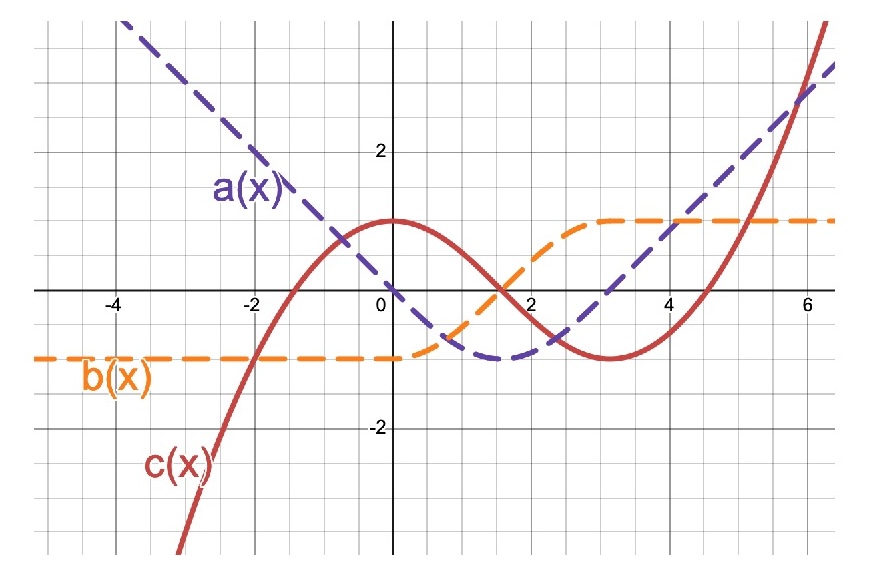
Solution: The red curve \(c\) has the shape of a cubic, so it is the original function \(f\). Its derivative should be a parabola-like curve with two zeros, which matches \(a\). The remaining curve \(b\) is then \(f''\). Thus \((a,b,c)=(f',f'',f)\).
-
What is the area of the plane region bounded by the curves \(\displaystyle y = 2x^2\) and \(\displaystyle y = 12 - x^2\). Draw the graphs, shade the region, and show your work.
- 32
- 16
- 8
- 0
- None of the above
Solution: The curves intersect where \(2x^2=12-x^2\), i.e. \(3x^2=12\), so \(x=\pm2\). The upper curve is \(12-x^2\) and the lower curve is \(2x^2\). Hence the area is \(\int_{-2}^{2}(12-3x^2)\,dx=[12x-x^3]_{-2}^{2}=\boxed{32}\).
-
Given the graph of \(\displaystyle f\) and \(\displaystyle g\) below, determine:
\[\displaystyle (f \circ g)'(2) + (f g)'(-1)\]
- 0
- \(\displaystyle -1/2\)
- \(\displaystyle 1/2\)
- 1
- \(\displaystyle 3/2\)
Graph of \(\displaystyle f(x)\) and \(\displaystyle g(x)\) is shown below the question.
IMAGE
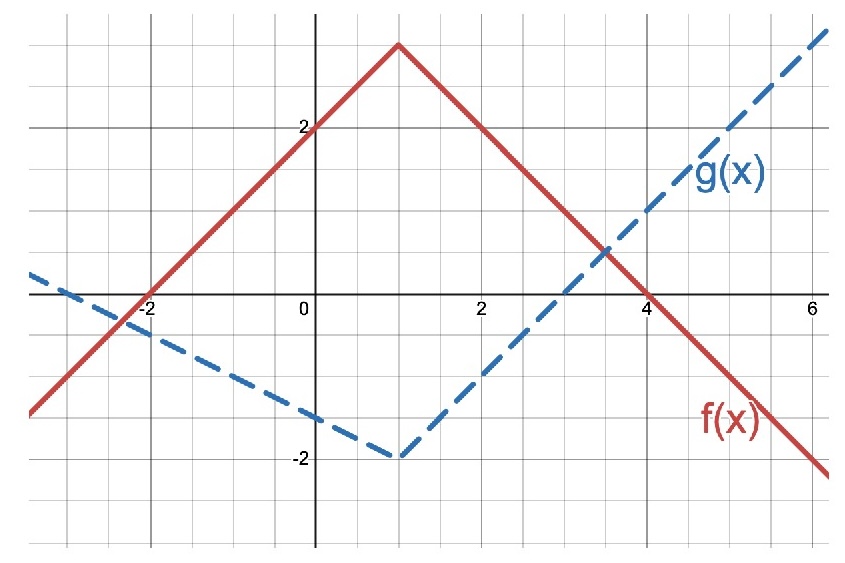
Solution: From the graph, \(g(2)=-1\) and the slope of \(g\) at \(2\) is \(g'(2)=1\). Also, on the left branch of \(f\), the slope is \(f'(-1)=1\). So \((f\circ g)'(2)=f'(g(2))g'(2)=f'(-1)\cdot1=1\). Next, at \(x=-1\), we have \(f(-1)=1\), \(f'(-1)=1\), \(g(-1)=-1\), and \(g'(-1)=-1/2\). Thus \((fg)'(-1)=f'(-1)g(-1)+f(-1)g'(-1)=-1-1/2=-3/2\). The total is \(1-3/2=\boxed{-1/2}\).
-
Evaluate \(\displaystyle \int_{-4}^3 6x \sqrt{25 - x^2} dx\).
- \(\displaystyle -182\)
- \(\displaystyle -74\)
- \(\displaystyle 0\)
- \(\displaystyle 144\)
- \(\displaystyle 288\)
Solution: Use \(u=25-x^2\), so \(du=-2x\,dx\) and \(6x\,dx=-3du\). Then \(\int 6x\sqrt{25-x^2}\,dx=-3\int u^{1/2}du=-2u^{3/2}\). Evaluating from \(-4\) to \(3\) gives \(-2(16)^{3/2}+2(9)^{3/2}=-128+54=\boxed{-74}\).
-
Suppose \(\displaystyle h(x)\) is an even function for which \(\displaystyle \int_0^3 h(x) dx = 5\) and \(\displaystyle \int_2^3 h(x) dx = 1\). Find \(\displaystyle \int_{-2}^2 h(x) dx\).
- \(\displaystyle 0\)
- \(\displaystyle 3\)
- \(\displaystyle 4\)
- \(\displaystyle 6\)
- \(\displaystyle 8\)
Solution: Since \(h\) is even, \(\int_{-2}^{2}h(x)\,dx=2\int_0^2 h(x)\,dx\). Also \(\int_0^2 h(x)\,dx=\int_0^3 h(x)\,dx-\int_2^3 h(x)\,dx=5-1=4\). Hence \(\int_{-2}^{2}h(x)\,dx=2\cdot4=\boxed{8}\).
-
Compute the following limits:
- \(\displaystyle \lim_{x \to 1} \sin\left(\frac{5\pi x}{4}\right)\)
- \(\displaystyle \lim_{x \to 0} \frac{\sin(x)}{\arcsin(2x)}\)
- \(\displaystyle \lim_{x \to 1^+} x^{1/(x-1)}\)
Solution:
- Direct substitution gives \(\sin(5\pi/4)=\boxed{-\dfrac{\sqrt2}{2}}\).
- As \(x\to0\), \(\sin x\sim x\) and \(\arcsin(2x)\sim 2x\), so the ratio tends to \(\boxed{\dfrac12}\).
- Write \(x^{1/(x-1)}=\exp\!\left(\dfrac{\ln x}{x-1}\right)\). Since \(\dfrac{\ln x}{x-1}\to1\) as \(x\to1^+\), the limit is \(\boxed{e}\).
-
Consider the function \(\displaystyle f(x) = \cos(x)\).
- Find its linearization at \(\displaystyle x = \pi\).
- Use the above linearization to estimate \(\displaystyle \cos(3)\).
Solution:
- The linearization of \(f\) at \(x=a\) is
\[
L(x)=f(a)+f'(a)(x-a).
\]
Here \(f(x)=\cos x\) and \(a=\pi\). We compute
\[
f(\pi)=\cos\pi=-1,\qquad f'(\pi)=-\sin\pi=0.
\]
Therefore
\[
L(x)=-1+0(x-\pi)=\boxed{-1}.
\]
- Use the linearization from part (a):
\[
\cos(3)\approx L(3)=-1.
\]
So the estimate is
\[
\boxed{-1}.
\]
-
The limit below represents the \textbf{derivative} of which function at which point? Justify your answer.
\[\displaystyle \lim_{h \to 0} \frac{\ln(e+h) - 1}{h}\]
Solution: The derivative definition has the form
\[
\lim_{h\to0}\frac{f(a+h)-f(a)}{h}.
\]
Here we can rewrite the numerator as
\[
\ln(e+h)-1=\ln(e+h)-\ln e,
\]
because \(\ln e=1\). So this limit is exactly
\[
\lim_{h\to0}\frac{\ln(e+h)-\ln e}{h},
\]
which is the derivative of the function
\[
f(x)=\ln x
\]
at the point
\[
a=e.
\]
Therefore the limit represents
\[
\boxed{f'(e)\text{ for }f(x)=\ln x}.
\]
-
Express the limit below as a \textbf{definite integral} over the interval \(\displaystyle [0, \frac{\pi}{4}]\). Justify your answer. (Note that you do not need to compute the integral nor the limit.)
\[\displaystyle \lim_{n \to \infty} \sum_{i=1}^n \frac{\pi}{4n} \tan\left( \frac{i\pi}{4n} \right)\]
Solution: A Riemann sum has the form
\[
\sum_{i=1}^n f(x_i)\,\Delta x.
\]
Here we can read off
\[
\Delta x=\frac{\pi}{4n},
\]
which is exactly the width obtained by dividing the interval \([0,\pi/4]\) into \(n\) equal pieces. The sample points are
\[
x_i=\frac{i\pi}{4n},
\]
which are the right endpoints of those subintervals. The function being sampled is therefore
\[
f(x)=\tan x.
\]
So the given limit is the right-endpoint Riemann sum for
\[
\int_0^{\pi/4}\tan(x)\,dx.
\]
Hence the limit can be expressed as
\[
\boxed{\int_0^{\pi/4}\tan(x)\,dx}.
\]
-
On the axes provided, sketch the graph of a single function \(\displaystyle h(x)\) which has all of the following properties :
- The domain of \(\displaystyle h(x)\) is \(\displaystyle [-3, 5)\).
- \(\displaystyle h(-1) = -4, h(0) = 2\).
- \(\displaystyle h(x)\) has a removable discontinuity at \(\displaystyle x = -1\), and \(\displaystyle h(x)\) is continuous through the rest of the domain.
- \(\displaystyle \lim_{x \to -1^-} h(x) = 2\).
- On the interval \(\displaystyle (-3, -1)\), \(\displaystyle h'(x) > 0\) and \(\displaystyle h''(x) > 0\).
- On the interval \(\displaystyle (-1, 3)\), \(\displaystyle h'(x) = 0\).
- \(\displaystyle h'(3)\) does not exist.
- \(\displaystyle \lim_{x \to 5^-} h(x) = \infty\).
[Graph with labeled axes and grid shown]
IMAGE
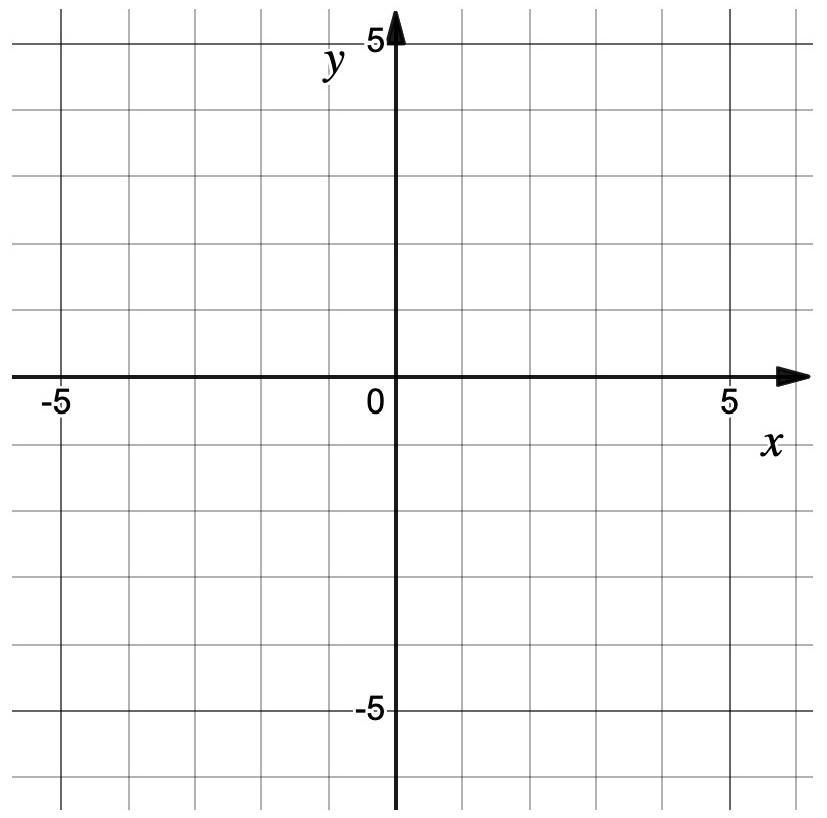
Solution: One valid sketch is: start on \([-3,-1)\) with an increasing, concave-up curve approaching the open point \((-1,2)\) from the left; define the actual value \(h(-1)=-4\); keep the graph horizontal at height \(2\) on \((-1,3)\); create a corner at \(x=3\); and then draw the graph rising toward \(+\infty\) as \(x\to5^-\). Any graph satisfying all stated properties earns full credit.
-
Evaluate the following integrals:
- \(\displaystyle \int \left( 4x^3 + \sqrt[4]{x^4} + \frac{1}{x^3} \right) dx\)
- \(\displaystyle \int \frac{\ln(x)}{x} dx\)
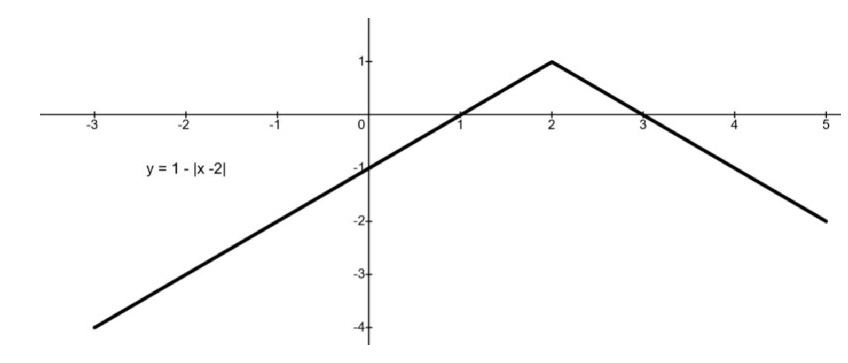
- \(\displaystyle \int_{-3}^{5} 1 - |x-2| dx\). (Hint: The integrand is graphed below:)
[Graph of \(\displaystyle y = 1 - |x-2|\) shown with labeled axes and domain from approximately \(\displaystyle -3\) to \(\displaystyle 5\).]
IMAGE
Solution:
- As written, \(\sqrt[4]{x^4}=|x|\). So one antiderivative is \(\boxed{x^4+\dfrac{x|x|}{2}-\dfrac{1}{2x^2}+C}\). If your class treated \(\sqrt[4]{x^4}\) differently because of domain assumptions, adapt this term accordingly.
- \(\displaystyle \int \dfrac{\ln x}{x}\,dx=\boxed{\dfrac12(\ln x)^2+C}\).
- From the graph or by splitting at \(x=2\), \(1-|x-2|=x-1\) on \([-3,2]\) and \(1-|x-2|=3-x\) on \([2,5]\). Hence the integral is \(\int_{-3}^{2}(x-1)dx+\int_{2}^{5}(3-x)dx=\boxed{-9}\).
-
A space shuttle is launched vertically from the JFK Center, and its position is being tracked by a radar device located 2 miles horizontally from the launch site. The shuttle is ascending vertically at a rate of 4 miles per second. Let \(\displaystyle \theta\) represent the angle between the horizontal ground and the line of sight from the radar to the shuttle. At what rate is \(\displaystyle \theta\) changing when the shuttle’s altitude is 3 miles?
Solution: Let \(y\) be the shuttle’s altitude in miles. The radar is \(2\) miles away horizontally, so the geometry gives
\[
\tan\theta=\frac{y}{2}.
\]
Differentiate with respect to time:
\[
\sec^2\theta\,\frac{d\theta}{dt}=\frac12\frac{dy}{dt}.
\]
We are told that the shuttle rises at
\[
\frac{dy}{dt}=4 \text{ mi/s},
\]
so
\[
\sec^2\theta\,\frac{d\theta}{dt}=2.
\]
When \(y=3\), we have
\[
\tan\theta=\frac32.
\]
Using \(\sec^2\theta=1+\tan^2\theta\),
\[
\sec^2\theta=1+\left(\frac32\right)^2=1+\frac94=\frac{13}{4}.
\]
Substitute into the related-rates equation:
\[
\frac{13}{4}\frac{d\theta}{dt}=2.
\]
Therefore
\[
\frac{d\theta}{dt}=\frac{2}{13/4}=\boxed{\frac{8}{13}\text{ rad/s}}.
\]
-
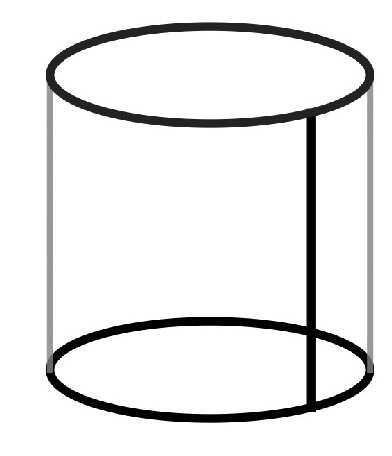
A company is designing a new underground water tank in the shape of a right circular cylinder. The tank will be constructed using two circular steel plates for the top and bottom and a curved steel sheet for the sides. The steel sheets are joined at the seams, which must be minimized to reduce construction costs and improve durability. The tank must hold exactly \(\displaystyle 4 \mathrm{m}^3\) of water. Find the dimensions (radius and height) of the tank that minimize the total length of the seams. Note that the seams are indicated in bold.
- Label the diagram of the tank, clearly marking all variables used to describe the function that you are optimizing.
[Diagram of a right circular cylinder/tank]
- Write all the constraints and equations relevant to the situation.
- Write a formula of the function you want to optimize in terms of a single variable, and give a reasonable domain for the function (this is the domain where the problem makes sense).
- Use calculus to minimize the function and find the tank dimensions that result in the lowest construction cost.
IMAGE
Solution:
- Let \(r\) be the radius and \(h\) the height.
- The volume constraint is \(\pi r^2h=4\), so \(h=\dfrac{4}{\pi r^2}\), with \(r>0\).
- The total seam length is the two circular seams plus one vertical seam: \(S=4\pi r+h\). Substituting the constraint gives \(S(r)=4\pi r+\dfrac{4}{\pi r^2}\), for \(r>0\).
- Differentiate: \(S'(r)=4\pi-\dfrac{8}{\pi r^3}\). Setting this to zero gives \(4\pi^2r^3=8\), so \(r^3=\dfrac{2}{\pi^2}\), hence \(\boxed{r=\left(\dfrac{2}{\pi^2}\right)^{1/3}}\). Then \(h=\dfrac{4}{\pi r^2}=\boxed{\dfrac{4}{\pi}\left(\dfrac{\pi^2}{2}\right)^{2/3}}\). Since \(S''(r)=\dfrac{24}{\pi r^4}>0\), this critical point gives the absolute minimum seam length.