-
Evaluate the following limits:
- \(\displaystyle \lim_{x \to 1} \frac{x^2 - 3}{2 - x}\)
- 0 C -2 E DNE
- 1 D \(\displaystyle \infty\) F Something else
- \(\displaystyle \lim_{x \to \infty} \frac{4x^2 - 10}{1 + 2x - 9x^2}\)
- \(\displaystyle -\frac{4}{9}\) C 2 E \(\displaystyle \infty\)
- \(\displaystyle \frac{4}{9}\) D 4 F DNE
-
Determine all horizontal asymptotes of \(\displaystyle g(x) = \frac{\sqrt{9x^2+1}}{2x}\).
- \(\displaystyle y = -\frac{9}{2}\)
- \(\displaystyle y = -\frac{3}{2}\)
- \(\displaystyle y = \frac{3}{2}\)
- \(\displaystyle y = \frac{9}{2}\)
- \(\displaystyle y = -\frac{3}{2}\) and \(\displaystyle y = \frac{3}{2}\)
- \(\displaystyle y = -\frac{9}{2}\) and \(\displaystyle y = \frac{9}{2}\)
- \(\displaystyle y = 0\)
- No horizontal asymptotes
-
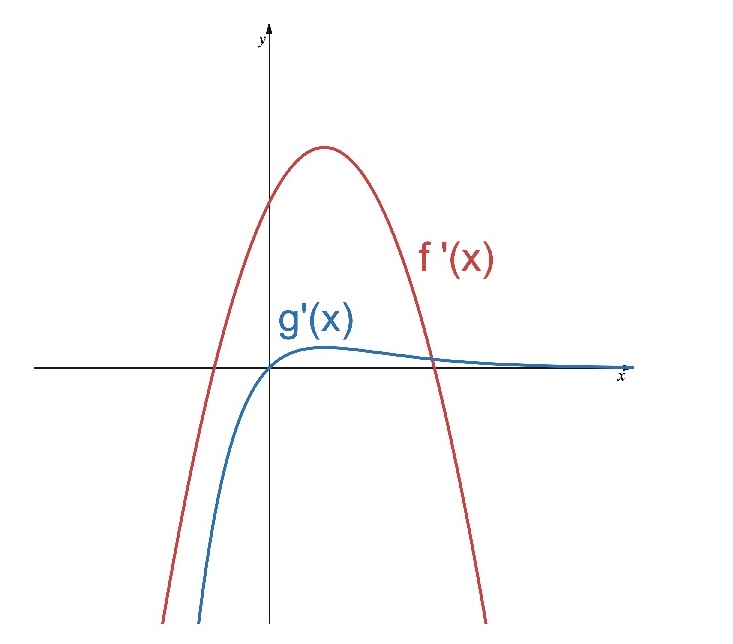
Below are the graphs of the derivatives of two functions \(\displaystyle f(x)\) and \(\displaystyle g(x)\). Carefully read the following statements and determine which of them must necessarily be true.
(Graph showing \(\displaystyle g'(x)\) and \(\displaystyle f'(x)\))
Statement (I): \(\displaystyle f(x)\) has a local minimum.
Statement (II): \(\displaystyle g(x)\) has a root.
Statement (III): \(\displaystyle g(x)\) is increasing everywhere.
- I only
- II only
- I and II
- I and III
- I, II, and III
IMAGE
-
Determine \(\displaystyle \frac{dy}{dx}\) if \(\displaystyle x^4 = x^2 y - y^3\).
- \(\displaystyle \frac{dy}{dx} = \frac{2x}{1 - 3y^2}\)
- \(\displaystyle \frac{dy}{dx} = \frac{4x^3}{2x - 3y^2}\)
- \(\displaystyle \frac{dy}{dx} = \frac{4x^3 - 2xy}{x^2 - 3y^2}\)
- \(\displaystyle \frac{dy}{dx} = \frac{4x^3 - x^2 y}{2x - 3y^2}\)
- \(\displaystyle \frac{dy}{dx} = \frac{4x^3(x^2 - y^2) - x^4(2x - 2y)}{(x^2 - y^2)^2}\)
-
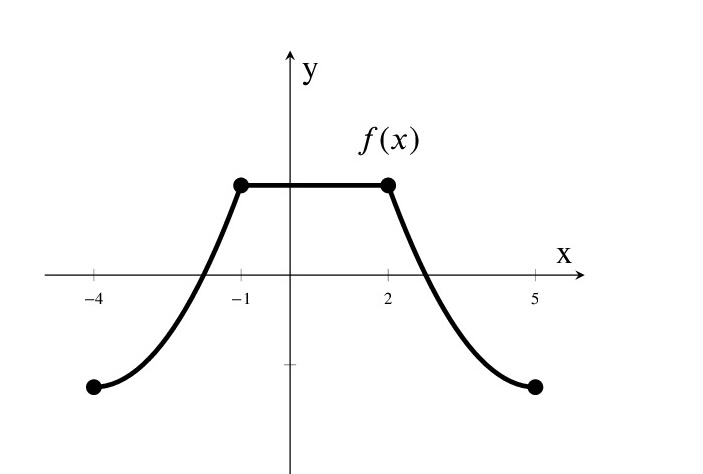
Consider the graph of a function \(\displaystyle f(x)\) which is twice differentiable except at a few points on the interval \(\displaystyle [-4, 5]\):
(Graph of \(\displaystyle f(x)\) with axes and points at \(\displaystyle x = -4, -1, 2, 5\))
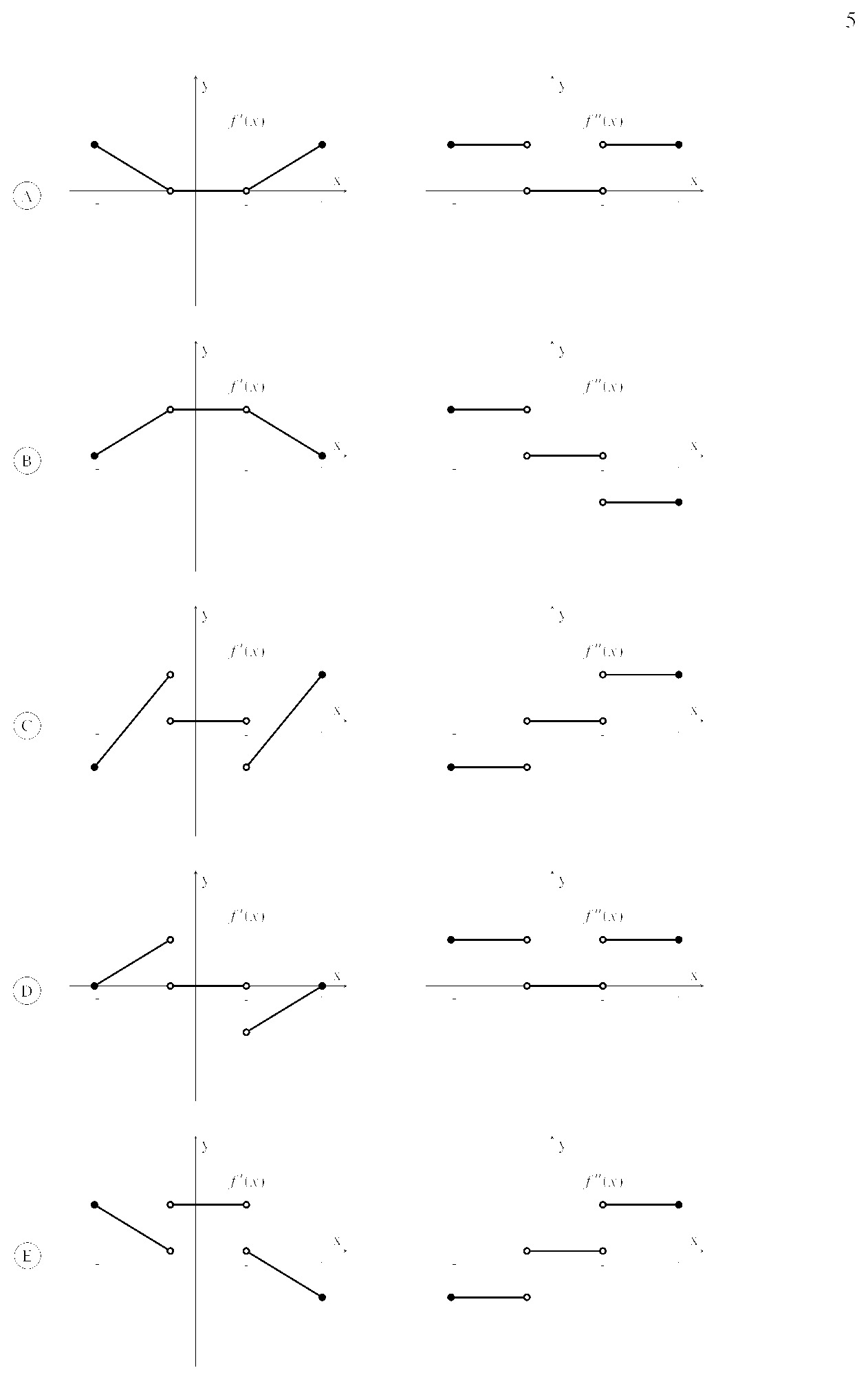
Which of the following sketches best describes the graphs of \(\displaystyle f'(x)\) and \(\displaystyle f''(x)\)?
1
2
3
4
5
IMAGE
IMAGE
-
At how many values of \(\displaystyle x\) on the interval \(\displaystyle [-1, 2]\) does the function \(\displaystyle f(x) = \frac{1}{4} x^4 - x^3 + x^2 + 3\) attain absolute minimum?
\(\displaystyle \circled{A}\ 0\)
\(\displaystyle \circled{B}\ 1\)
\(\displaystyle \circled{C}\ 2\)
\(\displaystyle \circled{D}\ 3\)
\(\displaystyle \circled{E}\ 4\)
-
If \(\displaystyle f(x) = \int_{\sqrt{x}}^{2} \sin(t^2) dt\) then \(\displaystyle f'(x)\) is
\(\displaystyle \circled{A}\ \frac{-\sin(x)}{\sqrt{x}}\)
\(\displaystyle \circled{B}\ \frac{-\sin(x)}{x}\)
\(\displaystyle \circled{C}\ \frac{\sin(x)}{x}\)
\(\displaystyle \circled{D}\ \frac{-\sin(x)}{2\sqrt{x}}\)
\(\displaystyle \circled{E}\ \frac{\sin(\sqrt{x})}{2\sqrt{x}}\)
\(\displaystyle \circled{F}\ \frac{2\sin(x)}{\sqrt{x}}\)
\(\displaystyle \circled{G}\ \frac{-\sin(x)}{2x}\)
\(\displaystyle \circled{H}\ \sin(x)\)
\(\displaystyle \circled{I}\ \sin(4) - \sin(x)\)
-
Approximate the area under the graph \(\displaystyle f(x) = 1 + \sin^2(\pi x)\) on \(\displaystyle \left[0, \frac{1}{2}\right]\) using a right-endpoint Riemann sum with three subintervals of equal length.
- \(\displaystyle \frac{1}{3}\) B \(\displaystyle \frac{2}{3}\) C \(\displaystyle \frac{5}{6}\) D \(\displaystyle \frac{3}{4}\) E \(\displaystyle \frac{2}{5}\)
-
The rate of growth of rabbit population in a forest is given by \(\displaystyle G(t) = 1000e^{0.05t}\), where \(\displaystyle G(t)\) is measured in number of rabbits per year, and \(\displaystyle t\) is the time in years since the start of 2010.
Using the correct units, what does \(\displaystyle \int_2^7 G(t) dt\) represent?
- The integral represents the area under the curve of \(\displaystyle G(t)\) between the years 2012 and 2017, measured in square rabbits.
- The total increase in the number of rabbits between the years 2012 and 2017, measured in rabbits.
- The rate of growth of the rabbit population at year 2017, measured in rabbits per year.
- The total number of rabbits born since 2012, measured in rabbits.
- The average rate of growth of the rabbit population between the years 2012 and 2017, measured in rabbits per year.
-
Which of the following is the derivative of the function
\[\displaystyle f(x) = \frac{e^{\arctan(x)}}{1 + x^2}\]?
- \(\displaystyle f'(x) = \frac{e^{\arctan(x)}}{2x}\)
- \(\displaystyle f'(x) = \frac{e^{\arctan(x)} (1 - 2x)}{(1 + x^2)^2}\)
- \(\displaystyle f'(x) = \frac{e^{\arctan(x)}}{(1 + x^2)^2} \left( 1 - \frac{2x}{(1 + x^2)^2} \right)\)
- \(\displaystyle f'(x) = e^{\arctan(x)} \left( \frac{1}{1 + x^2} - 2x \right)\)
- \(\displaystyle f'(x) = \frac{e^{\arctan(x)} (1 + x^2 - 2x)}{(1 + x^2)^2}\)
-
Which of the following is true about the function
\[\displaystyle H(x) = \frac{x^2 - 5x + 6}{x^2 - 8x + 15}?\]
- \(\displaystyle H(x)\) has a vertical asymptote at \(\displaystyle x = 3\), but has a removable discontinuity at \(\displaystyle x = 5\).
- \(\displaystyle H(x)\) has vertical asymptotes at \(\displaystyle x = 3\) and \(\displaystyle x = 5\), but has a removable discontinuity at \(\displaystyle x = 2\).
- \(\displaystyle H(x)\) has a vertical asymptote at \(\displaystyle x = 5\), but has a removable discontinuity at \(\displaystyle x = 3\).
- \(\displaystyle H(x)\) has vertical asymptotes at \(\displaystyle x = 2\) and \(\displaystyle x = 3\), but has a removable discontinuity at \(\displaystyle x = 5\).
- \(\displaystyle H(x)\) has a vertical asymptote at \(\displaystyle x = 2\) and \(\displaystyle x = 5\), but has a removable discontinuity at \(\displaystyle x = 3\).
-
Classify all local extrema of \(\displaystyle \frac{[\ln(x)]^2}{x}\).
- \(\displaystyle x = 1\) is a local minimum and \(\displaystyle x = e^2\) is a local maximum
- \(\displaystyle x = 1\) is a local minimum and \(\displaystyle x = 0\) and \(\displaystyle x = e^2\) are local maxima
- \(\displaystyle x = 1\) is a local maximum and \(\displaystyle x = e^2\) is a local minimum
- \(\displaystyle x = 1\) is the only extrema and is a local minimum
- \(\displaystyle x = e^2\) is the only local extrema and is a local maximum
-
Let \(\displaystyle F\) and \(\displaystyle G\) be two differentiable functions satisfying
\[\displaystyle F\left(\frac{\pi}{4}\right) = -1, F'\left(\frac{\pi}{4}\right) = 3, G\left(\frac{\sqrt{2}}{2}\right) = 2, \text{ and } G'\left(\frac{\sqrt{2}}{2}\right) = 5.\]
Which of the following is the value of the derivative of \(\displaystyle F(x) \cdot G(\cos(x))\) at \(\displaystyle x = \pi/4\)?
- \(\displaystyle 6 + \frac{5}{\sqrt{2}}\)
- \(\displaystyle 6 - \frac{5}{\sqrt{2}}\)
- \(\displaystyle 5 + \frac{6}{\sqrt{2}}\)
- \(\displaystyle 5 - \frac{6}{\sqrt{2}}\)
- None of the above
-
Find the area enclosed by the curve \(\displaystyle y = 1 - x^2\), the x-axis, and the lines \(\displaystyle x = 0\), and \(\displaystyle x = 3\).
- 6 B -6 C 7 D \(\displaystyle \frac{22}{3}\) E \(\displaystyle \frac{16}{3}\)
-
Compute the following limits:
(a) \[\displaystyle \lim_{x \to \frac{\pi}{2}} \frac{x \sin(2x)}{\cos(x)}\]
(b) \[\displaystyle \lim_{x \to 0} x \sin\left(\frac{1}{x}\right)\]
-
Use the limit definition of the derivative to compute the derivative of \(\displaystyle f(x) = x^3\) at \(\displaystyle x = 2\). **No credit will be awarded for any other method.**
[Hint: recall that \(\displaystyle (a+b)^3 = a^3 + 3a^2b + 3ab^2 + b^3\)]*
-
Consider the function \(\displaystyle \ln(x)\).
- Find its linearization at \(\displaystyle x = 1\).
- Use the above linearization to estimate \(\displaystyle \ln(1.02)\).
-
Evaluate the following indefinite integrals:
(a) \[\displaystyle \int \frac{x+1}{2x} dx\]
(b) \[\displaystyle \int \sqrt{2x+4} dx\]
-
In a petri dish, a colony of bacteria takes on a circular shape. The radius of this colony is increasing steadily at a rate of 0.2 millimeters per second. What’s the rate at which the area of the circle is increasing at the instant when the circumference reaches \(\displaystyle 20\pi\) millimeters? Make sure to include the units in your final answer.
-
Determine the derivative of \(\displaystyle f(x) = [\cos(2x)]^{3x}\). \textit{[You might want to use logarithmic differentiation.]}
-
You have been put in charge of designing a box for a revolutionary product in your favorite company. The product manager tells you that the rectangular box needs to have volume 200 cm\(\displaystyle ^3\), it should have a square base, and it should be painted in such a way that:
The top and bottom faces are squares, painted blue. (blue paint costs $1/cm\(\displaystyle ^2\))
The front face is painted red (red paint costs $2/cm\(\displaystyle ^2\)), while the rear face is painted yellow (yellow paint costs $0.5/cm\(\displaystyle ^2\)).
The left and the right faces are not painted.
The aim is to minimize the cost of painting the box.
- Draw a picture of the box. Mention explicitly which variable you use to denote which side, especially which variable you use to denote a side of the square base.
- Write all the constraints and equations relevant to the situation.
- Write a formula of the function you want to optimize in terms of a single variable, and give a reasonable domain for the function (this is the domain where the problem makes sense).
- Minimize the function using calculus, and thus determine the dimensions of the box that minimize the cost of painting.
-
Consider the function
\[\displaystyle f(x) = \frac{x^4}{2} + 2x^3.\]
Here is some useful information: the roots of \(\displaystyle f(x)\) are \(\displaystyle -4\) and \(\displaystyle 0\), its domain is the set of all real numbers and its derivative is
\[\displaystyle f'(x) = 2x^3 + 6x^2.\]
- Find the critical points of \(\displaystyle f(x)\).
- Find \(\displaystyle f''(x)\) and determine where the curve is concave down.
- Complete a number line/table/chart, partitioning it appropriately and indicating the sign of \(\displaystyle f'\), the sign of \(\displaystyle f''\) and the shape of \(\displaystyle f\) (increasing/decreasing and concave up/down).
- Sketch the graph of \(\displaystyle f(x)\).
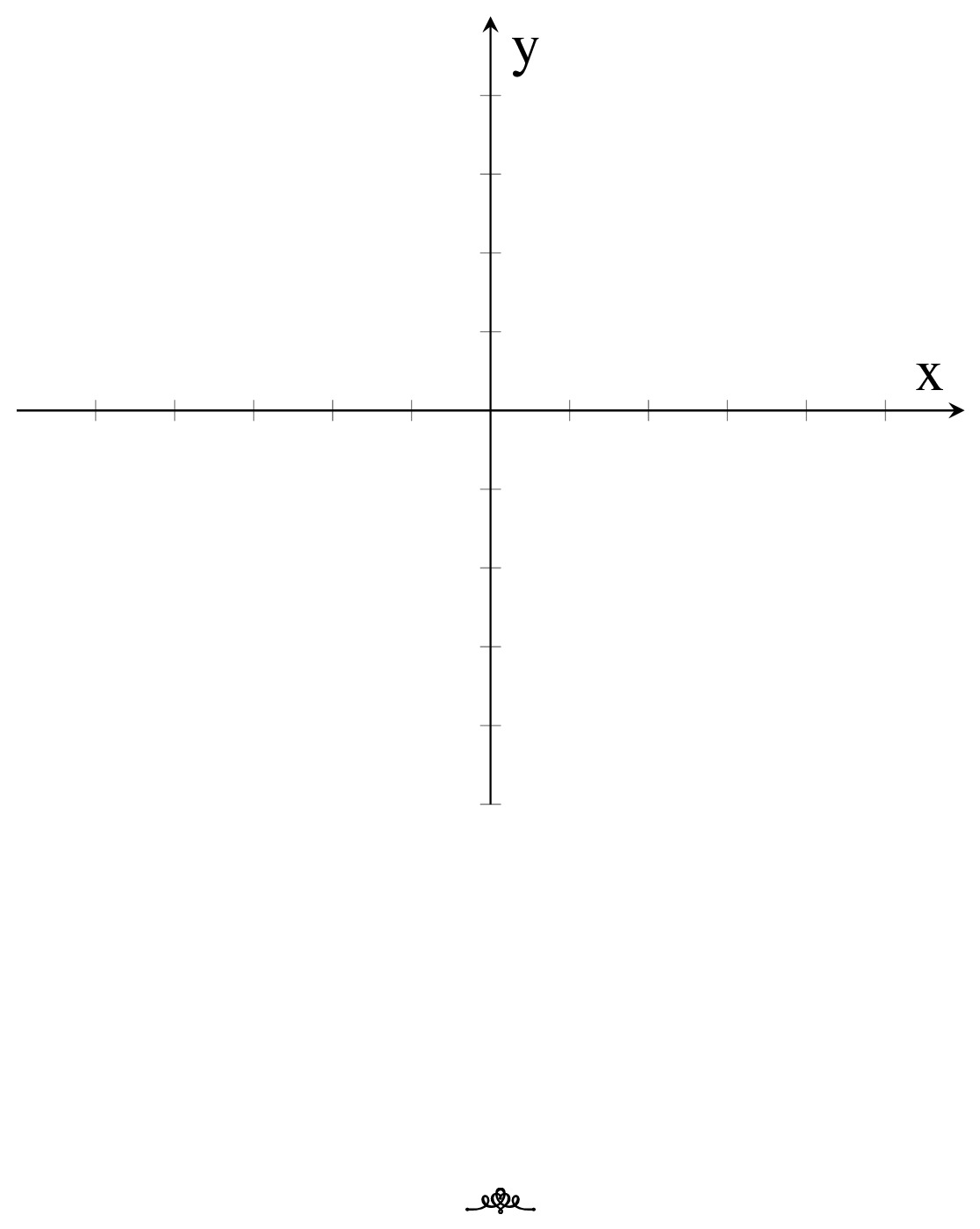
(Graph of coordinate axes with x and y labeled.)
IMAGE