-
The graph of \(\displaystyle y = \frac{x - 3}{x^2 + 4x - 21}\) has
- a vertical asymptote at \(\displaystyle x = -7\) and a removable discontinuity at \(\displaystyle x = 3\).
- a vertical asymptote at \(\displaystyle x = 3\) and a removable discontinuity at \(\displaystyle x = -7\).
- removable discontinuities at both \(\displaystyle x = -7\) and \(\displaystyle x = 3\).
- vertical asymptotes at both \(\displaystyle x = -7\) and \(\displaystyle x = 3\).
- neither removable discontinuities nor vertical asymptotes.
-
Let \(\displaystyle f(x) = 2x^3 - x^2 + 1\). The tangent line to the graph of \(\displaystyle f(x)\) at \(\displaystyle x = 1\) is parallel to which of the following lines?
- \(\displaystyle y = 5x - 1\)
- \(\displaystyle y = 4x + 3\)
- \(\displaystyle y = 2x + 2\)
- \(\displaystyle y = 4\)
- None of those
-
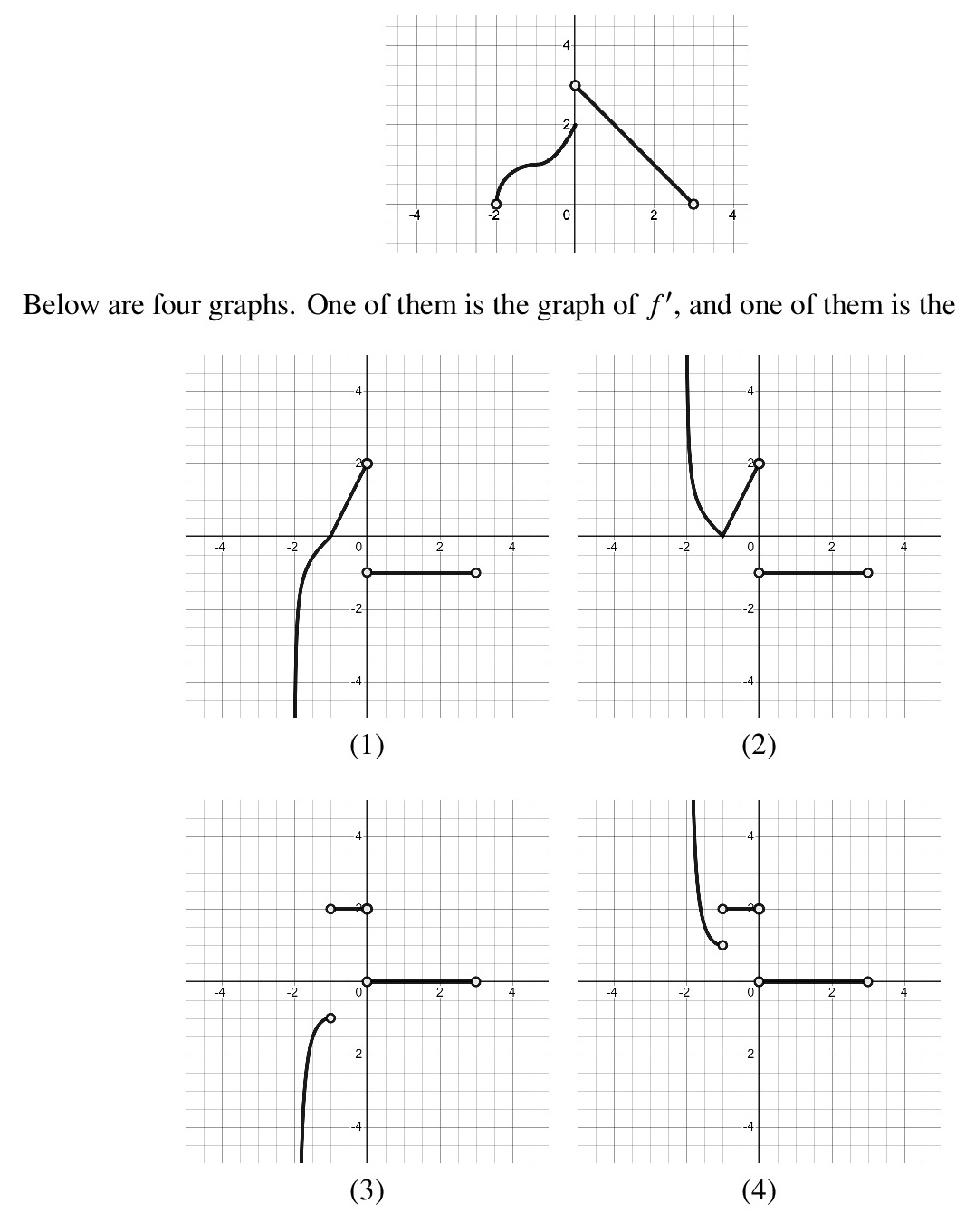
The function \(\displaystyle f\) is defined on \(\displaystyle (-2, 3)\). Its graph is given below:
(graph of \(\displaystyle f\), with domain from \(\displaystyle -2\) to \(\displaystyle 3\), piecewise linear and nonlinear segments, with a corner at some point, and open/closed endpoints)
Below are four graphs. One of them is the graph of \(\displaystyle f'\), and one of them is the graph of \(\displaystyle f''\).
(graph labeled (1), piecewise with vertical lines and open/closed endpoints)
(graph labeled (2), piecewise nonlinear)
(graph labeled (3), piecewise, including intervals with constant values and a jump)
(graph labeled (4), piecewise with vertical lines and open/closed endpoints)
Which is the graph of \(\displaystyle f'\), and which is the graph of \(\displaystyle f''\)?
In the choices below, the first number corresponds to the graph of \(\displaystyle f'\), the second one to that of \(\displaystyle f''\).
- 1, 3
- 3, 1
- 1, 4
- 2, 3
- 3, 2
IMAGE
-
Given \(\displaystyle f(x) = \frac{\ln(x^3 + x + 1)}{x \arcsin(x)}\), what is \(\displaystyle f'(x)\)?
A
\[\displaystyle \frac{\ln(3x^2 + 1)x \arcsin(x) - \ln(x^3 + x + 1)x \arccos(x)}{(x \arcsin(x))^2}\]
B
\[\displaystyle \frac{\ln(x^3 + x + 1)x \arccos(x) - \ln(3x^2 + 1)x \arcsin(x)}{(x \arcsin(x))^2}\]
C
\[\displaystyle \frac{\ln(x^3 + x + 1)(\arcsin(x) + x \arccos(x)) - \ln(3x^2 + 1)x \arcsin(x)}{(x \arcsin(x))^2}\]
D
\[\displaystyle \frac{\left( \frac{3x^2+1}{x^3+x+1} \right)x \arcsin(x) - \ln(x^3 + x + 1) \left( \arcsin(x) + x \cdot \frac{1}{\sqrt{1-x^2}} \right)}{(x \arcsin(x))^2}\]
E
\[\displaystyle \frac{\ln(x^3 + x + 1)\left( \arcsin(x) + x \cdot \frac{1}{\sqrt{1-x^2}} \right) - \left( \frac{3x^2+1}{x^3+x+1} \right)x \arcsin(x)}{(x \arcsin(x))^2}\]
-
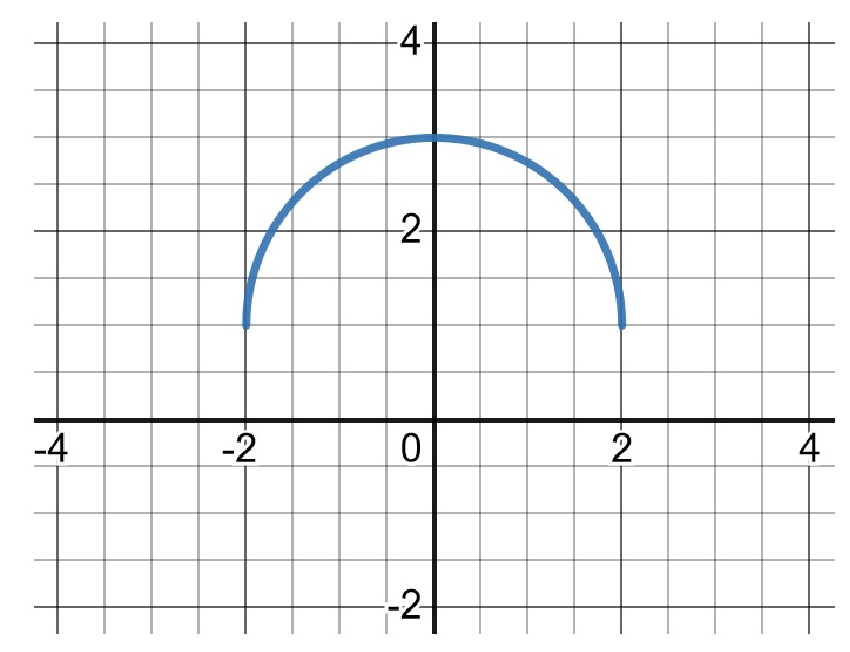
What is the value of
\[\displaystyle \int_{0}^{2} \left(1 + \sqrt{4 - x^2}\right) dx\]
(Hint: Use the following graph of \(\displaystyle y = 1 + \sqrt{4 - x^2}\), which is defined over \(\displaystyle [-2, 2]\).)
(Graph of \(\displaystyle y = 1 + \sqrt{4 - x^2}\))
- \(\displaystyle \pi\)
- \(\displaystyle 2\pi\)
- \(\displaystyle 4\pi\)
- \(\displaystyle \pi + 2\)
- \(\displaystyle 2\pi + 4\)
IMAGE
-
What is \(\displaystyle g'(e)\), if \(\displaystyle g(x) = \int_{1}^{x^2} (t \ln t) dt\) ?
- 0
- 1
- \(\displaystyle e^2\)
- \(\displaystyle 2e^3\)
- \(\displaystyle 4e^3\)
-
Compute \(\displaystyle \int \left( x^3 - 8x + x^{2/3} \right) dx\).
- \(\displaystyle \frac{1}{4} x^4 - 4x^2 + \frac{3}{5} x^{5/3} + C\)
- \(\displaystyle 3x^2 - 8 + \frac{2}{3}x^{-1/3} + C\)
- \(\displaystyle x^3 - 8x + x^{2/3} + C\)
- \(\displaystyle 3x^2 - 4x^2 + x^{2/3} + C\)
- \(\displaystyle \frac{1}{4}x^4 - 8x + \frac{3}{5}x^{5/3} + C\)
-
Using the properties of the definite integral find the value of
\[\displaystyle \int_{3}^{7} (1 - 5f(x)) dx\]
if it is known that
\[\displaystyle \int_{3}^{8} f(x) dx = 10 \text{and} \int_{7}^{8} f(x) dx = 8.\]
- \(\displaystyle -46\)
- \(\displaystyle -10\)
- \(\displaystyle -9\)
- \(\displaystyle -6\)
- \(\displaystyle 2\)
-
Find the following limits. If they do not exist, choose DNE.
- () \(\displaystyle \lim_{x \to 2} \frac{4x^2 - 16}{x - 2}\)
- () \(\displaystyle \lim_{x \to +\infty} x - \sqrt{x^2 + x}\)?
-
Given the values of \(\displaystyle f(x)\) and \(\displaystyle f'(x)\) in the table below, and given that
\[\displaystyle h(x) = f(3 + f(x)),\]
find \(\displaystyle h'(1)\).
| x |
f(x) |
f'(x) |
| 1 |
1 |
2 |
| 2 |
4 |
1 |
| 3 |
3 |
5 |
| 4 |
2 |
1/2 |
-
- () Find the linear approximation of \(\displaystyle h(x) = \sqrt{x}\) at \(\displaystyle x = 9\).
- () Use the above to estimate \(\displaystyle \sqrt{9.1}\).
-
Find the slope of the tangent to the curve implicitly defined by the equation
\[\displaystyle y^4 - x y^2 + x^4 = 1\]
at the point (1, 1).
-
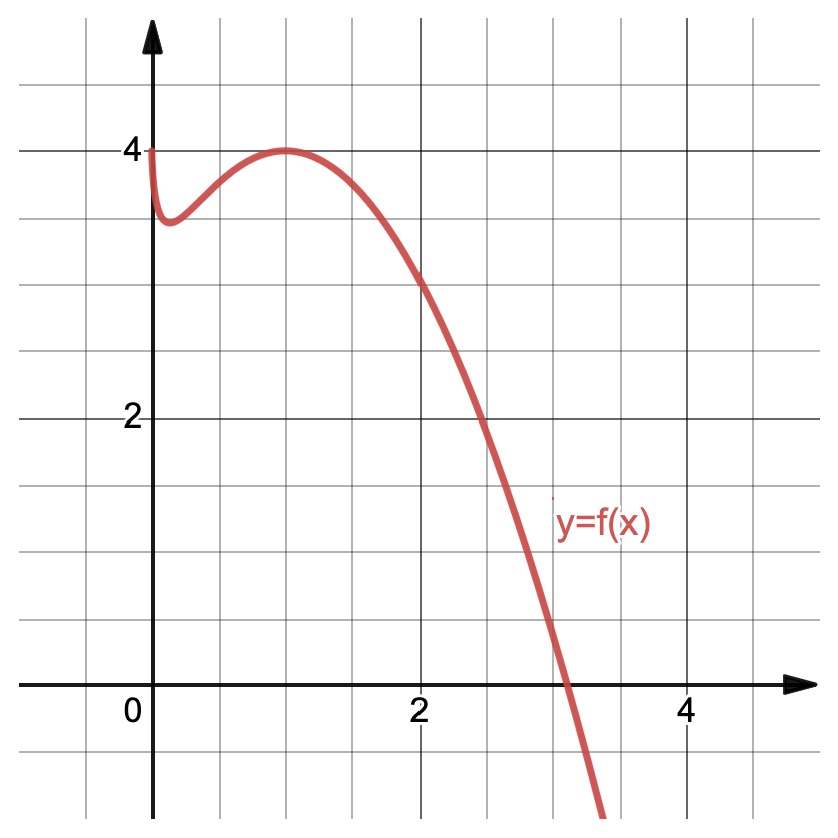
Sketched below is the graph of the function \(\displaystyle y = f(x)\).
[Graph of the function \(\displaystyle y = f(x)\) is shown.]
- () On the graph, sketch the tangent line to \(\displaystyle f(x)\) at \(\displaystyle x = 2\).
- () Use the graph to estimate the value of \(\displaystyle f'(2)\). Show the work that leads to your estimate.
IMAGE
-
The derivative of the function \(\displaystyle g(x)\) is given below. Both \(\displaystyle g\) and \(\displaystyle g'\) are defined everywhere except at 0 and 1.
\[\displaystyle g'(x) = \frac{x^2 - 4}{x^2 - x}\]
Answer the following questions.
- () What are the \(\displaystyle x\) coordinates of all local minima of \(\displaystyle g(x)\)?
– If there aren't any, write NONE.
ANSWER:________________________________________
- () What are the \(\displaystyle x\) coordinates of all local maxima of \(\displaystyle g(x)\)?
– If there aren't any, write NONE.
ANSWER:________________________________________
-
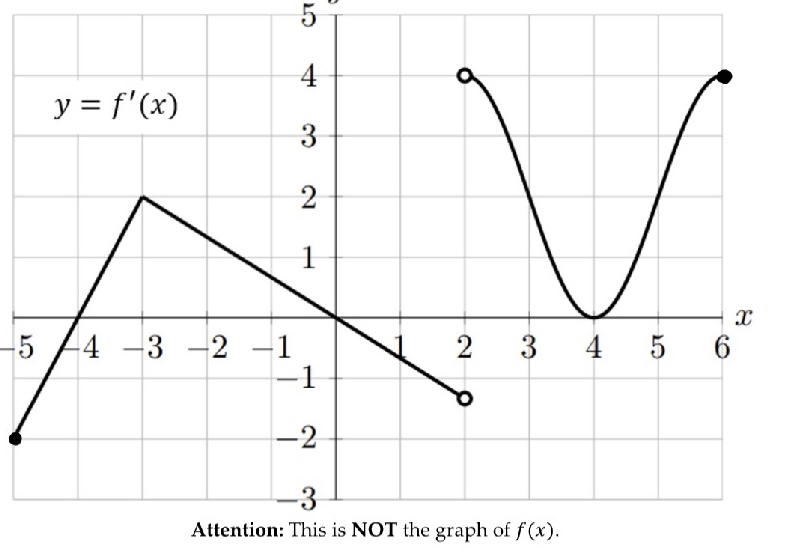
The graph of \(\displaystyle y = f'(x)\), the derivative function of \(\displaystyle f(x)\), is shown below. Assume that \(\displaystyle f(x)\) is defined and continuous on \(\displaystyle [-5, 6]\). Give a complete answer to the following questions.
\[\displaystyle \begin{array}{c} \text{Graph showing } y = f'(x) \text{ with labeled axes and key points marked.} \\ \text{Attention: This is NOT the graph of } f(x). \end{array}\]
- () What are the intervals where \(\displaystyle f(x)\) is concave up?
– If there aren’t any, write NONE.
ANSWER:__________________________________
- () How many inflection points does the graph of \(\displaystyle f(x)\) have?
– If there aren’t any, write 0.
ANSWER:__________________________________
- () What are the intervals where \(\displaystyle f(x)\) is increasing?
– If there aren’t any, write NONE.
ANSWER:__________________________________
IMAGE
-
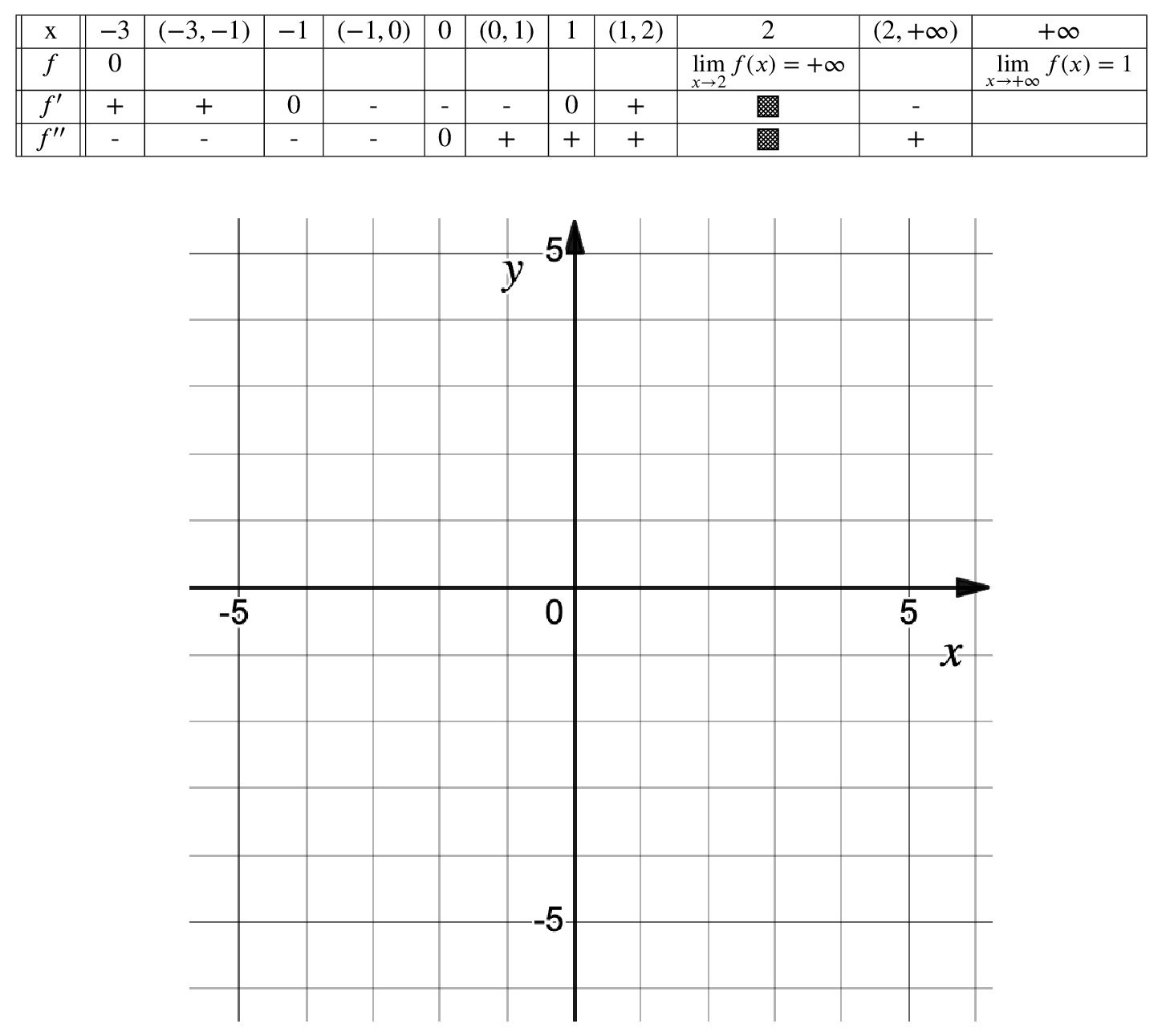
Below is the sign chart of a function \(\displaystyle f\) whose domain is \(\displaystyle [-3,2) \cup (2, \infty)\). Sketch the function as well as possible given the available data.
| x |
3 |
(-3, -1) |
1 |
(-1, 0) |
0 |
(0, 1) |
1 |
(1, 2) |
2 |
(2, +\infty) |
+\infty |
| f |
0 |
|
|
|
0 |
|
|
|
\lim\limits_{x\to2^-} f(x) = +\infty |
|
\lim\limits_{x\to+\infty} f(x) = 1 |
| f' |
+ |
+ |
0 |
|
|
|
0 |
+ |
|
|
|
| f'' |
|
|
|
|
0 |
+ |
+ |
+ |
|
+ |
|
(A coordinate grid for sketching a function is shown.)
IMAGE
-
What are the absolute maxima and the absolute minima of the function
\[\displaystyle f(x) = x^3 - 3x^2 + 1\]
on the interval [0, 5]?
-
Compute \(\displaystyle \int x^2 \cos (x^3 + 3)\ dx\).
-
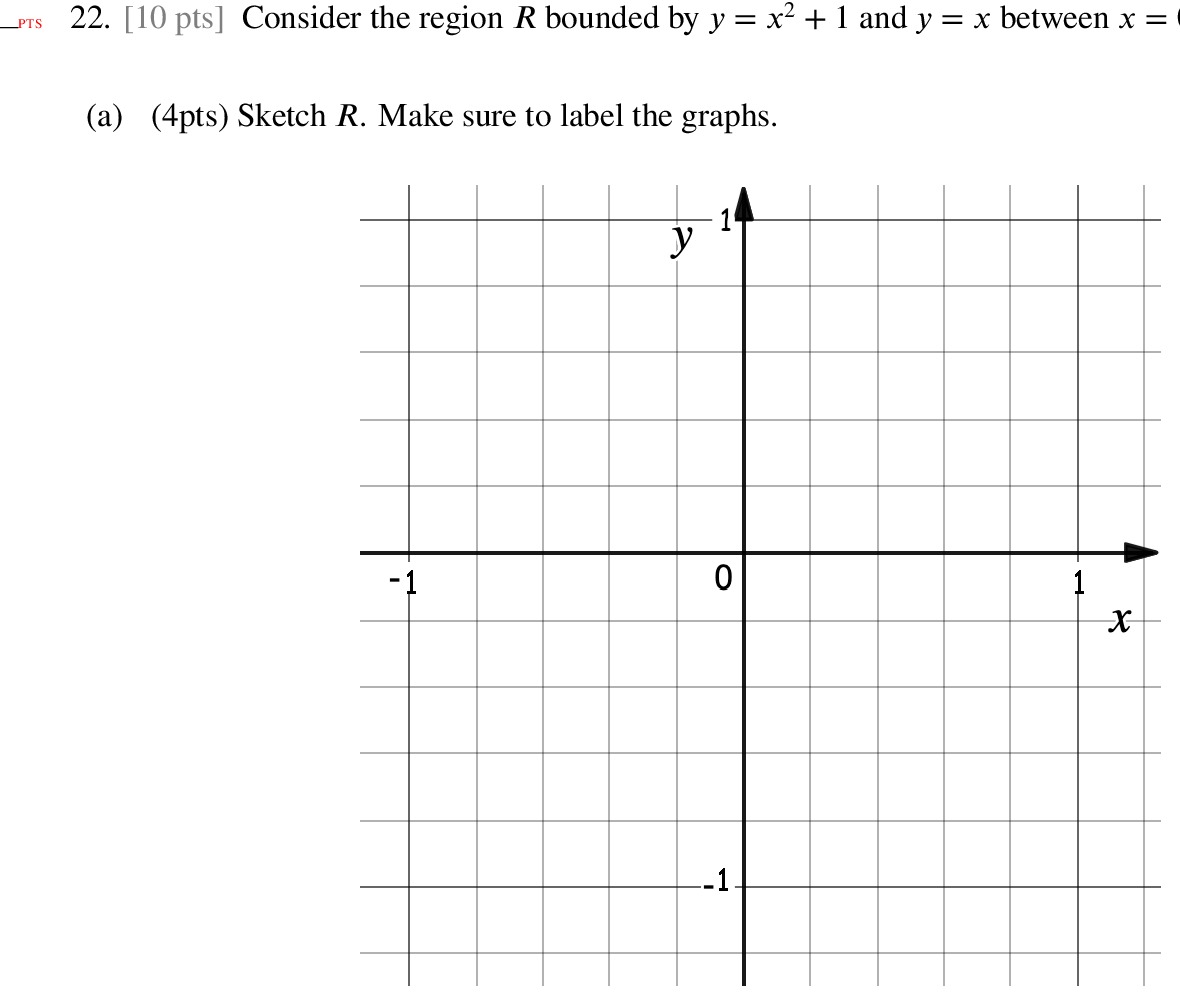
Consider the region \(\displaystyle R\) bounded by \(\displaystyle y = x^2 + 1\) and \(\displaystyle y = x\) between \(\displaystyle x = 0\) and \(\displaystyle x = 1\).
- () Sketch \(\displaystyle R\). Make sure to label the graphs.
(Graph with labeled axes and grid, showing space to sketch the described region.)
- () Find its area.
IMAGE
-
On a windy day, Camila launches a sunny yellow kite 300 ft into the sky. The wind tugs it horizontally at 25 ft/sec. When the string reaches 500 ft, how fast should she let it out?
-
With final exams wrapping up, many people will be traveling over the winter break. In preparation for this, people will need to make sure to check the dimensions of their checked and carry-on luggage to make sure that they are not too big. Passengers of many airlines are only allowed to carry a piece of luggage into an airplane if the total of its length, width, and height does not exceed 45 in.
- () Suppose that you wish to carry on a rectangular suitcase whose length is exactly 1.5 times its width, and whose dimensions add up to 45 in. Let \(\displaystyle w\) be the width of the suitcase. Give a formula, \(\displaystyle V(w)\), for the volume (in in\(\displaystyle ^3\)) of such a suitcase in terms of \(\displaystyle w\).
- () Find a reasonable domain for \(\displaystyle w\).
- () Find the value of \(\displaystyle w\) at which the volume of the suitcase \(\displaystyle V(w)\) is maximized.