Determine the following limits; show work or briefly explain your thinking on each one. If you apply L'Hopital's Rule, indicate where you have applied it and why you can apply it. If your final answer is “does not exist,” ∞, or, -∞, briefly explain your answer. (You will not receive full credit for a “does not exist” answer if the answer is ∞ or -∞.)
- \(\displaystyle \lim_{x \to 2} \sqrt[3]{x^2 - 6x - 7}\)
- \(\displaystyle \lim_{x \to 0} \frac{\sin(x) - x}{1 - \cos(x)}\)
- \(\displaystyle \lim_{x \to \infty} e^{-4x} + \ln(x)\)
- \(\displaystyle \lim_{x \to 0^+} \left( \frac{1}{x} + \frac{5}{x(x-5)} \right)\)
Use the limit definition of the derivative to determine the derivative of
Your answer should be \(\displaystyle f'(x) = \frac{1}{2\sqrt{x + 1}}\). No points will be awarded for the application of differentiation rules (and L'Hopital's Rule is not allowed.)
Show all steps.**
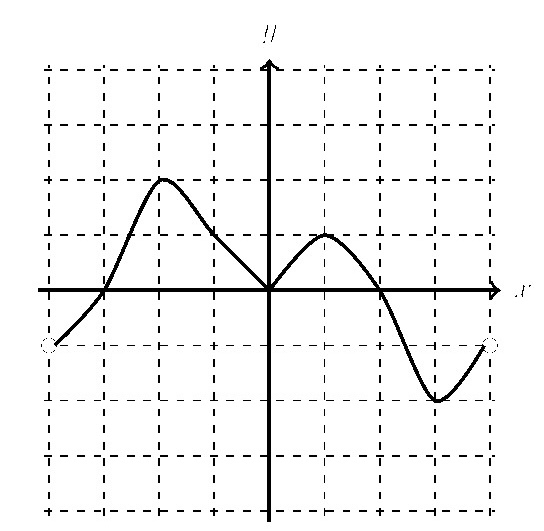
The graph below is the graph of the derivative of a function \(\displaystyle f\) (that is, the graph shows \(\displaystyle f'\)). The domain of this function is all real numbers.
DERIVATIVE
[A graph is shown here.]
- For what values of \(\displaystyle x\) does the original function \(\displaystyle f\) have a local maximum? Why?
- For what values of \(\displaystyle x\) does the original function \(\displaystyle f\) have an inflection point? Why?
- For what values of \(\displaystyle x\) is the tangent line to the graph of \(\displaystyle f\) horizontal? Why?
IMAGE
Determine \(\displaystyle \frac{dy}{dx}\) for each equation below. Remember to use correct notation to write your final answer. You do not need to simplify your final answer.
- \(\displaystyle y = \frac{2}{x^5} - \sqrt[3]{x}\)
- \(\displaystyle y = \frac{e^{-5x}}{\sin(x^2)}\)
- \(\displaystyle y = \ln(x)\tan(x)\)
- \(\displaystyle y = \sqrt{\cos^2(x)+2x}\)
Determine \(\displaystyle \frac{dy}{dx}\) for each equation below. Remember to use correct notation to write your final answer. You do not need to simplify your final answer.
- \(\displaystyle x^3 + y^3 = 2x + x \ln(y)\)
- \(\displaystyle y = \int_{2}^{x} \left( \sqrt{e^t} + \frac{1}{1 + 4t^2} \right) dt\)
Evaluate the following. You do not need to simplify your answers.
Evaluate the following. You do not need to simplify your answers.
- \(\displaystyle \int \frac{3 \cos(\ln(x))}{x} dx\)
- \(\displaystyle \int_{-1}^{0} e^{-3x+1} dx\)
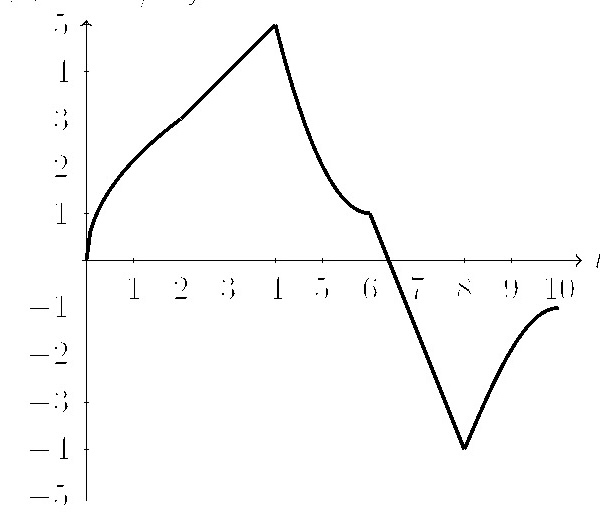
4. (4 points) The graph below shows the rate of stock price change for Gimble Company in dollars per month.
DERIVATIVE
VISUAL_REF: (graph)
- On what interval(s) is the stock price increasing? On what interval(s) is the stock price decreasing?
- At what time(s) is the stock price at a local maximum? At what time(s) is the stock price at a local minimum?
- Sketch a possible graph of the stock price.
Label axes and indicate at least one value of \(\displaystyle t\) for each local max/min identified above.
- State the meaning of a local maximum and a local minimum for the derivative in the context of the problem.
IMAGE
Each side of a square is increasing at a rate of 6 cm/sec. At what rate is the area of the square increasing when the area of the square is 16 cm\(\displaystyle ^2\)? Your final answer should be a complete sentence with appropriate units.
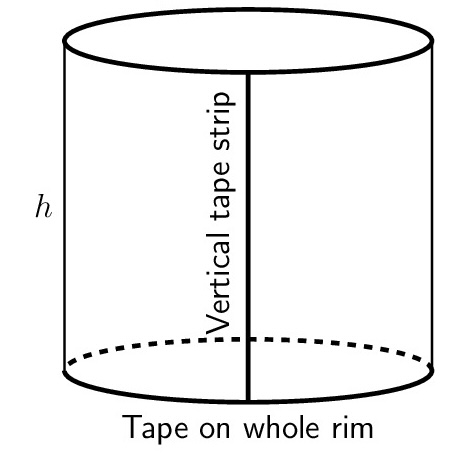
A cylindrical-shaped tube with radius \(\displaystyle r\) and height \(\displaystyle h\) is made of a long rolled-up sheet plus two circular lids, held closed with tape. We need to put tape around the rims of both lids, as well as one long strip of tape down the side of the tube. (See the labels on the figure on the below.)
Tape on whole rim
Vertical tape strip
Tape on whole rim
- Given that we have \(\displaystyle 20\pi\) inches of tape to seal this tube shut, write a function for the VOLUME of the tube as a function of the radius \(\displaystyle r\).
- Determine an appropriate domain for your function from (a). Briefly explain your reasoning.
- NOTE: Your work from parts (a) and (b) will not be used in this question.
The amount of tape needed to create a \(\displaystyle 700\pi\) in\(\displaystyle ^3\) tube with radius \(\displaystyle r\) is given by
The domain of \(\displaystyle T(r)\) is \(\displaystyle (0,\infty)\). Determine the radius \(\displaystyle r\) of the cylinder that will minimize the amount of tape needed. \textit{Justify, using methods of calculus, why your dimensions yield the absolute minimum.}
IMAGE