Determine the following limits; briefly explain your thinking on each one. If you apply L'Hopital’s Rule, indicate where you have applied it and why you can apply it. If your final answer is ”does not exist,” \(\displaystyle \infty\), or, \(\displaystyle -\infty\), briefly explain your answer. (You will not receive full credit for a "does not exist" answer if the answer is \(\displaystyle \infty\) or \(\displaystyle -\infty\).)
- \(\displaystyle \lim_{x \to 2} \sqrt[3]{\frac{x^2 + x - 6}{x^2 - x - 2}} =\)
- \(\displaystyle \lim_{x \to 7} \frac{\sqrt{x+2} - 3}{x-7} =\)
- \(\displaystyle \lim_{x \to 0} \frac{1 - \cos(x)}{x^2} =\)
- \(\displaystyle \lim_{x \to \infty} x e^{-3x} =\)
Solution:
- Inside the cube root, factor both numerator and denominator: \[ \frac{x^2+x-6}{x^2-x-2} =\frac{(x+3)(x-2)}{(x-2)(x+1)}. \] For \(x\neq2\), this simplifies to \[ \frac{x+3}{x+1}. \] Now take the limit: \[ \lim_{x\to2}\sqrt[3]{\frac{x+3}{x+1}} =\sqrt[3]{\frac{2+3}{2+1}} =\boxed{\sqrt[3]{\frac53}}. \]
- The expression \[ \lim_{x\to7}\frac{\sqrt{x+2}-3}{x-7} \] is the derivative of \(f(x)=\sqrt{x+2}\) at \(x=7\), because \(f(7)=3\). Therefore \[ f'(x)=\frac{1}{2\sqrt{x+2}}, \] so \[ \boxed{\lim_{x\to7}\frac{\sqrt{x+2}-3}{x-7}=f'(7)=\frac{1}{2\sqrt9}=\frac16}. \]
- This is a standard trigonometric limit: \[ \lim_{x\to0}\frac{1-\cos x}{x^2}=\boxed{\frac12}. \] If desired, one may also recall the identity \(1-\cos x=2\sin^2(x/2)\) and reduce it to the basic \(\sin u/u\) limit.
- Rewrite the expression as \[ xe^{-3x}=\frac{x}{e^{3x}}. \] As \(x\to\infty\), the exponential in the denominator grows much faster than the linear numerator, so the quotient tends to \(0\). Hence \[ \boxed{0}. \]
Consider the graph of \(\displaystyle y = f(x)\) defined on the closed interval \(\displaystyle [-5, 4]\) given below. The grid lines are one unit apart. Based on the graph, answer the following questions.
- Determine all values of \(\displaystyle a\) such that \(\displaystyle f(a)\) exists and \(\displaystyle \lim_{x \to a} f(x)\) does not exist.
- Determine all values of \(\displaystyle x\) in the interval \(\displaystyle (-5, 4)\) such that \(\displaystyle f(x)\) exists and \(\displaystyle f'(x)\) does not exist.
- Determine all values of \(\displaystyle x\) in the interval \(\displaystyle (-5, 4)\) such that \(\displaystyle f'(x) < 0\).
IMAGE
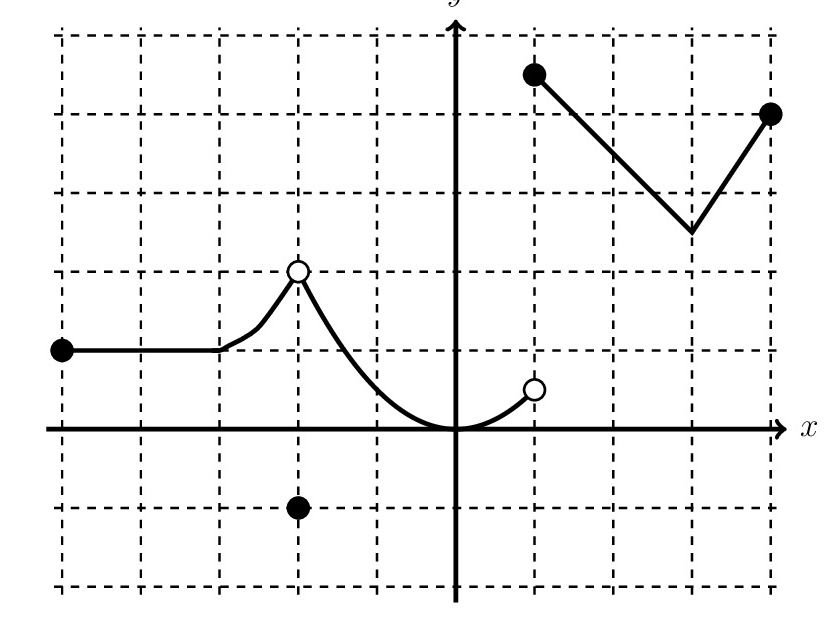
Solution:
- We want points \(a\) where the function value \(f(a)\) exists, but the two-sided limit \(\lim_{x\to a}f(x)\) does not exist. Looking at the graph, this happens where there is a jump or mismatch between the left-hand and right-hand behavior, while still having a filled point at that \(x\)-value. From the graph, those points are \[ \boxed{a=-2 \text{ and } a=1}. \]
- The derivative fails to exist at points where the function has a corner, cusp, vertical tangent, or discontinuity, provided the function itself is defined there. Reading these features from the graph gives approximately \[ \boxed{x=-2,\,-1,\,1,\,3}. \] At these locations the graph is either not smooth or not continuous enough for differentiability.
- The function is decreasing where its graph moves downward as \(x\) increases. From the picture, this occurs on the interval that runs from the peak near \(x=-2\) down to the minimum at \(x=0\), and again on the descending side of the V-shape from \(x=1\) to \(x=3\). In interval notation this is approximately \[ \boxed{(-2,0)\cup(1,3)}. \]
Use the limit definition of the derivative to determine the derivative of
No points will be awarded for the application of differentiation rules (and L’Hopital’s Rule is not allowed.)
Show all steps.**
Solution: We start from the limit definition of the derivative: \[ f'(x)=\lim_{h\to0}\frac{f(x+h)-f(x)}{h}. \] For \[ f(x)=\frac{1}{3x+7}, \] this becomes \[ \frac{f(x+h)-f(x)}{h} =\frac{\frac1{3x+3h+7}-\frac1{3x+7}}{h}. \] Combine the two fractions in the numerator: \[ \frac{(3x+7)-(3x+3h+7)}{h(3x+3h+7)(3x+7)} =\frac{-3h}{h(3x+3h+7)(3x+7)}. \] Cancel the factor \(h\): \[ \frac{-3}{(3x+3h+7)(3x+7)}. \] Now let \(h\to0\): \[ f'(x)=\lim_{h\to0}\frac{-3}{(3x+3h+7)(3x+7)} =-\frac{3}{(3x+7)^2}. \] Therefore \[ \boxed{f'(x)=-\frac{3}{(3x+7)^2}}. \]
Determine the first derivative of each of the following functions. Remember to use correct notation to write your final answer.
- \(\displaystyle f(t) = \frac{4t^5 - 3}{7t} + e^{9t}\)
- \(\displaystyle h(x) = \cos(x) \arcsin(x)\)
- \(\displaystyle k(y) = \tan(9y) - \ln(5y^3 - y^2 + 4)\)
Solution:
- \(f(t)=\dfrac{4t^5-3}{7t}+e^{9t}=\dfrac47 t^4-\dfrac{3}{7}t^{-1}+e^{9t}\), so \(f'(t)=\boxed{\dfrac{16}{7}t^3+\dfrac{3}{7t^2}+9e^{9t}}\).
- \(h'(x)=\boxed{-\sin(x)\arcsin(x)+\dfrac{\cos x}{\sqrt{1-x^2}}}\).
- \(k'(y)=\boxed{9\sec^2(9y)-\dfrac{15y^2-2y}{5y^3-y^2+4}}\).
Determine \(\displaystyle \frac{dy}{dx}\).
- \(\displaystyle y = x^{\sin(x)}\)
- \(\displaystyle y^3 - 4y = x^2 e^y\)
Solution:
- Let \(y=x^{\sin x}\). Then \(\ln y=\sin x\ln x\), so \(\dfrac{y'}{y}=\cos x\ln x+\dfrac{\sin x}{x}\). Hence \(\boxed{y'=x^{\sin x}\left(\cos x\ln x+\dfrac{\sin x}{x}\right)}\).
- Differentiate implicitly: \((3y^2-4)y'=2xe^y+x^2e^y y'\). Therefore \(\boxed{y'=\dfrac{2xe^y}{3y^2-4-x^2e^y}}\).
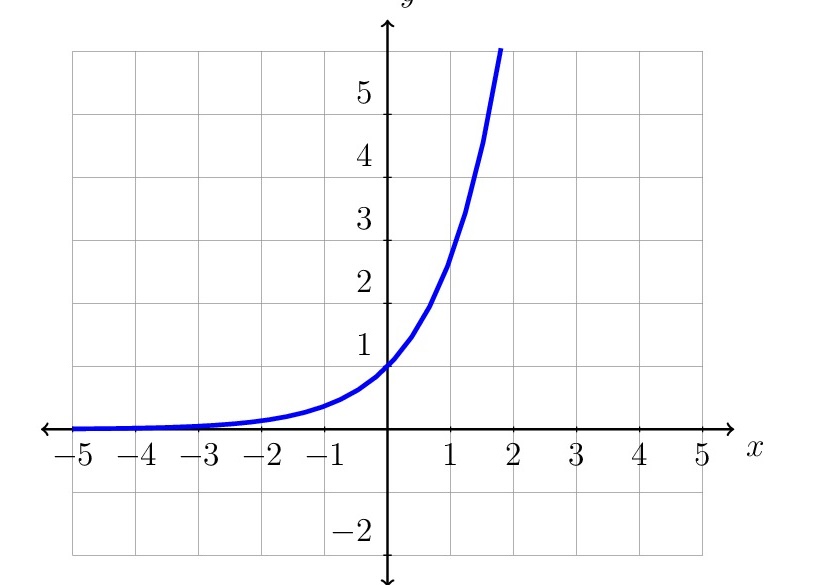
Consider \(\displaystyle f(x) = e^x\). It has been graphed below.
[Graph of \(\displaystyle y = e^x\) with labeled axes: \(\displaystyle x\) from -5 to 5, \(\displaystyle y\) from -2 to 5, and gridlines.]
- Write the equation of the tangent line of \(\displaystyle y = f(x)\) at the point (0, 1) and then \textbf{graph the line} on the grid provided above.
- Use the linearization of \(\displaystyle y = f(x)\) at \(\displaystyle x = 0\) to approximate \(\displaystyle e^{0.05}\). (You don't need to simplify.) Use the graph to explain whether or not your approximation is an overestimate or underestimate of \(\displaystyle e^{0.05}\).
IMAGE
Solution:
- The tangent line to \(f(x)=e^x\) at \(x=0\) uses the point \(f(0)=1\) and the slope \(f'(0)=e^0=1\). Using point-slope form, \[ y-1=1(x-0), \] so the tangent line is \[ \boxed{y=x+1}. \]
- The linearization of \(f(x)=e^x\) at \(x=0\) is \[ L(x)=f(0)+f'(0)(x-0)=1+x. \] Therefore \[ e^{0.05}\approx L(0.05)=1+0.05=\boxed{1.05}. \] To decide whether this is an overestimate or underestimate, note that \[ f''(x)=e^x>0 \] for all \(x\). So the graph of \(e^x\) is concave up, meaning its tangent line lies below the curve near the point of tangency. Therefore the approximation \(1.05\) is an \[ \boxed{\text{underestimate}}. \]
Evaluate the following. You do not need to simplify your answers.
- \(\displaystyle \int \left( \frac{2}{x^3} + \frac{8}{x} + \frac{1}{1+x^2} \right) dx\)
- \(\displaystyle \int \frac{\sqrt{\ln(x)} + 4}{x} dx\)
- \(\displaystyle \int_{-2}^{1} (x^2 + x + 1) dx\)
- \(\displaystyle \frac{d}{dx} \int_{2}^{x} \left( \csc^2(t) + 2^t \right) dt\)
Solution:
- \(\displaystyle \int \left(\frac{2}{x^3}+\frac8x+\frac{1}{1+x^2}\right)dx=\boxed{-\frac1{x^2}+8\ln|x|+\arctan x+C}\).
- With \(u=\ln x\), \(du=dx/x\), so \(\displaystyle \int \frac{\sqrt{\ln x}+4}{x}dx=\boxed{\frac23(\ln x)^{3/2}+4\ln x+C}\).
- \(\displaystyle \int_{-2}^{1}(x^2+x+1)dx=\left[\frac{x^3}{3}+\frac{x^2}{2}+x\right]_{-2}^{1}=\boxed{\frac92}\).
- By the FTC, \(\dfrac{d}{dx}\int_2^x(\csc^2 t+2^t)dt=\boxed{\csc^2 x+2^x}\).
Suppose that from a height of 6 feet above the ground, a ball is tossed vertically in such a way that its velocity function is given by \(\displaystyle v(t) = 32 - 32t\), where \(\displaystyle t\) is measured in seconds and \(\displaystyle v\) in feet per second. Assume that this function is valid for \(\displaystyle t \geq 0\).
- After how many seconds will the ball change direction and begin to fall to the ground?
- Determine the distance between the ball and the ground after 1.5 seconds.
- After how many seconds will the ball hit the ground?
Solution: Here the velocity is given directly: \[ v(t)=32-32t. \] So we should work from that equation, not introduce a different model.
- The ball changes direction when its velocity becomes \(0\). Solve \[ 32-32t=0. \] This gives \[ t=1. \] So the ball reaches its highest point and begins to fall after \[ \boxed{1\text{ second}}. \]
- Height is obtained by integrating the velocity and using the initial height \(s(0)=6\): \[ s(t)=6+\int_0^t (32-32u)\,du =6+\left[32u-16u^2\right]_0^t =6+32t-16t^2. \] At \(t=1.5\), \[ s(1.5)=6+32(1.5)-16(1.5)^2 =6+48-16(2.25) =6+48-36 =18. \] So after \(1.5\) seconds, the ball is \[ \boxed{18\text{ feet above the ground}}. \]
- The ball hits the ground when \(s(t)=0\): \[ 6+32t-16t^2=0. \] Divide by \(2\): \[ 3+16t-8t^2=0. \] Equivalently, \[ 8t^2-16t-3=0. \] Using the quadratic formula, \[ t=\frac{16\pm\sqrt{256+96}}{16} =\frac{16\pm\sqrt{352}}{16} =\frac{4\pm\sqrt{22}}{4}. \] We discard the negative root, so the physical solution is \[ \boxed{t=\frac{4+\sqrt{22}}{4}\text{ seconds}}. \]
Air is leaking from a spherical balloon at a rate of 5 cm\(\displaystyle ^3\)/min. Determine the rate at which the radius of the balloon is changing when the radius of the balloon is 10 cm. (You do not need to simplify your answer; decimal approximations will not be accepted.)
Hint: The volume of a sphere is \(\displaystyle V = \frac{4}{3} \pi r^3\).
Solution: For a sphere, \(V=\tfrac43\pi r^3\), so \(\dfrac{dV}{dt}=4\pi r^2\dfrac{dr}{dt}\). Air is leaking out, so \(\dfrac{dV}{dt}=-5\) cm\(^3\)/min. At \(r=10\), \[ -5=4\pi(10)^2\frac{dr}{dt}=400\pi\frac{dr}{dt}. \] Therefore \(\boxed{\dfrac{dr}{dt}=-\dfrac{1}{80\pi}\text{ cm/min}}\).
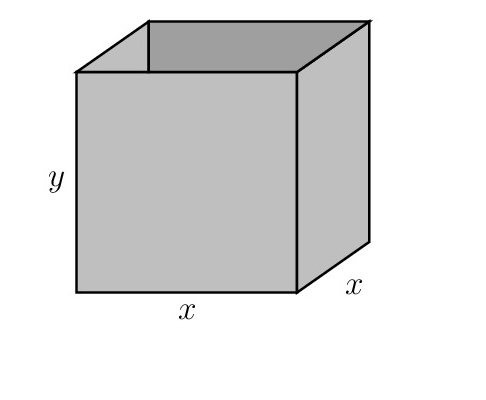
A rectangular box with a square base and an open top is to be constructed.
- Suppose the volume of the box is 200 cubic inches. Write a formula for the surface area of the box as a function of \(\displaystyle x\), the lengths of its base, and determine the domain of the function.
(A diagram of a box labeled with base dimensions \(\displaystyle x\) and height \(\displaystyle y\).)
- The manufacturing company has decided that the box will need to have a volume of 216 cubic inches. The material chosen to construct the box will cost \$0.20/square inch for the base and \$0.30/square inch for the sides. Then the cost (in dollars) of the box is given by
where \(\displaystyle x\) is represents the lengths of the base of the box. What should the dimensions of the box be to minimize the cost of making the box?
IMAGE
Solution:
- If the square base has side \(x\) and height \(y\), then \(x^2y=200\), so \(y=200/x^2\). The open-top surface area is \(S=x^2+4xy=x^2+\dfrac{800}{x}\), with domain \(x>0\).
- For the cost function \(C(x)=\dfrac{259.2}{x}+0.2x^2\), differentiate: \(C'(x)=-\dfrac{259.2}{x^2}+0.4x\). Setting this to zero gives \(0.4x^3=259.2\), so \(x^3=648\) and \(x=\boxed{9}\). Then \(y=216/x^2=216/81=\boxed{8/3}\). Since \(C''(x)=\dfrac{518.4}{x^3}+0.4>0\), this gives the minimum cost. So the minimizing dimensions are a \(9\text{ in}\times 9\text{ in}\) base and height \(8/3\) in.