Determine the following limits; briefly explain your thinking on each one. If you apply L'Hopital's rule, indicate where you have applied it and why you can apply it. If your final answer is "does not exist," \(\displaystyle \infty\), or \(\displaystyle -\infty\), briefly explain your answer. (You will not receive full credit for a "does not exist" answer if the answer is \(\displaystyle \infty\) or \(\displaystyle -\infty\).)
- \(\displaystyle \lim_{x \to 2} \left( x^3 - 7x + 17 \right)\)
- \(\displaystyle \lim_{x \to 0} \frac{2x}{e^{3x} - 7x - 1}\)
- \(\displaystyle \lim_{x \to \infty} \frac{\ln(x)}{7x^2}\)
Solution:
- This is a polynomial, and polynomials are continuous everywhere. Therefore we may use direct substitution: \[ \lim_{x\to2}(x^3-7x+17)=2^3-7(2)+17=8-14+17=11. \] So the limit is \(\boxed{11}\).
- As \(x\to0\), the numerator \(2x\to0\) and the denominator \(e^{3x}-7x-1\to 1-0-1=0\). So we have the indeterminate form \(0/0\), and L'Hospital's Rule applies. Differentiate numerator and denominator: \[ \lim_{x\to0}\frac{2x}{e^{3x}-7x-1} =\lim_{x\to0}\frac{2}{3e^{3x}-7} =\frac{2}{3e^0-7} =\frac{2}{3-7} =-\frac12. \] Thus the limit is \(\boxed{-\dfrac12}\).
- As \(x\to\infty\), the numerator \(\ln x\) grows very slowly, while the denominator \(7x^2\) grows quadratically. Quadratic growth dominates logarithmic growth, so the fraction goes to \(0\): \[ \lim_{x\to\infty}\frac{\ln x}{7x^2}=\boxed{0}. \] If desired, one could also justify this with L'Hospital's Rule twice.
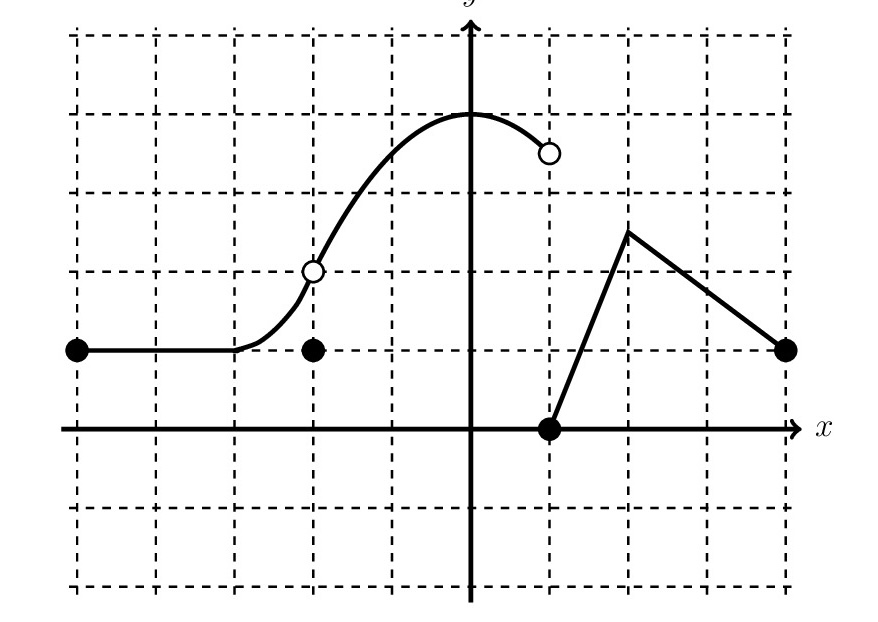
Consider the graph of \(\displaystyle y = f(x)\) given below. The grid lines are one unit apart. Based on the graph, answer the following questions.
[Graph of \(\displaystyle y = f(x)\)]
- Determine \(\displaystyle \lim_{x \to -2} f(x)\).
- Determine \(\displaystyle f(1)\).
- Determine all values of \(\displaystyle x\) in the interval \(\displaystyle (-5, 4)\) at which \(\displaystyle f'(x) < 0\).
- Determine all values of \(\displaystyle x\) in the interval \(\displaystyle (-5, 4)\) at which \(\displaystyle f'(x)\) is undefined. Briefly explain your thinking.
IMAGE
Solution:
- To compute \(\lim_{x\to-2}f(x)\), we compare the left-hand and right-hand behavior of the graph near \(x=-2\). From the picture, the values approached from the left and from the right are different. Since the one-sided limits are unequal, the two-sided limit does not exist. Thus \[ \boxed{\lim_{x\to-2}f(x)\text{ does not exist}}. \]
- The value \(f(1)\) is read from the filled point on the graph at \(x=1\). The filled point lies on the \(x\)-axis, so its \(y\)-coordinate is \(0\). Therefore \[ \boxed{f(1)=0}. \]
- The derivative \(f'(x)\) is negative where the graph of \(f\) is decreasing. Looking at the picture, the graph decreases from the top of the curved arc down to the open circle at \(x=1\), and it also decreases along the descending line segment on the right. So those are the \(x\)-values where \(f'(x)<0\).
- The derivative is undefined at points where the graph is not smooth, such as corners, cusps, vertical tangents, or discontinuities. From the graph, this happens at the discontinuity near \(x=-2\), at \(x=1\), and at the corner near \(x=2\). Therefore the values are \(\boxed{x=-2,1,2}\).
(a) State the limit definition of the derivative of \(\displaystyle f(x)\).
- Use the \textbf{limit definition of the derivative} to determine the derivative of \(\displaystyle f(x) = \frac{1}{1 - 3x}\). No points will be awarded for the application of differentiation rules (and L'Hopital's rule is not allowed).
Solution: The limit definition of the derivative is \[ f'(x)=\lim_{h\to0}\frac{f(x+h)-f(x)}{h}. \] For \(f(x)=\dfrac{1}{1-3x}\), substitute into the definition: \[ f'(x)=\lim_{h\to0}\frac{\frac{1}{1-3(x+h)}-\frac{1}{1-3x}}{h} =\lim_{h\to0}\frac{\frac{1}{1-3x-3h}-\frac{1}{1-3x}}{h}. \] Combine the fractions in the numerator: \[ \frac{1}{1-3x-3h}-\frac{1}{1-3x} =\frac{(1-3x)-(1-3x-3h)}{(1-3x-3h)(1-3x)} =\frac{3h}{(1-3x-3h)(1-3x)}. \] Now divide by \(h\): \[ \frac{\frac{3h}{(1-3x-3h)(1-3x)}}{h} =\frac{3}{(1-3x-3h)(1-3x)}. \] Finally, let \(h\to0\): \[ f'(x)=\lim_{h\to0}\frac{3}{(1-3x-3h)(1-3x)} =\frac{3}{(1-3x)^2}. \] Therefore \[ \boxed{f'(x)=\dfrac{3}{(1-3x)^2}}. \]
Determine the first derivative of each of the following functions. Remember to use correct notation to write your final answer.
- \(\displaystyle f(x) = \frac{x^5}{3} - \frac{1}{\sqrt{x}} + \pi^7\)
- \(\displaystyle f(x) = \frac{\sin(x)}{3x+4}\)
- \(\displaystyle f(x) = [x^2 + \arcsin(x)]^5\)
- \(\displaystyle y = x^{\cos(x)}\)
Solution:
- \(f'(x)=\boxed{\frac53x^4+\frac{1}{2x^{3/2}}}\).
- \(f'(x)=\boxed{\frac{\cos x(3x+4)-3\sin x}{(3x+4)^2}}\).
- \(f'(x)=\boxed{5[x^2+\arcsin(x)]^4\left(2x+\frac{1}{\sqrt{1-x^2}}\right)}\).
- For \(y=x^{\cos x}\), \(\ln y=\cos x\ln x\), so \(\boxed{y'=x^{\cos x}\left(-\sin x\ln x+\frac{\cos x}{x}\right)}\).
Determine the following indefinite integrals.
- \(\displaystyle \int \left( x^5 + 2\sqrt{x} - e^x \right) dx\)
- \(\displaystyle \int \left( \frac{3}{x} + \frac{4}{1 + x^2} \right) dx\)
- \(\displaystyle \int \sin(x) e^{3 \cos(x)} dx\)
Solution:
- \(\displaystyle \int(x^5+2\sqrt{x}-e^x)dx=\boxed{\frac{x^6}{6}+\frac43x^{3/2}-e^x+C}\).
- \(\displaystyle \int\left(\frac3x+\frac{4}{1+x^2}\right)dx=\boxed{3\ln|x|+4\arctan x+C}\).
- Let \(u=3\cos x\), so \(du=-3\sin x\,dx\). Then \(\int \sin x\,e^{3\cos x}dx=\boxed{-\frac13 e^{3\cos x}+C}\).
Evaluate the following definite integrals.
- \(\displaystyle \int_{\pi/12}^{\pi/6} (\cos(3x)) dx\)
- \(\displaystyle \int_0^1 (1-2x)^6 dx\)
Solution:
- \(\displaystyle \int_{\pi/12}^{\pi/6}\cos(3x)dx=\left[\frac13\sin(3x)\right]_{\pi/12}^{\pi/6}=\boxed{\frac13-\frac{\sqrt2}{6}}\).
- With \(u=1-2x\), \(dx=-du/2\), so \(\int_0^1(1-2x)^6dx=\boxed{\frac17}\).
An object moves along a straight line with acceleration function \(\displaystyle a(t) = -10t\) meters per second squared, where \(\displaystyle t \geq 0\). The object's initial velocity is 70 meters/second. Give appropriate units with each answer.
- Determine the velocity function \(\displaystyle v(t)\).
- When is the particle at rest?
- When is the object's velocity 50 meters per second?
- What is the displacement of the object from \(\displaystyle t = 0\) seconds to \(\displaystyle t = 5\) seconds?
Solution:
- Acceleration is the derivative of velocity, so \[ v'(t)=a(t)=-10t. \] Integrating gives \[ v(t)=-5t^2+C. \] Use the initial condition \(v(0)=70\): \[ 70=-5(0)^2+C, \] so \(C=70\). Therefore \[ \boxed{v(t)=70-5t^2\text{ m/s}}. \]
- The particle is at rest when its velocity is zero: \[ 70-5t^2=0. \] Divide by \(5\): \[ 14-t^2=0 \quad\Longrightarrow\quad t^2=14. \] Since \(t\ge0\), we take \[ \boxed{t=\sqrt{14}\text{ s}}. \]
- We want the time when the velocity is \(50\) m/s, so solve \[ 70-5t^2=50. \] Then \[ 20=5t^2 \quad\Longrightarrow\quad t^2=4 \quad\Longrightarrow\quad t=2, \] since \(t\ge0\). Thus the velocity is \(50\) m/s at \[ \boxed{t=2\text{ s}}. \]
- Displacement on the interval \([0,5]\) is the integral of the velocity: \[ \int_0^5 v(t)\,dt=\int_0^5(70-5t^2)\,dt. \] Antidifferentiate: \[ \int(70-5t^2)\,dt=70t-\frac{5}{3}t^3. \] Now evaluate from \(0\) to \(5\): \[ \left[70t-\frac{5}{3}t^3\right]_0^5 =\left(70\cdot5-\frac{5}{3}\cdot125\right)-0 =350-\frac{625}{3} =\frac{425}{3}. \] Therefore the displacement is \[ \boxed{\frac{425}{3}\text{ m}}. \]
A rocket sitting on the ground is launched vertically upward and is tracked by an observer who is sitting on the ground 1000 feet from the launch site. Determine the velocity of the rocket when the angle of observation \(\displaystyle \theta\) from the observer to the rocket is \(\displaystyle \pi/6\) radians and is increasing at a rate of 0.2 radians per second.
![A diagram showing an observer, the rocket's starting point, a vertical ascent, and the angle \(\displaystyle \theta\) from the observer to the rocket.]
IMAGE
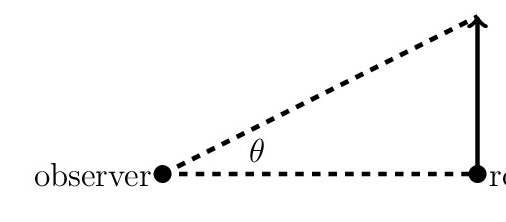
Solution: Let \(y\) be the height of the rocket above the ground. The observer is \(1000\) ft from the launch site, so the right triangle gives \[ \tan\theta=\frac{y}{1000}. \] We want the rocket's vertical velocity, which is \(\dfrac{dy}{dt}\). Differentiate both sides with respect to time: \[ \sec^2\theta\,\frac{d\theta}{dt}=\frac{1}{1000}\frac{dy}{dt}. \] Now substitute the given values. When \(\theta=\pi/6\), \[ \sec^2\left(\frac{\pi}{6}\right)=\left(\frac{2}{\sqrt3}\right)^2=\frac43. \] Also, \[ \frac{d\theta}{dt}=0.2=\frac15. \] So \[ \frac43\cdot\frac15=\frac{1}{1000}\frac{dy}{dt}. \] That is, \[ \frac{4}{15}=\frac{1}{1000}\frac{dy}{dt}. \] Multiply by \(1000\): \[ \frac{dy}{dt}=1000\cdot\frac{4}{15}=\frac{800}{3}. \] Therefore the rocket's velocity is \[ \boxed{\frac{800}{3}\text{ ft/s}}. \]
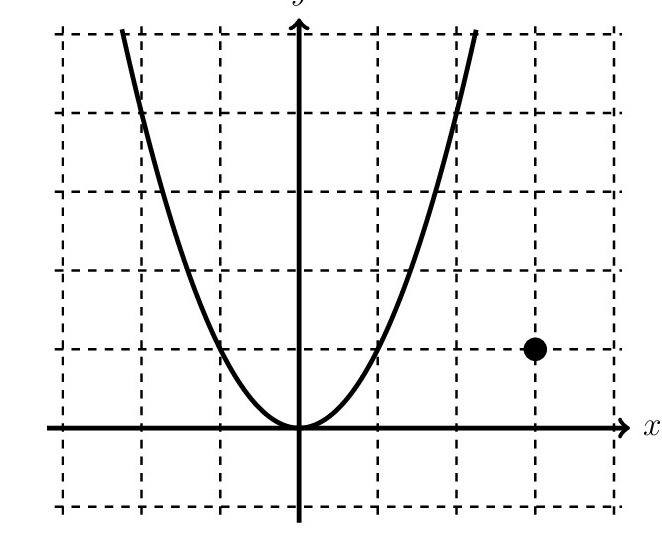
Consider the point (3, 1) and the parabola \(\displaystyle y = x^2\) graphed below. (Adjacent grid lines are one unit apart.)
- Let \(\displaystyle (x, y)\) represent a point on the parabola \(\displaystyle y = x^2\). Determine a function \(\displaystyle f(x)\) for the distance from the point \(\displaystyle (x, y)\) to the point (3, 1). Your function should include the variable \(\displaystyle x\) and can not include any other variables.
- Suppose you want to determine the closest point on the parabola to the point (3, 1). Determine an appropriate domain for the function \(\displaystyle f(x)\), and briefly explain your answer. (Do not determine the closest point.)
IMAGE
Solution:
- If the point on the parabola is \((x,x^2)\), the distance to \((3,1)\) is \(\boxed{f(x)=\sqrt{(x-3)^2+(x^2-1)^2}}\).
- A reasonable domain is all real numbers, \(\boxed{(-\infty,\infty)}\), because every real \(x\) gives a point on the parabola and therefore a valid distance.
You plan to make an open-top box with a square base; you want to construct the box to have volume 5 ft\(\displaystyle ^3\) and the minimum possible cost. The cost of the material for the base of the box is $3 per square foot, and the cost of the material for the sides of the box is $1 per square foot.
Let \(\displaystyle w\) represent the (base) width of the box, respectively. Then the cost (in dollars) of the box is
Using the function \(\displaystyle C(w)\) with domain \(\displaystyle (0, \infty)\), determine the width \(\displaystyle w\) that results in the minimum possible cost for your box. You must use calculus techniques to verify that your \(\displaystyle w\) results in the minimum possible cost.
Solution: We are given \[ C(w)=3w^2+\frac{20}{w}, \qquad w>0. \] To minimize the cost, we look for critical points of \(C\) on \((0,\infty)\). Differentiate: \[ C'(w)=6w-\frac{20}{w^2}. \] Set the derivative equal to zero: \[ 6w-\frac{20}{w^2}=0. \] Multiply by \(w^2\) (which is positive on the domain): \[ 6w^3-20=0. \] So \[ 6w^3=20 \qquad\Longrightarrow\qquad w^3=\frac{10}{3} \qquad\Longrightarrow\qquad w=\left(\frac{10}{3}\right)^{1/3}. \] Thus the only critical point in the domain is \[ \boxed{w=\left(\frac{10}{3}\right)^{1/3}\text{ ft}}. \] To verify that this critical point gives a minimum, compute the second derivative: \[ C''(w)=6+\frac{40}{w^3}. \] For every \(w>0\), both terms are positive, so \[ C''(w)>0. \] Therefore \(C\) is concave up on \((0,\infty)\), and this critical point is a minimum. Hence the width that minimizes the cost is \[ \boxed{w=\left(\frac{10}{3}\right)^{1/3}\text{ ft}}. \]