Determine the following limits. If you apply L'Hopital's rule, indicate where you have applied it and why you can apply it. If your final answer is "does not exist," \(\displaystyle \infty\), or \(\displaystyle -\infty\), briefly explain your answer. (You will not receive full credit for a "does not exist" answer if the answer is \(\displaystyle \infty\) or \(\displaystyle -\infty\).)
- \(\displaystyle \lim_{x \to 5} (4 + 7x - x^2)\)
- \(\displaystyle \lim_{x \to 0} \frac{e^{3x} - 1}{7x}\)
- \(\displaystyle \lim_{x \to \infty} \frac{7x^5 - 3x^2 + 1}{2x^5 + x^2 - 6}\)
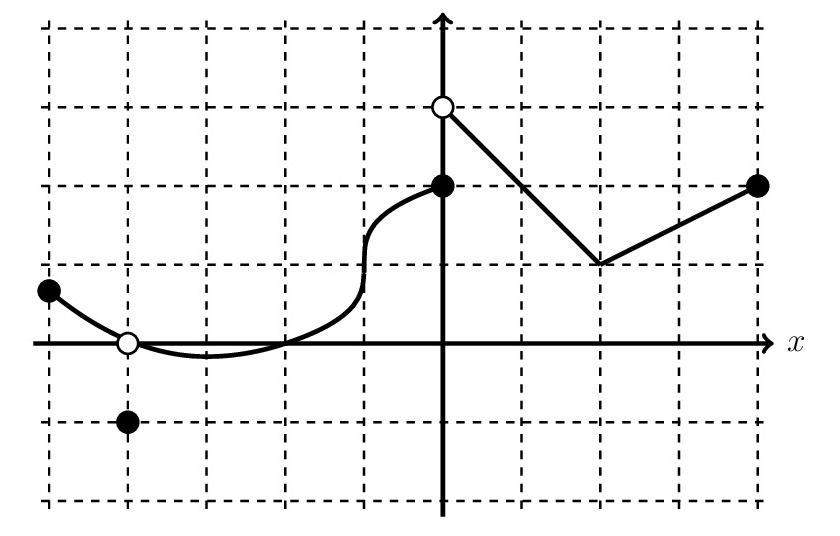
Consider the graph of \(\displaystyle y = f(x)\) given below. The grid lines are one unit apart. Based on the graph answer the following questions.
y
x
- Determine \(\displaystyle \lim_{x \to 2} f(x)\).
- Determine \(\displaystyle f(0)\).
- Determine all values of \(\displaystyle x\) in the interval \(\displaystyle (-5, 4)\) at which \(\displaystyle f(x)\) is NOT continuous. Briefly explain your thinking.
- Determine all values of \(\displaystyle x\) in the interval \(\displaystyle (-5, 4)\) at which \(\displaystyle f'(x)\) is undefined. Briefly explain your thinking.
IMAGE
(a) State the limit definition of the derivative of \(\displaystyle f(x)\).
- Use the \textbf{limit definition of the derivative} to determine the derivative of \(\displaystyle f(x) = \sqrt{8 - 3x}\). No points will be awarded for the application of differentiation rules (and L'Hopital’s rule is not allowed).
Determine the first derivative of each of the following functions. Remember to use correct notation to write your final answer.
- \(\displaystyle f(x) = e^{x^2} + \frac{5}{x^2} + \frac{x}{x+1}\)
- \(\displaystyle f(x) = (2x^5 + 3) \tan(x)\)
- \(\displaystyle f(x) = (\arcsin(3x))^2\)
- \(\displaystyle y = x^{3x^2-x}\)
Determine the following indefinite integrals.
- \(\displaystyle \int \left( \frac{6x^4 + 3x^3 - 8}{x} \right) dx\)
- \(\displaystyle \int \left( \cos(2x) - \frac{1}{1+x^2} \right) dx\)
- \(\displaystyle \int \frac{1}{\sqrt{x}(5+2\sqrt{x})^3} dx\)
Evaluate the following definite integrals.
- \(\displaystyle \int_{0}^{1} (x^3 + e^{-3x}) dx\)
- \(\displaystyle \int_{0}^{4} \sqrt{4y + 9} dy\)
- \(\displaystyle \int_{0}^{\pi/2} \frac{\sin x}{1 + \cos x} dx\)
Water is added to an empty rain barrel at a rate of \(\displaystyle 30 - 2t\) gallons per hour, starting at time \(\displaystyle t = 0\), until the tank is completely full. If the rain barrel holds 225 gallons, how long will it take to completely fill the tank?
Hint: What does \(\displaystyle 30 - 2t\) gallons per hour represent?
The surface area of a cube of ice is decreasing at a rate of \(\displaystyle 10 \ \mathrm{cm}^2/\mathrm{s}\). At what rate is the volume of the cube changing when the surface area is \(\displaystyle 24 \ \mathrm{cm}^2\)?
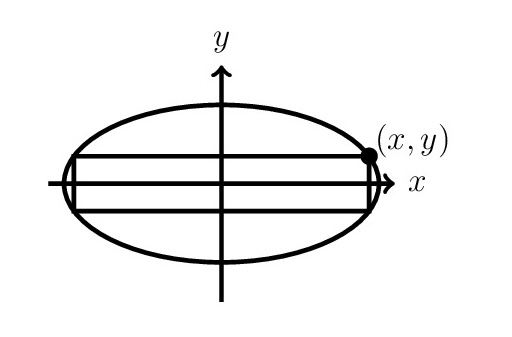
A rectangle is to be inscribed in the ellipse \(\displaystyle \frac{x^2}{4} + y^2 = 1\). (See diagram below.)
(Diagram of an ellipse with axes labeled \(\displaystyle x\) and \(\displaystyle y\), and a rectangle inscribed. The top-right corner is marked as \(\displaystyle (x, y)\).)
- Let \(\displaystyle x\) represent the \(\displaystyle x\)-coordinate of the top-right corner of the rectangle. Determine a formula \(\displaystyle A(x)\) for the area of the rectangle as a function of \(\displaystyle x\) alone. Your final answer should include the variable \(\displaystyle x\) and can not include any other variables.
- Suppose you want to determine the dimensions of the rectangle that will result in the maximum possible area. Determine an appropriate domain for \(\displaystyle A(x)\). Briefly explain your answer. (Note: We will not actually maximize \(\displaystyle A(x)\) in this problem.)
IMAGE
Suppose you want to find the dimensions (in centimeters) of the open-top cylinder with volume \(\displaystyle V = 16\pi\) cubic centimeters that has the minimum possible surface area.
The surface area of an open-top cylinder with radius \(\displaystyle r\) centimeters and height \(\displaystyle h\) centimeters is \(\displaystyle S = 2\pi rh + \pi r^2\) square centimeters. Since the volume is \(\displaystyle 16\pi\) cubic centimeters, we know that \(\displaystyle 16\pi = \pi r^2 h\).
- Determine the surface area \(\displaystyle S\) as a function of \(\displaystyle r\). (The variable \(\displaystyle h\) should not be used in your answer.)
- Determine an appropriate domain for the surface area function \(\displaystyle S\) from part (a), and explain briefly.
- Use calculus techniques to determine the value of \(\displaystyle r\) which results in the minimum possible surface area. Write a sentence, using appropriate units, to summarize your answer.