Determine the following limits; briefly explain your thinking on each one. If you apply L'Hopital's rule, indicate where you have applied it and why you can apply it. If your final answer is "does not exist," \(\displaystyle \infty\), or \(\displaystyle -\infty\), briefly explain your answer. (You will not receive full credit for a "does not exist" answer if the answer is \(\displaystyle \infty\) or \(\displaystyle -\infty\).)
- \(\displaystyle \lim_{x \to 1} \frac{x^2 - 9}{x^2 + x - 6}\)
- \(\displaystyle \lim_{x \to 2^+} \frac{x^2 - 9}{x^2 + x - 6}\)
- \(\displaystyle \lim_{p \to 0} \frac{\ln(1 + 5p) - p}{\sin(3p)}\)
- \(\displaystyle \lim_{x \to \infty} xe^{-2x}\)
Solution:
- Since the denominator is not zero at \(x=1\), we can substitute directly: \[ \frac{1^2-9}{1^2+1-6}=\frac{-8}{-4}=2. \] Therefore \[ \boxed{2}. \]
- As \(x\to2^+\), the numerator tends to \[ 2^2-9=-5, \] which is negative. The denominator factors as \[ x^2+x-6=(x+3)(x-2). \] Here \(x+3\to5^+\) and \(x-2\to0^+\), so the denominator tends to \(0^+\). A negative number divided by something very small and positive tends to \[ \boxed{-\infty}. \]
- As \(p\to0\), use the standard linear approximations \[ \ln(1+5p)\sim5p,\qquad \sin(3p)\sim3p. \] So the numerator behaves like \(5p-p=4p\), and the denominator behaves like \(3p\). Hence \[ \lim_{p\to0}\frac{\ln(1+5p)-p}{\sin(3p)}=\frac{4}{3}. \] Therefore \[ \boxed{\frac43}. \]
- We can rewrite the expression as \[ xe^{-2x}=\frac{x}{e^{2x}}. \] As \(x\to\infty\), the exponential in the denominator grows much faster than the linear term in the numerator, so the quotient goes to \(0\). Thus \[ \boxed{0}. \]
(a) State the limit definition of the derivative of \(\displaystyle f(x)\).
- Use the \textbf{limit definition of the derivative} to determine the derivative of \(\displaystyle f(x) = \frac{1}{3 - 2x}\). No points will be awarded for the application of differentiation rules (and L'Hopital's rule is not allowed).
Solution:
- The limit definition of the derivative is \[ f'(x)=\lim_{h\to0}\frac{f(x+h)-f(x)}{h}, \] provided the limit exists.
- For \[ f(x)=\frac{1}{3-2x}, \] the difference quotient is \[ \frac{f(x+h)-f(x)}{h} =\frac{\frac1{3-2x-2h}-\frac1{3-2x}}{h}. \] Combine the fractions in the numerator: \[ \frac{(3-2x)-(3-2x-2h)}{h(3-2x-2h)(3-2x)} =\frac{2h}{h(3-2x-2h)(3-2x)}. \] Cancel \(h\): \[ \frac{2}{(3-2x-2h)(3-2x)}. \] Now let \(h\to0\): \[ f'(x)=\lim_{h\to0}\frac{2}{(3-2x-2h)(3-2x)} =\frac{2}{(3-2x)^2}. \] Therefore \[ \boxed{f'(x)=\frac{2}{(3-2x)^2}}. \]
Determine the first derivative of each of the following functions. Remember to use correct notation to write your final answer.
- \(\displaystyle f(x) = x^2 - \sin(x)\cos(x)\)
- \(\displaystyle g(t) = \arctan(\ln(t))\)
- \(\displaystyle h(x) = \frac{e^{3x}}{x+1}\)
Solution:
- \(\displaystyle \frac{d}{dx}\bigl(x^2-\sin x\cos x\bigr)=2x-(\cos^2x-\sin^2x)=\boxed{2x-\cos(2x)}\).
- By the chain rule, \[ \frac{d}{dt}\arctan(\ln t)=\boxed{\frac{1}{t\bigl(1+(\ln t)^2\bigr)}}. \]
- Using the quotient rule, \[ \frac{d}{dx}\left(\frac{e^{3x}}{x+1}\right)=\frac{3e^{3x}(x+1)-e^{3x}}{(x+1)^2}=\boxed{\frac{e^{3x}(3x+2)}{(x+1)^2}}. \]
Determine the \textbf{second derivative} of the function
Solution: First differentiate once: \[ f'(t)=6t-\frac{1}{2\sqrt t}. \] Differentiating again gives \[ f''(t)=6+\frac{1}{4t^{3/2}}. \] Therefore the second derivative is \(\boxed{6+\dfrac{1}{4t^{3/2}}}\).
Determine the following indefinite integrals.
- \(\displaystyle \int \left( x^3 - 5x + 7 \right) dx\)
- \(\displaystyle \int \frac{\left( \ln(x) + 4 \right)^{10}}{x} dx\)
- \(\displaystyle \int \frac{\sin(t)}{1 - 2\cos(t)} dt\)
Solution:
- \(\displaystyle \int(x^3-5x+7)dx=\boxed{\frac{x^4}{4}-\frac{5x^2}{2}+7x+C}\).
- Let \(u=\ln x+4\). Then \(du=dx/x\), so \(\displaystyle \int\frac{(\ln x+4)^{10}}{x}dx=\boxed{\frac{(\ln x+4)^{11}}{11}+C}\).
- Let \(u=1-2\cos t\). Then \(du=2\sin t\,dt\), hence \[ \int\frac{\sin t}{1-2\cos t}dt=\frac12\int\frac{du}{u}=\boxed{\frac12\ln|1-2\cos t|+C}. \]
Evaluate the following definite integrals.
- \(\displaystyle \int_{0}^{1} \left( e^{x} - \frac{3}{1 + x^{2}} \right) dx\)
- \(\displaystyle \int_{0}^{3} f(x) dx\), where \(\displaystyle f(x)\) is the function given by \(f(x) = \begin{cases}
\sin(x) & 0 \leq x < \frac{\pi}{2} \\
1 & \frac{\pi}{2} \leq x \leq 3
\end{cases}\)
Solution:
- Use the Fundamental Theorem of Calculus term by term: \[ \int_0^1\left(e^x-\frac{3}{1+x^2}\right)dx =\int_0^1 e^x\,dx-3\int_0^1\frac{1}{1+x^2}\,dx. \] Compute each piece: \[ \int_0^1 e^x\,dx=\bigl[e^x\bigr]_0^1=e-1, \] and \[ \int_0^1\frac{1}{1+x^2}\,dx=\bigl[\arctan x\bigr]_0^1=\frac{\pi}{4}. \] Therefore \[ \int_0^1\left(e^x-\frac{3}{1+x^2}\right)dx=e-1-\frac{3\pi}{4}. \] So the value is \[ \boxed{e-1-\frac{3\pi}{4}}. \]
- From the piecewise definition, \(f(x)=\sin x\) on \([0,\pi/2)\) and \(f(x)=1\) on \([\pi/2,3]\). So we split the integral at \(\pi/2\): \[ \int_0^3 f(x)\,dx=\int_0^{\pi/2}\sin x\,dx+\int_{\pi/2}^{3}1\,dx. \] Now evaluate: \[ \int_0^{\pi/2}\sin x\,dx=\bigl[-\cos x\bigr]_0^{\pi/2}=1, \] and \[ \int_{\pi/2}^{3}1\,dx=3-\frac{\pi}{2}. \] Adding the two pieces gives \[ \int_0^3 f(x)\,dx=1+\left(3-\frac{\pi}{2}\right)=4-\frac{\pi}{2}. \] Hence \[ \boxed{4-\frac{\pi}{2}}. \]
Use calculus techniques to determine the \(\displaystyle x\)-coordinates of the local (relative) extrema for the function below. Be sure to label each extremum as a local (relative) maximum or as a local (relative) minimum.
Solution: Differentiate: \[ f'(x)=6x^5-12x^2=6x^2(x^3-2). \] The critical points are \(x=0\) and \(x=\sqrt[3]{2}\). Since the factor \(x^2\) does not change sign at \(0\), that point is not a local extremum. The sign of \(x^3-2\) changes from negative to positive at \(x=\sqrt[3]{2}\), so \(f\) has a local minimum there. Thus the only local extremum is a \(\boxed{\text{local minimum at }x=\sqrt[3]{2}}\); there is no local maximum.
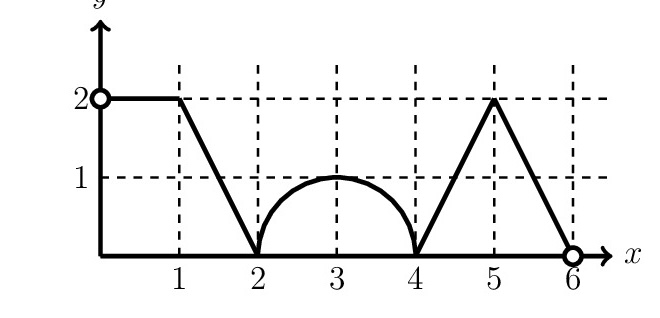
The graph of \(\displaystyle y = f(x)\) is given below and consists of line segments and circle arcs. The domain of \(\displaystyle f\) is \(\displaystyle (0,6)\).
[Graph of y = f(x) as described in the problem, with labeled axes, intervals, and the function drawn.]
- Determine all values of \(\displaystyle x\) in \(\displaystyle (0,6)\) for which \(\displaystyle f'(x) > 0\). Write your answer using interval notation.
- Determine all values of \(\displaystyle x\) in \(\displaystyle (0,6)\) for which \(\displaystyle f'(x)\) is undefined.
- Estimate \(\displaystyle f'(1.5)\).
- Determine whether \(\displaystyle f''(3)\) is positive, negative, or zero. (Write “positive,” “negative,” or “zero.” No explanation is needed.)
- Determine \(\displaystyle \int_0^6 f(x)dx\).
IMAGE
Solution:
- The graph rises on the left half of the semicircle and on the rising line segment from \(x=4\) to \(x=5\). Hence \(f'(x)>0\) on \(\boxed{(2,3)\cup(4,5)}\).
- The derivative is undefined at the corners and sharp transitions, namely \(\boxed{x=1,2,4,5}\).
- At \(x=1.5\), the graph lies on the line joining \((1,2)\) to \((2,0)\), whose slope is \(\dfrac{0-2}{2-1}=-2\). So \(\boxed{f'(1.5)=-2}\).
- At \(x=3\), the curve is the top of an upper semicircle, so it is concave down there. Hence \(\boxed{f''(3)\text{ is negative}}\).
- The integral is the total area under the graph: a rectangle of area \(2\) from \(0\) to \(1\), two triangles of area \(1\) each on \([1,2]\), \([4,5]\), and \([5,6]\), and a semicircle of radius \(1\) with area \(\pi/2\). Therefore \[ \int_0^6 f(x)dx=2+1+\frac{\pi}{2}+1+1=\boxed{5+\frac{\pi}{2}}. \]
Determine all values of \(\displaystyle c\) for which the function below is continuous on \(\displaystyle (-\infty, \infty)\). Use the limit definition of continuity to explain your answer.
IMAGE
Solution: The only possible issue for continuity is at \(x=3\), because each branch is continuous on its own interval.
To be continuous at \(x=3\), we need three things: \[ \lim_{x\to3}f(x)\text{ exists},\qquad f(3)\text{ is defined},\qquad \lim_{x\to3}f(x)=f(3). \] First, using the middle branch, \[ f(3)=3-3=0. \] Next, compute the one-sided limits. From the left branch, \[ \lim_{x\to3^-}(9-x^2)=9-9=0. \] From the right branch, the function is the constant \(c\), so \[ \lim_{x\to3^+}f(x)=c. \] For the two-sided limit to exist and equal \(f(3)\), we must have \[ 0=c=0. \] Therefore the function is continuous exactly when \[ \boxed{c=0}. \]
Karina and Juan both leave an intersection at the same time, both driving on long, straight roads. Karina drives north at a speed of 50 miles per hour, and Juan drives east at 60 miles per hour. When 1.5 hours have elapsed since they left the intersection, how fast is the distance between Karina and Juan changing? Use calculus to justify your answer.
Solution: Let \(x\) be Juan’s eastward distance, \(y\) be Karina’s northward distance, and \(z\) be the distance between them. Since Juan drives east at \(60\) mph and Karina drives north at \(50\) mph, \[ x=60t,\qquad y=50t. \] Their distances form the legs of a right triangle, so the separation satisfies \[ z^2=x^2+y^2. \] Differentiate with respect to time: \[ 2z\frac{dz}{dt}=2x\frac{dx}{dt}+2y\frac{dy}{dt}. \] At \(t=1.5\), we have \[ x=60(1.5)=90,\qquad y=50(1.5)=75, \] and \[ z=\sqrt{90^2+75^2}=15\sqrt{61}. \] Also, \[ \frac{dx}{dt}=60,\qquad \frac{dy}{dt}=50. \] So \[ \frac{dz}{dt}=\frac{90\cdot60+75\cdot50}{15\sqrt{61}}=\frac{610}{\sqrt{61}}\approx\boxed{78.1\text{ mph}}. \] Thus the distance between Karina and Juan is increasing at approximately \(78.1\) miles per hour after \(1.5\) hours.
You plan to make a rectangular box having an open top. Each face of the box is a rectangle, and the top face of the box is missing so that the box is open. For the base of the box, you want the length to be twice the width; you also want the total surface area of the resulting box to be 200 square inches.
- Let \(\displaystyle w\) represent the width of the box in inches. Determine a formula \(\displaystyle V(w)\) for the total volume of the box as a function of \(\displaystyle w\) alone. Your final answer should include the variable \(\displaystyle w\) and can not include any other variables.
- Suppose you want to determine the dimensions of the box that will result in the maximum possible volume. Determine an appropriate domain for \(\displaystyle V(w)\). Briefly explain your answer. (Note: We will not actually maximize \(\displaystyle V(w)\) in this problem.)
Solution:
- Let the width be \(w\), the length be \(2w\), and the height be \(h\). Since the box is open, the surface area is \[ 2w^2+2(2wh)+2(wh)=2w^2+6wh=200. \] Thus \(h=\dfrac{100-w^2}{3w}\). The volume is \[ V(w)=2w^2h=2w^2\cdot\frac{100-w^2}{3w}=\boxed{\frac{2w(100-w^2)}{3}}. \]
- We need \(w>0\) and \(h>0\). Since \(h=\dfrac{100-w^2}{3w}\), the second condition gives \(100-w^2>0\). Hence an appropriate domain is \(\boxed{0<w<10}\).
Suppose you run a factory that processes raw materials in two possible ways.
Using method A, you can process \(\displaystyle x\) tons of material at a cost of \(\displaystyle x^2\) dollars.
Using method B, you can process \(\displaystyle y\) tons of material at a cost of \(\displaystyle 10y\) dollars.
You want to process a total of 200 tons of material, so your process is constrained by the equation \(\displaystyle x + y = 200\). The overall cost (in dollars) of processing the two materials is
You can process a partial ton of material using each method, so \(\displaystyle x\) and \(\displaystyle y\) do not have to be whole numbers. You plan to minimize the overall cost.
- Determine the overall cost \(\displaystyle C\) \(\displaystyle \textbf{as a function of } x\). (The variable \(\displaystyle y\) should not be used in your answer.)
- Determine an appropriate domain for your cost function \(\displaystyle C\) from part (a), and explain briefly.
[This problem continues on the next page.]
[Problem 15, continued]
- Use calculus techniques to determine the value of \(\displaystyle x\) which results in the minimum overall cost. Write a sentence, using appropriate units, to summarize your answer.
Solution:
- Since \(x+y=200\), we have \(y=200-x\). Substitute into the cost: \[ C(x)=x^2+10(200-x)=\boxed{x^2-10x+2000}. \]
- Because both amounts processed must be nonnegative, we need \(0\le x\le200\). So a natural domain is \(\boxed{[0,200]}\).
- Differentiate: \(C'(x)=2x-10\). Setting \(C'(x)=0\) gives \(x=5\). Since \(C''(x)=2>0\), this critical point gives the minimum. Therefore the minimum cost occurs when the factory processes \(\boxed{5\text{ tons by method A and }195\text{ tons by method B}}\).