Determine the following limits; briefly explain your thinking on each one. If you apply L'Hopital's rule, indicate where you have applied it and why you can apply it. If your final answer is "does not exist," \(\displaystyle \infty\), or \(\displaystyle -\infty\), briefly explain your answer. (You will not receive full credit for a "does not exist" answer if the answer is \(\displaystyle \infty\) or \(\displaystyle -\infty\).)
Please circle your final answer.**
- \(\displaystyle \lim_{x \to 0} \frac{e^{2x} - 2}{e^x + 1}\)
- \(\displaystyle \lim_{x \to 3^-} \frac{x^2 + 7}{x - 3}\)
- \(\displaystyle \lim_{x \to \pi / 2} \frac{\cos(x)}{x - \frac{\pi}{2}}\)
- \(\displaystyle \lim_{x \to \infty} \frac{3x^2(x-1)}{x^2 - 2}\)
Solution:
- The numerator and denominator are continuous at \(x=0\), and the denominator is not zero there because \(e^0+1=2\). So direct substitution is valid: \[ \lim_{x\to0}\frac{e^{2x}-2}{e^x+1}=\frac{e^0-2}{e^0+1}=\frac{1-2}{1+1}=-\frac12. \] Thus the limit is \(\boxed{-\dfrac12}\).
- As \(x\to3^-\), the numerator \(x^2+7\) tends to \(16\), which is positive. The denominator \(x-3\) tends to \(0\) through negative values because we approach \(3\) from the left. Therefore the quotient is a positive number divided by a very small negative number, so it decreases without bound: \[ \lim_{x\to3^-}\frac{x^2+7}{x-3}=\boxed{-\infty}. \]
- As \(x\to\pi/2\), both numerator and denominator tend to \(0\), so we may apply L'Hospital's Rule. Differentiating numerator and denominator gives \[ \lim_{x\to\pi/2}\frac{\cos x}{x-\pi/2} =\lim_{x\to\pi/2}\frac{-\sin x}{1} =-\sin\left(\frac{\pi}{2}\right) =-1. \] Hence the limit is \(\boxed{-1}\).
- Expand the leading behavior: \[ 3x^2(x-1)=3x^3-3x^2. \] So for large \(x\), the numerator behaves like \(3x^3\), while the denominator \(x^2-2\) behaves like \(x^2\). Therefore the quotient behaves like \[ \frac{3x^3}{x^2}=3x, \] and \(3x\to+\infty\) as \(x\to\infty\). Thus \[ \lim_{x\to\infty}\frac{3x^2(x-1)}{x^2-2}=\boxed{+\infty}. \]
(a) State the limit definition of the derivative of \(\displaystyle f(x)\).
- Use the limit definition of the derivative to determine the derivative of \(\displaystyle f(x) = \sqrt{x-3}\). No points will be awarded for the application of differentiation rules (and L’Hopital’s rule is not allowed).
Solution:
- The limit definition of the derivative is \[ f'(x)=\lim_{h\to0}\frac{f(x+h)-f(x)}{h}, \] provided the limit exists.
- For \(f(x)=\sqrt{x-3}\), we begin with the definition: \[ f'(x)=\lim_{h\to0}\frac{\sqrt{x+h-3}-\sqrt{x-3}}{h}. \] To simplify this quotient, multiply numerator and denominator by the conjugate: \[ \frac{\sqrt{x+h-3}-\sqrt{x-3}}{h}\cdot \frac{\sqrt{x+h-3}+\sqrt{x-3}}{\sqrt{x+h-3}+\sqrt{x-3}}. \] Using \((A-B)(A+B)=A^2-B^2\), the numerator becomes \[ (x+h-3)-(x-3)=h. \] So for \(h\neq0\), \[ \frac{\sqrt{x+h-3}-\sqrt{x-3}}{h} =\frac{h}{h\bigl(\sqrt{x+h-3}+\sqrt{x-3}\bigr)} =\frac{1}{\sqrt{x+h-3}+\sqrt{x-3}}. \] Now let \(h\to0\): \[ f'(x)=\lim_{h\to0}\frac{1}{\sqrt{x+h-3}+\sqrt{x-3}} =\frac{1}{2\sqrt{x-3}}. \] Therefore \[ \boxed{f'(x)=\dfrac{1}{2\sqrt{x-3}}}. \]
Determine the first derivative of each of the following functions. Remember to use correct notation to write your final answer. Please circle your final answer.
- \(\displaystyle f(x) = \frac{x^3}{4} - \frac{2}{x^3} + \pi^2\)
- \(\displaystyle f(x) = \left( \arctan(x) \right)^3\)
- \(\displaystyle f(x) = e^{\sqrt{x} \cos(x)}\)
- \(\displaystyle f(x) = x^{1/x}\)
Solution:
- \(\displaystyle \frac{d}{dx}\left(\frac{x^3}{4}-\frac{2}{x^3}+\pi^2\right)=\frac{3x^2}{4}+\frac{6}{x^4}\).
- By the chain rule, \(\displaystyle \frac{d}{dx}(\arctan x)^3=\boxed{\frac{3(\arctan x)^2}{1+x^2}}\).
- If \(u(x)=\sqrt{x}\cos x\), then \((e^{u(x)})'=e^{u(x)}u'(x)\), with \(u'(x)=\dfrac{\cos x}{2\sqrt{x}}-\sqrt{x}\sin x\). Thus \(\displaystyle f'(x)=\boxed{e^{\sqrt{x}\cos x}\left(\frac{\cos x}{2\sqrt{x}}-\sqrt{x}\sin x\right)}\).
- Let \(y=x^{1/x}\). Then \(\ln y=\dfrac{\ln x}{x}\). Differentiating gives \(\dfrac{y'}{y}=\dfrac{1-\ln x}{x^2}\). Hence \(\displaystyle y'=\boxed{x^{1/x}\frac{1-\ln x}{x^2}}\).
Consider the curve defined by the equation
The graph of the curve is provided to the right.
The graph of the curve is provided to the right.
- Determine \(\displaystyle \frac{dy}{dx}\).
- Determine an equation of the line tangent to the curve at the point \(\displaystyle (x, y) = (\sqrt{5}, 1)\).
IMAGE
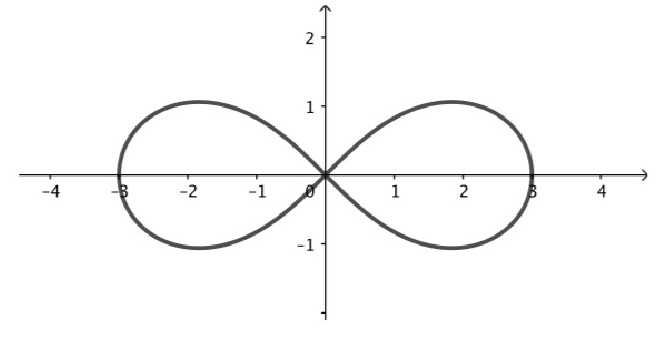
Solution:
- Differentiate implicitly: \[ 2(x^2+y^2)(2x+2yy')=9(2x-2yy'). \] After collecting the \(y'\)-terms, we obtain \[ y'\bigl(4y(x^2+y^2)+18y\bigr)=18x-4x(x^2+y^2). \] So \[ \frac{dy}{dx}=\boxed{\frac{x\bigl(18-4(x^2+y^2)\bigr)}{y\bigl(4(x^2+y^2)+18\bigr)}}. \]
- At \((\sqrt5,1)\), we have \(x^2+y^2=6\). Therefore \[ \frac{dy}{dx}=\frac{\sqrt5(18-24)}{4\cdot6+18}=-\frac{\sqrt5}{7}. \] Hence the tangent line is \[ \boxed{y-1=-\frac{\sqrt5}{7}(x-\sqrt5)}. \]
Determine the following indefinite integrals. **Please circle your final answer**.
- \(\displaystyle \int (\cos(5x) + 1) dx\)
- \(\displaystyle \int \left( \frac{1}{\sqrt{1-x^2}} + \frac{1}{e^x} \right) dx\)
- \(\displaystyle \int \frac{3}{x (\ln(x))^2} dx\)
Solution:
- \(\displaystyle \int(\cos 5x+1)\,dx=\boxed{\frac15\sin(5x)+x+C}\).
- \(\displaystyle \int\left(\frac1{\sqrt{1-x^2}}+e^{-x}\right)dx=\boxed{\arcsin x-e^{-x}+C}\).
- Set \(u=\ln x\), so \(du=dx/x\). Then \(\displaystyle \int\frac{3}{x(\ln x)^2}dx=3\int u^{-2}\,du=\boxed{-\frac{3}{\ln x}+C}\).
Evaluate the following definite integrals. \textbf{Please circle your final answer}.
Solution:
- \(\displaystyle \int_0^1(2x^2+3x+5)dx=\left[\frac{2x^3}{3}+\frac{3x^2}{2}+5x\right]_0^1=\boxed{\frac{43}{6}}\).
- Use \(u=x^2+1\), so \(du=2x\,dx\). Then \[ \int_1^2\frac{x}{(x^2+1)^{1/3}}dx=\frac12\int_2^5u^{-1/3}du=\frac34\Bigl(5^{2/3}-2^{2/3}\Bigr). \] Thus the value is \(\boxed{\frac34(5^{2/3}-2^{2/3})}\).
- Let \(u=1+e^{2x}\), so \(du=2e^{2x}dx\). Then \[ \int_0^{1/2}\frac{e^{2x}}{1+e^{2x}}dx=\frac12\int_2^{1+e}\frac{1}{u}du=\boxed{\frac12\ln\left(\frac{1+e}{2}\right)}. \]
For this problem, consider the function \(\displaystyle f(x) = |x-3|\).
Solution:
- Here \(\Delta x=\dfrac45\), and the left endpoints are \(0,\dfrac45,\dfrac85,\dfrac{12}5,\dfrac{16}5\). The corresponding function values are \(3,\dfrac{11}5,\dfrac75,\dfrac35,\dfrac15\). Thus the left Riemann sum is \[ \frac45\left(3+\frac{11}5+\frac75+\frac35+\frac15\right)=\boxed{\frac{148}{25}}. \]
- The exact integral is an area computation. From \(0\) to \(3\) we have a triangle of base \(3\) and height \(3\), area \(\dfrac92\). From \(3\) to \(4\) we have a triangle of base \(1\) and height \(1\), area \(\dfrac12\). Hence \[ \int_0^4|x-3|dx=\boxed{5}. \]
Use calculus to determine the absolute maximum and absolute minimum values of the function below on the interval \(\displaystyle [-10, 1]\):
Solution: We compute \[ f'(x)=\frac{(x^2+9)-2x^2}{(x^2+9)^2}=\frac{9-x^2}{(x^2+9)^2}. \] The critical points are \(x=\pm3\). On the interval \([-10,1]\), the relevant candidates are \(x=-10,-3,1\). We evaluate: \[ f(-10)=-\frac{10}{109},\qquad f(-3)=-\frac16,\qquad f(1)=\frac1{10}. \] Therefore the absolute minimum is \(\boxed{-\frac16}\) at \(x=-3\), and the absolute maximum is \(\boxed{\frac1{10}}\) at \(x=1\).
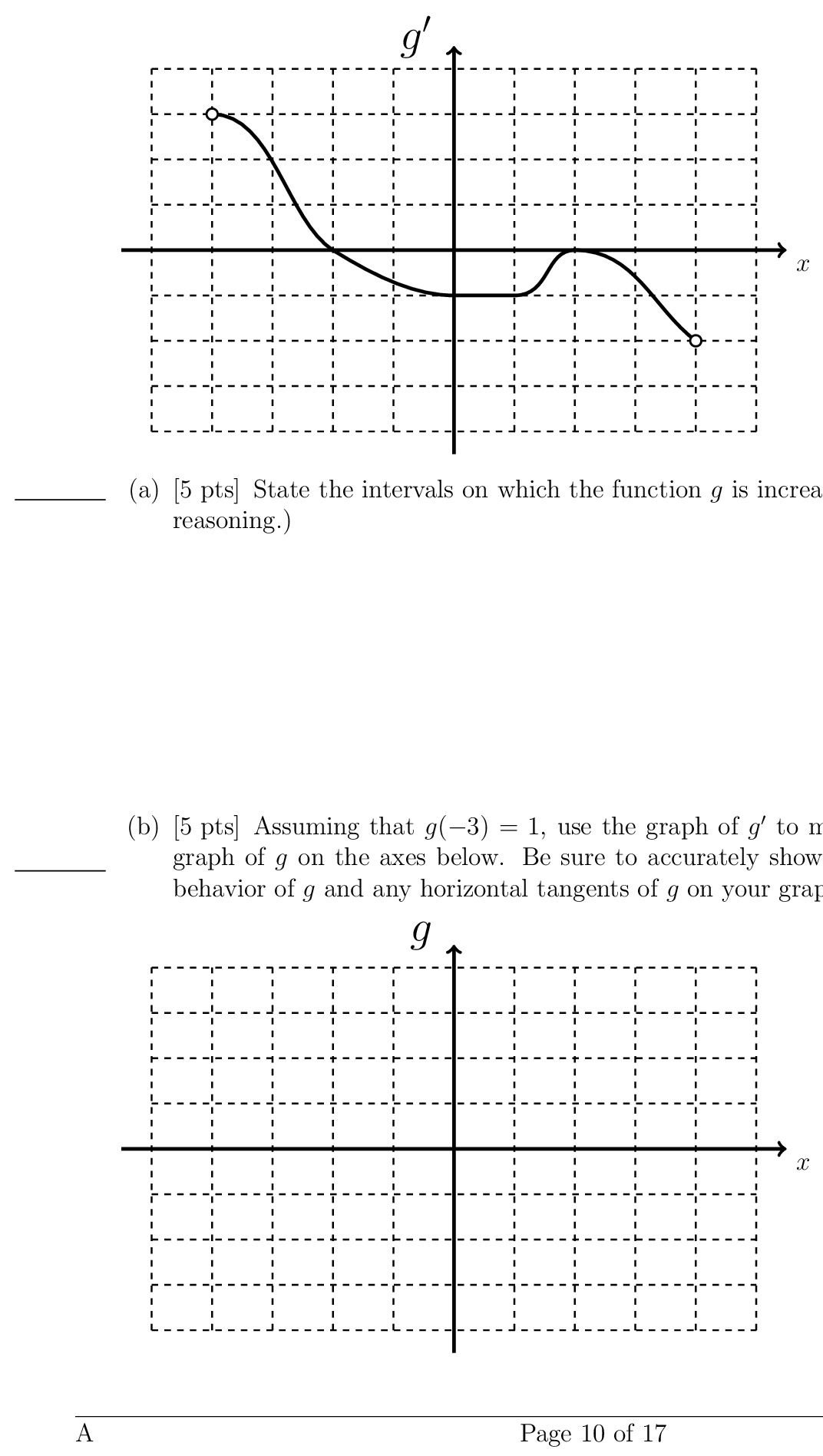
The graph of \(\displaystyle y = g'(x)\), the derivative of \(\displaystyle g\), is given below. Consecutive grid lines are one unit apart.
This is the graph of \(\displaystyle g'\).
- State the intervals on which the function \(\displaystyle g\) is increasing. (Briefly explain your reasoning.)
- Assuming that \(\displaystyle g(-3) = 1\), use the graph of \(\displaystyle g'\) to make a rough sketch of the graph of \(\displaystyle g\) on the axes below. Be sure to accurately show the increasing/decreasing behavior of \(\displaystyle g\) and any horizontal tangents of \(\displaystyle g\) on your graph.
IMAGE
Solution:
- The function \(g\) is increasing where \(g'(x)>0\), that is, where the graph of \(g'\) lies above the x-axis. From the picture this happens approximately on \(\boxed{(-4,-2)\cup(2,3)}\).
- To sketch \(g\), start at the given point \((-3,1)\). Since \(g'\) is positive just to the right of \(-3\), the graph rises at first; when \(g'\) becomes negative, the graph must turn and decrease; when \(g'\) becomes positive again near \(x=2\), the graph rises once more; and when \(g'\) turns negative again, the graph falls. Horizontal tangents occur where \(g'=0\), namely near \(x=-2\), \(x=2\), and near the right-hand zero of the graph.
On the axes below, sketch the graph of a function \(\displaystyle f\) having the following properties.
(Consecutive grid lines are one unit apart.)
The domain of \(\displaystyle f\) is \(\displaystyle (-\infty, \infty)\).
\(\displaystyle f(-2) = 4\)
The line \(\displaystyle y = 1\) is a horizontal asymptote.
(Cartesian axes and grid provided for sketching the graph)
IMAGE
Solution: A correct sketch must satisfy all the stated conditions at once: a hole-like behavior near \(x=-2\) with \(f(-2)=4\) but \(\lim_{x\to-2}f(x)=-3\), a vertical blow-up as \(x\to2\), a horizontal asymptote \(y=1\), and \(f(x)\to0\) as \(x\to\infty\). In particular, the branch near \(x=2\) must shoot upward, and the far-right part of the graph must approach the x-axis, while another part approaches \(y=1\). Any sketch exhibiting all of these features earns full credit.
Suppose \(\displaystyle f\) and \(\displaystyle g\) are continuous on \(\displaystyle [0, 5]\); some values of \(\displaystyle f(x)\), \(\displaystyle f'(x)\), \(\displaystyle g(x)\), and \(\displaystyle g'(x)\) are given in the table below.
- Let \(\displaystyle h(x) = f(x)g(x)\). Determine \(\displaystyle h'(2)\).
- Determine the linearization \(\displaystyle L(x)\) of \(\displaystyle h(x) = f(x)g(x)\) at \(\displaystyle x = 2\).
- For the function \(\displaystyle h(x) = f(x)g(x)\), use the linearization to approximate the value of \(\displaystyle h(2.1)\).
Solution:
- Since \(h(x)=f(x)g(x)\), we use the product rule: \[ h'(x)=f'(x)g(x)+f(x)g'(x). \] Now evaluate at \(x=2\). From the table, \[ f'(2)=-1,\qquad g(2)=-3,\qquad f(2)=5,\qquad g'(2)=2. \] Therefore \[ h'(2)=(-1)(-3)+5(2)=3+10=13. \] So \(\boxed{h'(2)=13}\).
- The linearization of \(h\) at \(x=2\) is \[ L(x)=h(2)+h'(2)(x-2). \] We already know \(h'(2)=13\). To find \(h(2)\), use the definition of \(h\): \[ h(2)=f(2)g(2)=5(-3)=-15. \] Substitute into the linearization formula: \[ L(x)=-15+13(x-2). \] Thus \[ \boxed{L(x)=-15+13(x-2)}. \]
- To estimate \(h(2.1)\), replace \(h\) by its linearization near \(x=2\): \[ h(2.1)\approx L(2.1). \] Now compute: \[ L(2.1)=-15+13(2.1-2)=-15+13(0.1)=-15+1.3=-13.7. \] Therefore \[ \boxed{h(2.1)\approx -13.7}. \]
A particle moves along a straight line with position function \(\displaystyle s(t) = \frac{15 t^2}{2} - t^3\), for \(\displaystyle t > 0\), where \(\displaystyle s\) is in feet and \(\displaystyle t\) is in seconds.
- Determine the velocity of the particle when the acceleration is zero.
- On the interval \(\displaystyle (0, \infty)\), when is the particle moving in the positive direction? In the negative direction?
- Determine all local (relative) extrema of the position function on the interval \(\displaystyle (0, \infty)\). (You may use any relevant work from previous parts.)
- Determine \(\displaystyle \frac{d}{dt} \left( \int_{1}^{t} s(u) du \right)\).
Solution:
- The velocity is the derivative of the position: \[ v(t)=s'(t)=15t-3t^2. \] The acceleration is the derivative of the velocity: \[ a(t)=v'(t)=15-6t. \] We are asked for the velocity when the acceleration is zero, so solve \[ 15-6t=0 \quad\Longrightarrow\quad t=\frac52. \] Now evaluate the velocity at this time: \[ v\left(\frac52\right)=15\cdot\frac52-3\left(\frac52\right)^2 =\frac{75}{2}-\frac{75}{4} =\frac{75}{4}. \] Therefore the velocity is \(\boxed{\dfrac{75}{4}\text{ ft/s}}\).
- The particle moves in the positive direction when \(v(t)>0\), and in the negative direction when \(v(t)<0\). Factor the velocity: \[ v(t)=15t-3t^2=3t(5-t). \] Since \(t>0\), the factor \(3t\) is positive. Therefore the sign of \(v(t)\) is determined by \(5-t\). So \[ v(t)>0 \text{ for } 0<t<5, \qquad v(t)<0 \text{ for } t>5. \] Hence the particle moves in the positive direction on \(\boxed{(0,5)}\) and in the negative direction on \(\boxed{(5,\infty)}\).
- Local extrema of the position occur at critical times, that is, where \(s'(t)=v(t)=0\) or where \(v\) is undefined. Here \[ v(t)=3t(5-t), \] so the zeros are \(t=0\) and \(t=5\). On the interval \((0,\infty)\), the interior critical time is \(t=5\). From part (b), \(v(t)\) changes from positive to negative at \(t=5\), so \(s(t)\) changes from increasing to decreasing there. Therefore \(s\) has a local maximum at \(t=5\). Its value is \[ s(5)=\frac{15(25)}{2}-125=\frac{375}{2}-125=\frac{125}{2}. \] Thus the only local extremum on \((0,\infty)\) is a local maximum \(\boxed{\dfrac{125}{2}}\) at \(\boxed{t=5}\).
- Let \[ F(t)=\int_1^t s(u)\,du. \] By the Fundamental Theorem of Calculus, if the integrand is continuous, then \[ F'(t)=s(t). \] Therefore \[ \frac{d}{dt}\left(\int_1^t s(u)\,du\right)=\boxed{s(t)}. \]
According to one model, the average global temperature \(\displaystyle x\) of the earth (in degrees Celsius) is related to the atmospheric concentration \(\displaystyle y\) of carbon dioxide (in parts per million, or ppm) by the equation
When the global temperature is 15 degrees Celsius and the concentration of carbon dioxide is increasing at a rate of 5 ppm/year, determine the rate of change of the global temperature with respect to time.
Solution: Differentiate the model with respect to time: \[ (2x+30)\frac{dx}{dt}=140\cdot\frac{1}{2\sqrt y}\frac{dy}{dt}=\frac{70}{\sqrt y}\frac{dy}{dt}. \] At the instant in question, \(x=15\), so first solve for \(y\): \[ 15^2+30(15)+2125=2800=140\sqrt y\implies \sqrt y=20. \] Hence \(y=400\). Now substitute \(x=15\), \(\sqrt y=20\), and \(dy/dt=5\): \[ 60\frac{dx}{dt}=\frac{70}{20}\cdot5=\frac{35}{2}. \] Therefore \[ \boxed{\frac{dx}{dt}=\frac{7}{24}\text{ degrees Celsius per year}}. \]
You plan to build a box with a square base and no lid. The material for the base of the box costs $0.20 per square foot and the material for the sides costs $0.05 per square foot. You can spend at most $5.40 total on the materials for the box. You want to use these materials to construct the box of maximum possible volume which is within your budget.
- Let \(\displaystyle x\) be the length, in feet, of each of the sides of the square base. Determine a formula for the function \(\displaystyle V(x)\) representing the volume of the box having base dimension \(\displaystyle x\) feet. Your final answer \(\displaystyle V(x)\) should include the variable \(\displaystyle x\) and may not include any other variables.
- Determine an appropriate domain for \(\displaystyle V(x)\). Briefly explain your answer. (Note: There may be more than one correct answer; choose one domain you believe is a reasonable choice, and explain your thinking.)
Solution:
- Let \(x\) be the side length of the square base and \(h\) the height of the box. Then the volume is \[ V=x^2h. \] We must use the cost condition to eliminate \(h\). The base has area \(x^2\), and its material costs \$0.20 per square foot, so the base costs \[ 0.20x^2. \] Each side has area \(xh\), and there are four sides. Since the sides cost \$0.05 per square foot, the total side cost is \[ 0.05(4xh)=0.20xh. \] The total amount available is \$5.40, so \[ 0.20x^2+0.20xh=5.40. \] Divide by \(0.20\): \[ x^2+xh=27. \] Now solve for \(h\): \[ xh=27-x^2 \qquad\Longrightarrow\qquad h=\frac{27-x^2}{x}=\frac{27}{x}-x. \] Substitute this into the volume formula: \[ V(x)=x^2\left(\frac{27}{x}-x\right)=27x-x^3. \] Therefore \[ \boxed{V(x)=27x-x^3}. \]
- A physical box requires positive dimensions. First, since \(x\) is a side length, we need \[ x>0. \] Second, the height must be positive: \[ h=\frac{27}{x}-x>0. \] Because \(x>0\), we may multiply through by \(x\) without changing the inequality: \[ 27-x^2>0 \qquad\Longrightarrow\qquad x^2<27. \] Thus \[ 0<x<3\sqrt3. \] So an appropriate domain is \[ \boxed{(0,3\sqrt3)}. \] On this interval, both the base width and the height are positive.
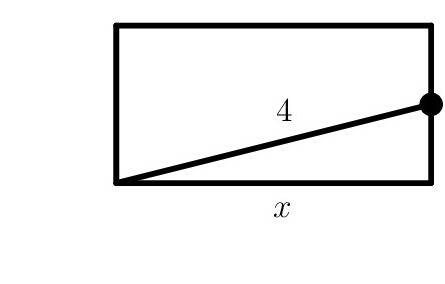
A rectangle with base \(\displaystyle x\) units has a segment of length 4 cm joining one vertex to the midpoint \(\displaystyle M\) of an opposite side, as shown in the diagram below. The area \(\displaystyle A(x)\) of the rectangle is given by the function \(\displaystyle A(x) = 2x\sqrt{16 - x^2}\).
[Diagram of a rectangle with a base labeled \(\displaystyle x\), and a diagonal segment of length 4 from one vertex to the midpoint \(\displaystyle M\) of the opposite side.]
- Determine an appropriate domain for the function \(\displaystyle A(x)\). Briefly explain your answer.
- Determine the maximum possible area of the rectangle. Use calculus to justify your answer.
IMAGE
Solution:
- Because the square root requires \(16-x^2\ge0\), we must have \(-4\le x\le4\). Since \(x\) is a base length, we also need \(x\ge0\). Thus an appropriate domain is \(\boxed{0\le x\le4}\).
- Differentiate \[ A(x)=2x\sqrt{16-x^2}. \] Using the product rule, \[ A'(x)=2\sqrt{16-x^2}-\frac{2x^2}{\sqrt{16-x^2}}=\frac{32-4x^2}{\sqrt{16-x^2}}. \] So the interior critical point satisfies \(32-4x^2=0\), hence \(x=2\sqrt2\). The endpoint values are \(A(0)=0\) and \(A(4)=0\), while \[ A(2\sqrt2)=2(2\sqrt2)\sqrt{8}=16. \] Therefore the maximum possible area is \(\boxed{16\text{ cm}^2}\).