Determine the following limits; briefly explain your thinking on parts (b) and (c). If you apply L'Hopital's rule, indicate where you have applied it and why you can apply it. Print your final answer in the box provided.
- no explanation needed: \(\displaystyle \lim_{x \to -1} (x^7 - 4x + 2)\)
answer:
- \(\displaystyle \lim_{x \to -\infty} \frac{x-1}{|x-1|}\)
answer:
- \(\displaystyle \lim_{x \to 0} \frac{e^{5x} - 1}{3x}\)
answer:
Solution:
- This is a polynomial, and polynomials are continuous everywhere. So we can substitute \(x=-1\) directly: \[ (-1)^7-4(-1)+2=-1+4+2=5. \] Therefore \[ \boxed{5}. \]
- As \(x\to-\infty\), the quantity \(x-1\) is negative, so \[ |x-1|=-(x-1). \] Therefore \[ \frac{x-1}{|x-1|}=\frac{x-1}{-(x-1)}=-1 \] for all sufficiently negative \(x\). Hence \[ \boxed{-1}. \]
- As \(x\to0\), both numerator and denominator approach \(0\), so we use the standard limit \[ \frac{e^{5x}-1}{5x}\to1. \] Rewrite the expression as \[ \frac{e^{5x}-1}{3x}=\frac{5}{3}\cdot\frac{e^{5x}-1}{5x}. \] Taking the limit gives \[ \boxed{\frac53}. \]
Determine whether the function below is continuous at \(\displaystyle x = 3\).
\textbf{Use the definition of continuity to explain your answer.}
Solution: To check continuity at \(x=3\), we use the definition: \(f\) is continuous at \(x=3\) if and only if all three of the following hold.
1. \(f(3)\) is defined. Since the first branch applies when \(x\le3\), \[ f(3)=4(3)-6=6. \]
2. \(\lim_{x\to3}f(x)\) exists. The left-hand limit comes from the algebraic expression \(4x-6\), which is continuous, so \[ \lim_{x\to3^-}f(x)=4(3)-6=6. \] For the right-hand limit, rationalize: \[ \frac{\sqrt{x}-\sqrt{3}}{x-3}\cdot\frac{\sqrt{x}+\sqrt{3}}{\sqrt{x}+\sqrt{3}} =\frac{1}{\sqrt{x}+\sqrt{3}}. \] Therefore \[ \lim_{x\to3^+}f(x)=\frac{1}{2\sqrt{3}}. \] Since \[ 6\neq \frac{1}{2\sqrt{3}}, \] the one-sided limits are not equal, so the two-sided limit does not exist.
3. Because the limit does not exist, it cannot equal \(f(3)\).
Therefore the function is \[ \boxed{\text{not continuous at }x=3}. \]
(a) State the limit definition of the derivative of \(\displaystyle f(x)\).
- Use the \textbf{limit definition of the derivative} to determine the derivative of \(\displaystyle f(x) = \frac{1}{1 + 2x}\). (No points will be awarded for the application of differentiation rules.)
Solution:
- The limit definition is \[ f'(x)=\lim_{h\to0}\frac{f(x+h)-f(x)}{h}, \] provided the limit exists.
- For \[ f(x)=\frac{1}{1+2x}, \] the difference quotient is \[ \frac{f(x+h)-f(x)}{h} =\frac{\frac1{1+2x+2h}-\frac1{1+2x}}{h}. \] Combine the fractions in the numerator: \[ \frac{(1+2x)-(1+2x+2h)}{h(1+2x+2h)(1+2x)} =\frac{-2h}{h(1+2x+2h)(1+2x)}. \] Cancel the factor \(h\): \[ \frac{-2}{(1+2x+2h)(1+2x)}. \] Now let \(h\to0\): \[ f'(x)=\lim_{h\to0}\frac{-2}{(1+2x+2h)(1+2x)} =-\frac{2}{(1+2x)^2}. \] Therefore \[ \boxed{f'(x)=-\frac{2}{(1+2x)^2}}. \]
Determine the first derivative of each of the following functions. Print your answer in the box provided. **You do not have to simplify your answers or explain your steps.**
- \(\displaystyle f(x) = 7x^5 - x^{3/5} + 2018\)
- \(\displaystyle g(x) = \frac{e^x}{x^2 + 5}\)
- \(\displaystyle f(x) = x^9 \cos(4x)\)
- \(\displaystyle f(x) = \arctan(x) + \sqrt{x^7} + 3x\)
Solution:
- \(\displaystyle f'(x)=\boxed{35x^4-\frac{3}{5}x^{-2/5}}\).
- By the quotient rule, \[ \boxed{g'(x)=\frac{e^x(x^2+5)-2xe^x}{(x^2+5)^2}=\frac{e^x(x^2-2x+5)}{(x^2+5)^2}}. \]
- Using the product rule, \[ \boxed{f'(x)=9x^8\cos(4x)-4x^9\sin(4x)}. \]
- Since \(\sqrt{x^7}=x^{7/2}\) for \(x\ge0\), \[ \boxed{f'(x)=\frac{1}{1+x^2}+\frac72x^{5/2}+3}. \]
(a) Determine \(\displaystyle \frac{dy}{dx}\) where \(\displaystyle 2x^3 + 3x^2y + y^3 = 4\).
Print your answer in the box provided. You do not have to simplify your answer.
- Determine all points on the graph of \(\displaystyle 2x^3 + 3x^2y + y^3 = 4\) at which the curve has a horizontal tangent line. Give your answer(s) in the form \(\displaystyle (x, y)\). (You may use your work from part (a).)
Answer:
Solution:
- Differentiate implicitly: \[ 6x^2+6xy+3x^2y'+3y^2y'=0. \] Therefore \[ \boxed{\frac{dy}{dx}=-\frac{6x^2+6xy}{3x^2+3y^2}=-\frac{2x(x+y)}{x^2+y^2}}. \]
- A horizontal tangent occurs where \(\dfrac{dy}{dx}=0\). For a rational expression, that means the numerator must be zero while the denominator is not zero. So from
\[
\frac{dy}{dx}=-\frac{2x(x+y)}{x^2+y^2},
\]
we need
\[
2x(x+y)=0.
\]
Thus either \(x=0\) or \(x+y=0\).
If \(x=0\), substitute into the original curve: \[ 2(0)^3+3(0)^2y+y^3=4 \quad\Longrightarrow\quad y^3=4, \] so \[ y=\sqrt[3]{4}. \] This gives the point \((0,\sqrt[3]{4})\).
If \(x+y=0\), then \(y=-x\). Substitute into the original equation: \[ 2x^3+3x^2(-x)+(-x)^3=4\implies-2x^3=4\implies x=-\sqrt[3]{2},\ y=\sqrt[3]{2}. \] So the second point is \((-\sqrt[3]{2},\sqrt[3]{2})\).
Therefore the horizontal tangents occur at \[ \boxed{(0,\sqrt[3]{4})\text{ and }(-\sqrt[3]{2},\sqrt[3]{2})}. \]
Determine the following indefinite integrals. Print your answer to each part in the box provided. **You do not have to simplify your answers or explain your steps.**
- \(\displaystyle \int \left( x^3 - 7x + 12 \right) dx\)
Final answer:
- \(\displaystyle \int \left( \frac{1}{\sqrt{1-x^2}} + \sec(x)\tan(x) \right) dx\)
Final answer:
- \(\displaystyle \int e^{\sin(3x)} (\cos(3x)) dx\)
Final answer:
Solution:
- \(\displaystyle \int(x^3-7x+12)dx=\boxed{\frac{x^4}{4}-\frac{7x^2}{2}+12x+C}\).
- \(\displaystyle \int\left(\frac{1}{\sqrt{1-x^2}}+\sec x\tan x\right)dx=\boxed{\arcsin x+\sec x+C}\).
- Let \(u=\sin(3x)\). Then \(du=3\cos(3x)dx\), so \[ \int e^{\sin(3x)}\cos(3x)dx=\frac13\int e^u\,du=\boxed{\frac13e^{\sin(3x)}+C}. \]
Evaluate the following definite integrals. Print your answer in the box provided.
You do not have to simplify your answers or explain your steps.
- \(\displaystyle \int_{0}^{1/2} \left(e^{x} - \cos(\pi x)\right) dx\)
Value:
- \(\displaystyle \int_{0}^{1} \left(\frac{1}{x^{6} - 4x + 7}\right) \left(6x^{5} - 4\right) dx\)
Value:
Solution:
- \[ \int_0^{1/2}(e^x-\cos(\pi x))dx=\bigl[e^x\bigr]_0^{1/2}-\left[\frac{\sin(\pi x)}{\pi}\right]_0^{1/2}=\boxed{e^{1/2}-1-\frac1\pi}. \]
- Let \(u=x^6-4x+7\). Then \(du=(6x^5-4)dx\), and as \(x\) goes from \(0\) to \(1\), \(u\) goes from \(7\) to \(4\). Hence \[ \int_0^1\frac{6x^5-4}{x^6-4x+7}dx=\int_7^4\frac{du}{u}=\boxed{\ln\left(\frac47\right)}. \]
Use calculus to determine the absolute maximum and absolute minimum values of the function below on the interval [1, 5]:
Solution: To find the absolute extrema on \([1,5]\), we evaluate the function at all critical points in the interval and at the endpoints.
Differentiate: \[ f'(x)=3x^2(x-4)^3+3x^3(x-4)^2=6x^2(x-4)^2(x-2). \] The critical numbers are where \(f'(x)=0\), namely \(x=0,2,4\). On the interval \([1,5]\), only \(x=2\) and \(x=4\) matter. We also include the endpoints \(x=1\) and \(x=5\). So the candidates are \(x=1,2,4,5\).
Now evaluate: \[ f(1)=-27,\qquad f(2)=-64,\qquad f(4)=0,\qquad f(5)=125. \] Among these values, the smallest is \(-64\) and the largest is \(125\). Therefore the absolute minimum is \[ \boxed{-64 \text{ at } x=2}, \] and the absolute maximum is \[ \boxed{125 \text{ at } x=5}. \]
Consider the function \(\displaystyle f(x) = e^{x^2}\).
- Determine interval(s) on which \(\displaystyle f\) is increasing and interval(s) on which \(\displaystyle f\) is decreasing.
- Approximate the integral
by a Riemann sum using four sub-intervals of equal width and left endpoints. You do \textbf{not} need to simplify your expression for the Riemann sum; expressions involving powers of \(\displaystyle e\) such as \(\displaystyle e^{v^2}\) are acceptable.
- Based \textbf{only} on your answer to part (a), will your final answer to (b) be an over-estimate or under-estimate of the true exact value of
? Explain briefly.
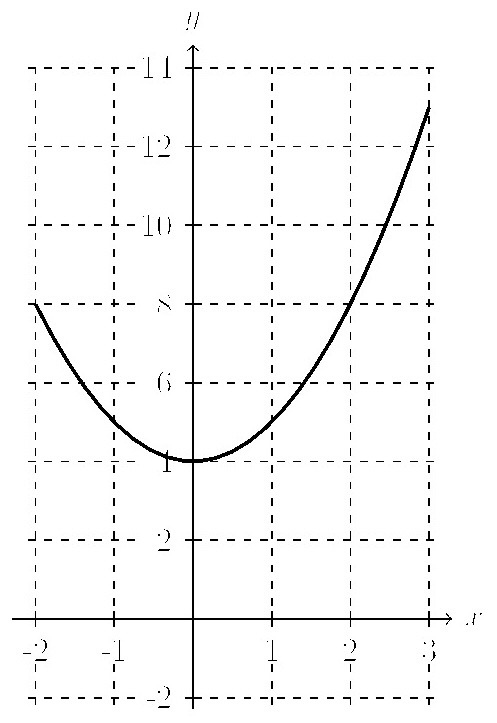
Let \(\displaystyle f(x)\) be the function whose graph is shown below.
[graph image]
What is the value of \(\displaystyle f(-1)\)?
IMAGE
Solution:
- Since \(f'(x)=2xe^{x^2}\), the sign of \(f'\) is the sign of \(x\). Thus \(f\) is decreasing on \(\boxed{(-\infty,0)}\) and increasing on \(\boxed{(0,\infty)}\).
- On \([1,3]\), four equal subintervals give \(\Delta x=\dfrac12\). The left endpoints are \(1,\dfrac32,2,\dfrac52\). Hence the left Riemann sum is \[ \boxed{\frac12\left(e^1+e^{(3/2)^2}+e^{2^2}+e^{(5/2)^2}\right)}. \]
- Because \(f\) is increasing on \([1,3]\), a left-endpoint sum lies below the exact area. So the approximation in part (b) is an \(\boxed{\text{underestimate}}\).
- From the graph shown below this text, the point at \(x=-1\) has y-coordinate \(5\). Thus \(\boxed{f(-1)=5}\).
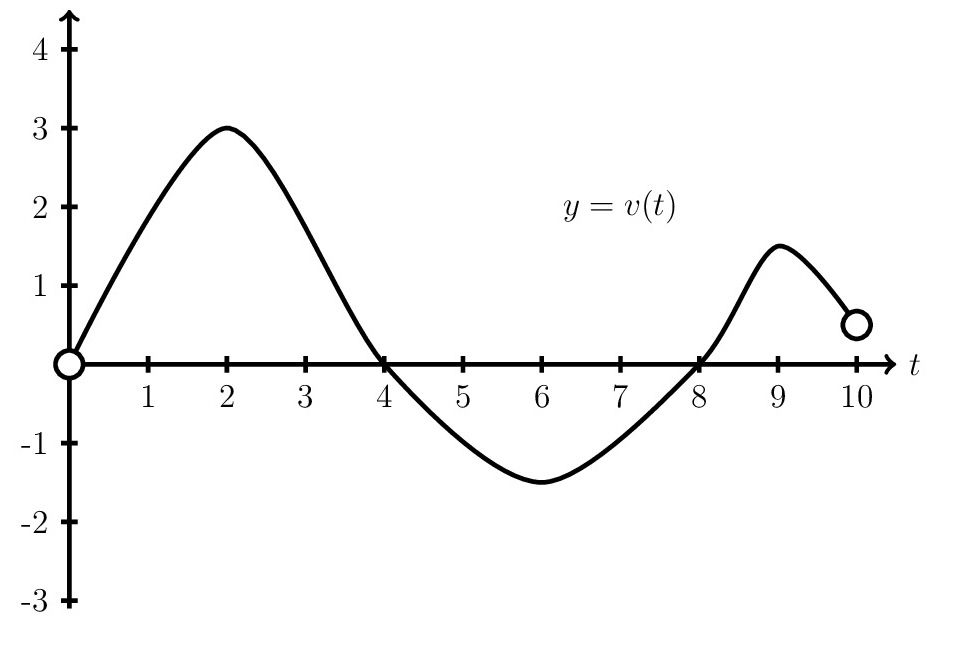
An object moves along a straight line with position function \(\displaystyle s(t)\), where \(\displaystyle s\) is in meters and \(\displaystyle t\) is in seconds with \(\displaystyle 0 < t < 10\). The graph below represents \(\displaystyle v(t)\), the object's velocity function.
- Determine the intervals on which the object's position function \(\displaystyle s(t)\) is increasing.
- Determine intervals on which the graph of the object's position function \(\displaystyle s(t)\) is concave upward.
- Determine all values of \(\displaystyle t\) at which the position function \(\displaystyle s(t)\) has a relative minimum.
IMAGE
Solution:
- The position function \(s(t)\) is increasing where its derivative \(s'(t)=v(t)\) is positive. So we look for where the velocity graph lies above the \(t\)-axis. From the graph, this happens on \[ \boxed{(0,4)\cup(8,10)}. \]
- The graph of \(s\) is concave upward where \(s''(t)>0\). Since \(s''(t)=v'(t)\), this means we look for where the velocity graph is increasing. From the picture, the velocity graph is increasing on approximately \[ \boxed{(0,2)\cup(6,9)}. \]
- A relative minimum of \(s\) occurs where \(s'(t)=v(t)\) changes from negative to positive. From the graph, the velocity crosses upward through the axis at \[ \boxed{t=8}. \] So \(s(t)\) has a relative minimum at \(t=8\).
The dimensions of a rectangle are changing, but the rectangle’s height is always twice its width. When the area of the rectangle is 50 in\(\displaystyle ^2\), the area of the rectangle is increasing at a rate of 10 in\(\displaystyle ^2\) per second. Determine the rate of change of the perimeter of the rectangle at that instant.
Solution: Let the width be \(w\), so the height is \(2w\). Then the area is \(A=2w^2\). At the instant in question, \(A=50\), so \(2w^2=50\), giving \(w=5\). Differentiate: \[ \frac{dA}{dt}=4w\frac{dw}{dt}. \] With \(dA/dt=10\) and \(w=5\), we get \(10=20\,dw/dt\), so \(dw/dt=\frac12\). The perimeter is \[ P=2(w+2w)=6w, \] so \[ \frac{dP}{dt}=6\frac{dw}{dt}=6\cdot\frac12=\boxed{3\text{ in/s}}. \]
You plan to make a box with a square base and lid, with largest possible volume, and with surface area 140 in\(\displaystyle ^2\). Note: The last part of this problem is on the next page.
- If the square base of the box is \(\displaystyle x\) inches wide, determine a formula for the function \(\displaystyle V(x)\) representing the volume of the box (in cubic inches). Your function should contain the variable \(\displaystyle x\) and cannot contain any other variables.
- Determine a domain for \(\displaystyle V(x)\) which makes sense in the context of the scenario. Briefly explain why you chose the domain you provided.
The problem continues on the next page.
Solution:
- If the square base has side \(x\) and height \(h\), then the closed box has surface area \[ 2x^2+4xh=140. \] Thus \(h=\dfrac{140-2x^2}{4x}=\dfrac{70-x^2}{2x}\). The volume is \[ V(x)=x^2h=x^2\cdot\frac{70-x^2}{2x}=\boxed{35x-\frac{x^3}{2}}. \]
- We need \(x>0\) and \(h>0\). The second condition gives \(70-x^2>0\), hence \(0<x<\sqrt{70}\). So a natural domain is \(\boxed{(0,\sqrt{70})}\).
, continued:
- Determine the largest possible volume of such a box. You must use calculus to verify that the volume you find is the largest possible volume.
Solution: Using the volume function from the previous page, \[ V(x)=35x-\frac{x^3}{2}. \] Differentiate: \[ V'(x)=35-\frac32x^2. \] Set \(V'(x)=0\): \[ 35=\frac32x^2\implies x^2=\frac{70}{3}\implies x=\sqrt{\frac{70}{3}}. \] Because \(V''(x)=-3x<0\) for positive \(x\), this critical point gives a maximum. The corresponding height is \[ h=\frac{70-x^2}{2x}=\frac{70-70/3}{2x}=\frac{70}{3x}=x, \] so the maximizing box is a cube. The largest possible volume is therefore \[ \boxed{V_{\max}=\left(\frac{70}{3}\right)^{3/2}\text{ in}^3}. \]