Determine the following limits; briefly explain your thinking on parts (b) and (c). If you apply L'Hopital's rule, indicate where you have applied it and why you can apply it. Print your final answer in the box provided.
- no explanation needed: \(\displaystyle \lim_{x \to -1} (x^7 - 4x + 2)\)
answer:
- \(\displaystyle \lim_{x \to -\infty} \frac{x-1}{|x-1|}\)
answer:
- \(\displaystyle \lim_{x \to 0} \frac{e^{5x} - 1}{3x}\)
answer:
Determine whether the function below is continuous at \(\displaystyle x = 3\).
\textbf{Use the definition of continuity to explain your answer.}
(a) State the limit definition of the derivative of \(\displaystyle f(x)\).
- Use the \textbf{limit definition of the derivative} to determine the derivative of \(\displaystyle f(x) = \frac{1}{1 + 2x}\). (No points will be awarded for the application of differentiation rules.)
Determine the first derivative of each of the following functions. Print your answer in the box provided. **You do not have to simplify your answers or explain your steps.**
- \(\displaystyle f(x) = 7x^5 - x^{3/5} + 2018\)
- \(\displaystyle g(x) = \frac{e^x}{x^2 + 5}\)
- \(\displaystyle f(x) = x^9 \cos(4x)\)
- \(\displaystyle f(x) = \arctan(x) + \sqrt{x^7} + 3x\)
(a) Determine \(\displaystyle \frac{dy}{dx}\) where \(\displaystyle 2x^3 + 3x^2y + y^3 = 4\).
Print your answer in the box provided. You do not have to simplify your answer.
- Determine all points on the graph of \(\displaystyle 2x^3 + 3x^2y + y^3 = 4\) at which the curve has a horizontal tangent line. Give your answer(s) in the form \(\displaystyle (x, y)\). (You may use your work from part (a).)
Answer:
Determine the following indefinite integrals. Print your answer to each part in the box provided. **You do not have to simplify your answers or explain your steps.**
- \(\displaystyle \int \left( x^3 - 7x + 12 \right) dx\)
Final answer:
- \(\displaystyle \int \left( \frac{1}{\sqrt{1-x^2}} + \sec(x)\tan(x) \right) dx\)
Final answer:
- \(\displaystyle \int e^{\sin(3x)} (\cos(3x)) dx\)
Final answer:
Evaluate the following definite integrals. Print your answer in the box provided.
You do not have to simplify your answers or explain your steps.
- \(\displaystyle \int_{0}^{1/2} \left(e^{x} - \cos(\pi x)\right) dx\)
Value:
- \(\displaystyle \int_{0}^{1} \left(\frac{1}{x^{6} - 4x + 7}\right) \left(6x^{5} - 4\right) dx\)
Value:
Use calculus to determine the absolute maximum and absolute minimum values of the function below on the interval [1, 5]:
Consider the function \(\displaystyle f(x) = e^{x^2}\).
- Determine interval(s) on which \(\displaystyle f\) is increasing and interval(s) on which \(\displaystyle f\) is decreasing.
- Approximate the integral
by a Riemann sum using four sub-intervals of equal width and left endpoints. You do \textbf{not} need to simplify your expression for the Riemann sum; expressions involving powers of \(\displaystyle e\) such as \(\displaystyle e^{v^2}\) are acceptable.
- Based \textbf{only} on your answer to part (a), will your final answer to (b) be an over-estimate or under-estimate of the true exact value of
? Explain briefly.
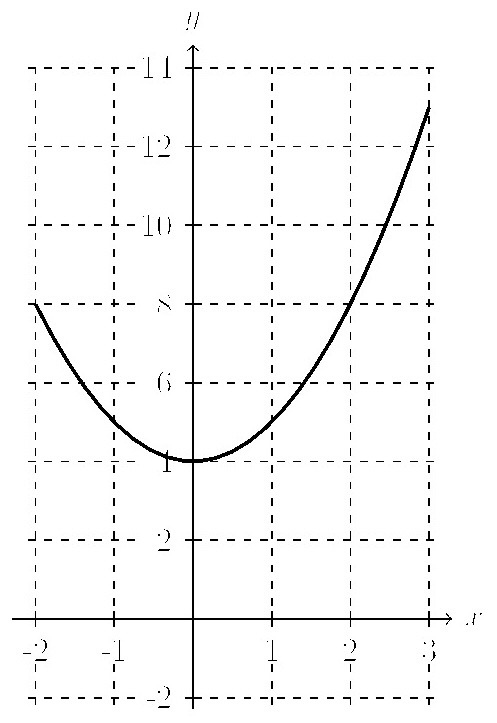
Let \(\displaystyle f(x)\) be the function whose graph is shown below.
[graph image]
What is the value of \(\displaystyle f(-1)\)?
IMAGE
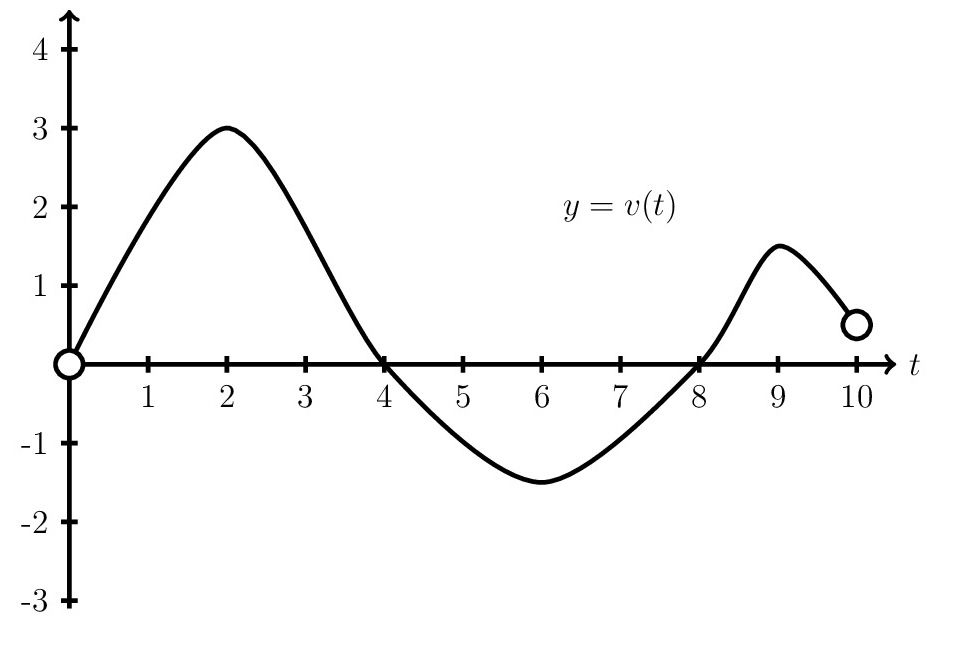
An object moves along a straight line with position function \(\displaystyle s(t)\), where \(\displaystyle s\) is in meters and \(\displaystyle t\) is in seconds with \(\displaystyle 0 < t < 10\). The graph below represents \(\displaystyle v(t)\), the object's velocity function.
- Determine the intervals on which the object's position function \(\displaystyle s(t)\) is increasing.
- Determine intervals on which the graph of the object's position function \(\displaystyle s(t)\) is concave upward.
- Determine all values of \(\displaystyle t\) at which the position function \(\displaystyle s(t)\) has a relative minimum.
IMAGE
The dimensions of a rectangle are changing, but the rectangle’s height is always twice its width. When the area of the rectangle is 50 in\(\displaystyle ^2\), the area of the rectangle is increasing at a rate of 10 in\(\displaystyle ^2\) per second. Determine the rate of change of the perimeter of the rectangle at that instant.
You plan to make a box with a square base and lid, with largest possible volume, and with surface area 140 in\(\displaystyle ^2\). Note: The last part of this problem is on the next page.
- If the square base of the box is \(\displaystyle x\) inches wide, determine a formula for the function \(\displaystyle V(x)\) representing the volume of the box (in cubic inches). Your function should contain the variable \(\displaystyle x\) and cannot contain any other variables.
- Determine a domain for \(\displaystyle V(x)\) which makes sense in the context of the scenario. Briefly explain why you chose the domain you provided.
The problem continues on the next page.
, continued:
- Determine the largest possible volume of such a box. You must use calculus to verify that the volume you find is the largest possible volume.