Determine the following limits. If you answer with \(\displaystyle \infty\) or \(\displaystyle -\infty\), briefly explain your thinking. Print your final answer in the box provided.
- \(\displaystyle \lim_{x \to 2}(3x^2 + 7x - 5)\)
answer:
- \(\displaystyle \lim_{x \to 1^-} \frac{2x}{x-1}\)
answer:
- \(\displaystyle \lim_{x \to \infty} \frac{\ln(5x)}{x^3+1}\)
answer:
Solution:
- Polynomials are continuous, so direct substitution gives \(3(2)^2+7(2)-5=\boxed{21}\).
- As \(x\to1^-\), the numerator tends to \(2>0\) and the denominator tends to \(0^-\). Hence the quotient tends to \(\boxed{-\infty}\).
- The logarithm grows much more slowly than the cubic denominator, so the quotient tends to \(\boxed{0}\).
Determine the first derivative of each of the following functions. Print your answer in the box provided. *You do not have to simplify your answers or explain your steps.*
- \(\displaystyle f(x) = 8x^3 - 15x + 12\)
- \(\displaystyle g(t) = \frac{\sin(t)}{t}\)
- \(\displaystyle f(x) = \frac{e^x}{2x+1}\)
- \(\displaystyle h(x) = (4x-3)^2 \arctan(x)\)
Solution:
- \(\displaystyle \frac{d}{dx}(8x^3-15x+12)=\boxed{24x^2-15}\).
- Using the quotient rule, \[ \left(\frac{\sin t}{t}\right)'=\frac{t\cos t-\sin t}{t^2}. \] So \(\boxed{g'(t)=\dfrac{t\cos t-\sin t}{t^2}}\).
- Again by the quotient rule, \[ \left(\frac{e^x}{2x+1}\right)'=\frac{e^x(2x+1)-2e^x}{(2x+1)^2}=\boxed{\frac{e^x(2x-1)}{(2x+1)^2}}. \]
- Apply the product rule: \[ h'(x)=2(4x-3)\cdot4\,\arctan x+(4x-3)^2\frac{1}{1+x^2}. \] Hence \(\boxed{h'(x)=8(4x-3)\arctan x+\frac{(4x-3)^2}{1+x^2}}\).
(a) Determine \(\displaystyle \frac{dy}{dx}\) for the equation \(\displaystyle y^3 - x^4 y = 6\). Print your answer in the box provided. You do not have to simplify your answer.
- Determine an equation of the tangent line to the curve \(\displaystyle y^3 - x^4 y = 6\) at the point \(\displaystyle (1, 2)\).
Equation:
Solution:
- Differentiate implicitly: \[ 3y^2y'-4x^3y-x^4y'=0. \] Therefore \[ (3y^2-x^4)y'=4x^3y, \] so \[ \boxed{\frac{dy}{dx}=\frac{4x^3y}{3y^2-x^4}}. \]
- At \((1,2)\), the slope is \(\dfrac{4\cdot1^3\cdot2}{3\cdot4-1}=\dfrac{8}{11}\). Thus the tangent line is \[ \boxed{y-2=\frac{8}{11}(x-1)}. \]
Determine the following indefinite integrals. Print your answer to each part in the box provided.
- \(\displaystyle \int (-4x^7 + 8x^5 + 12) dx\)
Final answer:
- \(\displaystyle \int \left( \sec^2(t) + \frac{1}{t} \right) dt\)
Final answer:
- \(\displaystyle \int \frac{x^4}{\sqrt{x^5 + 3}} dx\)
Final answer:
Solution:
- \(\displaystyle \int(-4x^7+8x^5+12)dx=\boxed{-\frac{x^8}{2}+\frac{4}{3}x^6+12x+C}\).
- \(\displaystyle \int\left(\sec^2 t+\frac1t\right)dt=\boxed{\tan t+\ln|t|+C}\).
- Set \(u=x^5+3\), so \(du=5x^4dx\). Then \[ \int\frac{x^4}{\sqrt{x^5+3}}dx=\frac15\int u^{-1/2}du=\boxed{\frac25\sqrt{x^5+3}+C}. \]
Evaluate the following definite integrals. Print your answer in the box provided.
- \(\displaystyle \int_{1}^{8} \left( x^{2/3} - \frac{1}{x^{4/3}} \right) dx\)
Value:
- \(\displaystyle \int_{0}^{1/2} \frac{-1}{\sqrt{1-x^2}} dx\)
Value:
- \(\displaystyle \int_{0}^{\pi/4} \sin(4x) e^{\cos(4x)} dx\)
Value:
Solution:
- \(\displaystyle \int_1^8\left(x^{2/3}-x^{-4/3}\right)dx=\left[\frac35x^{5/3}+3x^{-1/3}\right]_1^8=\boxed{\frac{81}{5}}\).
- \(\displaystyle \int_0^{1/2}\frac{-1}{\sqrt{1-x^2}}dx=-\bigl[\arcsin x\bigr]_0^{1/2}=\boxed{-\frac{\pi}{6}}\).
- Let \(u=\cos(4x)\), so \(du=-4\sin(4x)dx\). Then \[ \int_0^{\pi/4}\sin(4x)e^{\cos(4x)}dx=-\frac14\int_1^{-1}e^u\,du=\boxed{\frac{e-e^{-1}}{4}}. \]
(a) State the limit definition of the derivative of \(\displaystyle f(x)\).
- Use the limit definition of the derivative to show that the derivative of \(\displaystyle f(x) = 12x - 2x^2\) is \(\displaystyle f'(x) = 12 - 4x\). (You will receive 0 points for using the power rule.)
- Determine all values of \(\displaystyle x\) for which the graph of \(\displaystyle f(x) = 12x - 2x^2\) has a horizontal tangent line.
Solution:
- The limit definition is \[ f'(x)=\lim_{h\to0}\frac{f(x+h)-f(x)}{h}, \] provided the limit exists.
- For \[ f(x)=12x-2x^2, \] we compute \[ f(x+h)=12(x+h)-2(x+h)^2. \] So the difference quotient is \[ \frac{f(x+h)-f(x)}{h} =\frac{12(x+h)-2(x+h)^2-(12x-2x^2)}{h}. \] Expand and simplify: \[ \frac{12x+12h-2x^2-4xh-2h^2-12x+2x^2}{h} =\frac{12h-4xh-2h^2}{h}. \] Now divide every term by \(h\): \[ 12-4x-2h. \] Let \(h\to0\): \[ f'(x)=\lim_{h\to0}(12-4x-2h)=12-4x. \] Therefore \[ \boxed{f'(x)=12-4x}. \]
- A horizontal tangent occurs where \(f'(x)=0\). So \[ 12-4x=0 \quad\Longrightarrow\quad x=3. \] Hence the graph has a horizontal tangent at \[ \boxed{x=3}. \]
Determine the absolute maximum and absolute minimum values of \(\displaystyle f(x) = 2x\sqrt{9-x}\) on the interval \(\displaystyle [-1,9]\).
Solution: The domain is \([-1,9]\). We differentiate: \[ f(x)=2x\sqrt{9-x},\qquad f'(x)=2\sqrt{9-x}-\frac{x}{\sqrt{9-x}}=\frac{18-3x}{\sqrt{9-x}}. \] The critical point is \(x=6\). We compare the endpoint and critical values: \[ f(-1)=-2\sqrt{10},\qquad f(6)=12\sqrt3,\qquad f(9)=0. \] Therefore the absolute minimum is \(\boxed{-2\sqrt{10}}\) at \(x=-1\), and the absolute maximum is \(\boxed{12\sqrt3}\) at \(x=6\).
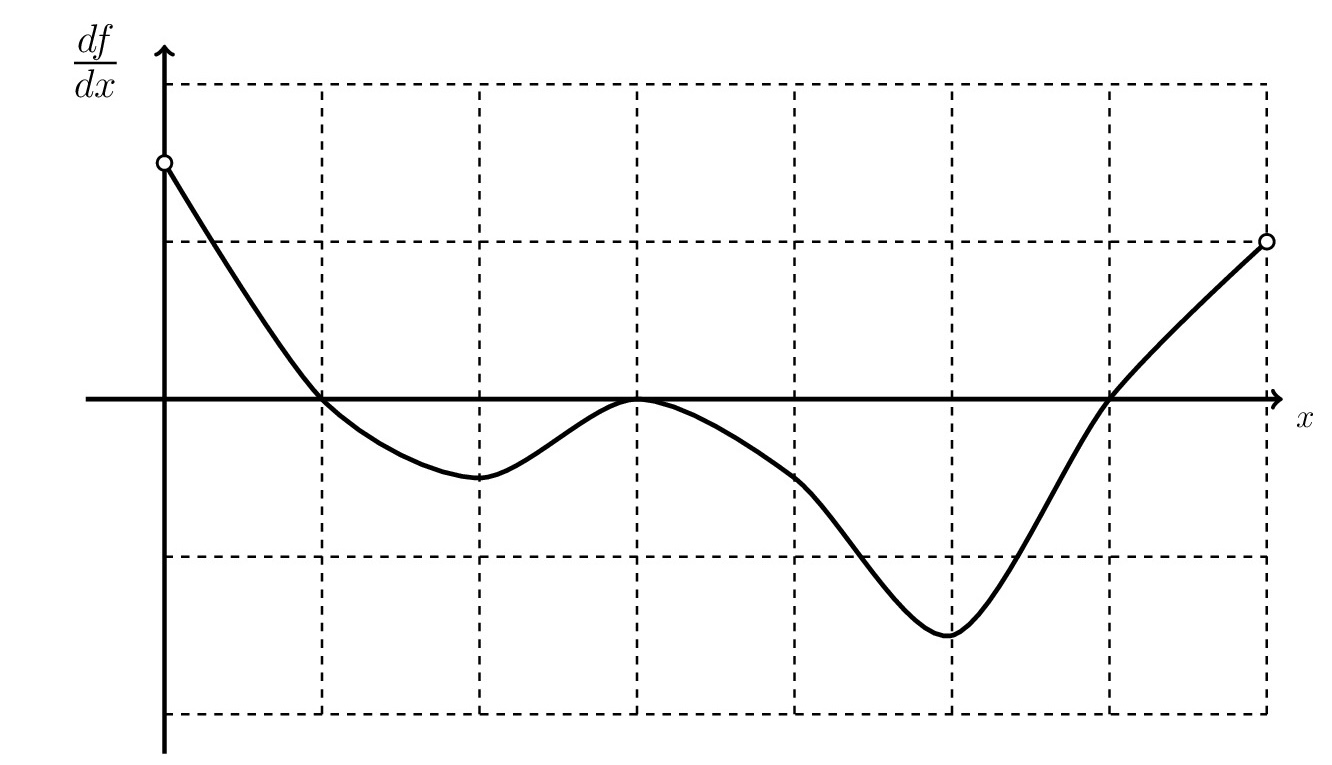
The graph below is the graph of the derivative of \(\displaystyle f(x)\). Use it to answer the questions that follow. The grid lines are one unit apart, and the domain of \(\displaystyle f\) is (0, 7).
- Determine all critical numbers (critical points) of \(\displaystyle f\).
- Determine the intervals on which \(\displaystyle f\) is increasing.
- Determine all values of \(\displaystyle x\) at which \(\displaystyle f\) has a local minimum.
- Determine the intervals on which \(\displaystyle f\) is concave up.
IMAGE
Solution:
- Critical numbers of \(f\) occur where \(f'(x)=0\) or where \(f'(x)\) does not exist. Reading those points from the graph of \(f'\), we get \[ \boxed{x=1,3,6}. \]
- The function \(f\) is increasing where \(f'(x)>0\), meaning where the graph of \(f'\) lies above the x-axis. From the graph, that happens on \[ \boxed{(0,1)\cup(6,7)}. \]
- A local minimum of \(f\) occurs where \(f'(x)\) changes from negative to positive. From the graph, that sign change happens at \[ \boxed{x=6}. \] So \(f\) has a local minimum at \(x=6\).
- The function \(f\) is concave up where \(f''(x)>0\), which means where \(f'(x)\) is increasing. From the graph of \(f'\), this occurs approximately on \[ \boxed{(2,3)\cup(5,7)}. \]
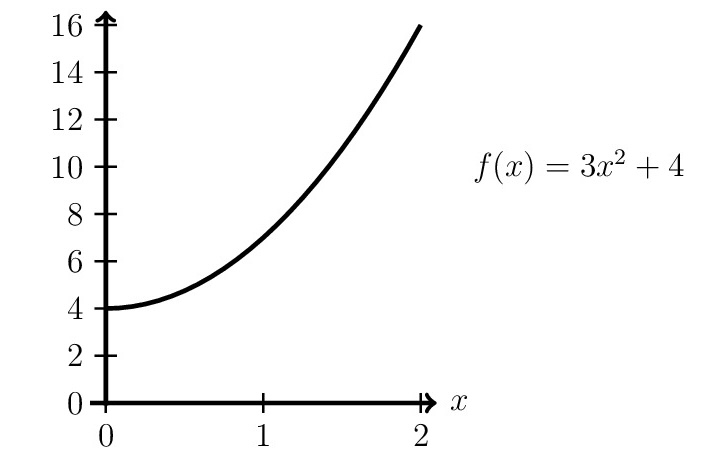
For this problem, use \(\displaystyle f(x) = 3x^2 + 4\) on the interval \(\displaystyle [0, 2]\). Its graph is provided to the right.
\(\displaystyle f(x) = 3x^2 + 4\)
- Determine a Riemann sum for \(\displaystyle f\) on the interval \(\displaystyle [0, 2]\) using 3 subintervals of equal width and using right endpoints on each subinterval.
- Is your Riemann sum above an over- or under-estimate of the integral \(\displaystyle \int_0^2 f(x) dx\)?
Explain how you can tell, \textit{without doing any calculations or working out the answers}, whether it’s an over-estimate or an under-estimate. (You may want to illustrate the Riemann sum on the graph of \(\displaystyle f\) provided above.)
- Use summation (sigma) notation to write an expression for a Riemann sum for \(\displaystyle f\) on the interval \(\displaystyle [0,2]\) using \(\displaystyle n\) subintervals of equal width and using right endpoints on each subinterval. \textit{You do not have to work out the value of the sum, but your sum should involve only \(\displaystyle \sum_{k=1}^n\), the variables \(\displaystyle k\) and \(\displaystyle n\), and numbers.}
IMAGE
Solution:
- On \([0,2]\), using three equal subintervals gives \[ \Delta x=\frac{2-0}{3}=\frac23. \] The right endpoints are \[ \frac23,\ \frac43,\ 2. \] Therefore the right-endpoint Riemann sum is \[ \frac23\left[f\left(\frac23\right)+f\left(\frac43\right)+f(2)\right] =\frac23\left(\frac{16}{3}+\frac{28}{3}+16\right)=\boxed{\frac{184}{9}}. \]
- Because \(f(x)=3x^2+4\) is increasing on \([0,2]\), each right-endpoint rectangle uses the largest function value on its subinterval. So the rectangles lie above the curve, and the sum is an \[ \boxed{\text{overestimate}}. \]
- For \(n\) equal subintervals, \[ \Delta x=\frac{2}{n}, \] and the right endpoint of the \(k\)-th subinterval is \[ x_k=\frac{2k}{n}. \] So a right-endpoint Riemann sum is \[ \boxed{\sum_{k=1}^{n}\frac{2}{n}\left(3\left(\frac{2k}{n}\right)^2+4\right)}. \]
Use the values of the given definite integrals to determine the quantities below.
- \(\displaystyle \int_{1}^{7} \left( 2f(x) - 5g(x) \right) dx\)
- \(\displaystyle \int_{1}^{3} f(x) dx\)
- \(\displaystyle \int_{1}^{7} \left( g(t) - t^2 \right) dt\)
Solution:
- By linearity of the integral, \[ \int_1^7(2f-5g)=2\int_1^7f-5\int_1^7g=2(-8)-5(9)=\boxed{-61}. \]
- Since \(\int_1^7f=\int_1^3f+\int_3^7f\), we get \(\int_1^3f=-8-12=\boxed{-20}\).
- Again by linearity, \[ \int_1^7(g(t)-t^2)dt=\int_1^7g(t)dt-\int_1^7t^2dt=9-\left[\frac{t^3}{3}\right]_1^7=9-114=\boxed{-105}. \]
The charts below contain information about a function \(\displaystyle f\) and its derivative. Assume that \(\displaystyle f\) is differentiable on \(\displaystyle [-2, 1]\). Use the charts to answer the questions that follow.
- Determine the linearization of \(\displaystyle f\) at \(\displaystyle x = -1\).
- Use your linearization above to estimate the value of \(\displaystyle f(-1.5)\).
- Suppose you also know that \(\displaystyle f'\) is continuous on \(\displaystyle [-2, 1]\). Explain why the graph of \(\displaystyle f\) must have an inflection point somewhere in the interval \(\displaystyle [-2, 1]\).
Solution:
- The linearization at \(x=-1\) is \[ L(x)=f(-1)+f'(-1)(x+1)=2-\frac13(x+1). \] So \(\boxed{L(x)=2-\frac13(x+1)}\).
- Then \[ f(-1.5)\approx L(-1.5)=2-\frac13(-0.5)=2+\frac16=\boxed{\frac{13}{6}}. \]
- Because \(f'\) is continuous and the table shows that \(f'\) decreases from \(-\tfrac18\) to \(-1\) and later increases to \(0\), the continuous function \(f'\) must attain a local minimum somewhere in \((-2,1)\). At such a point, the monotonicity of \(f'\) changes, so the concavity of \(f\) changes as well. Therefore \(f\) must have an inflection point somewhere in \(\boxed{(-2,1)}\).
A diesel truck develops an oil leak. The oil drips onto the dry ground in the shape of a circular puddle. Assuming that the leak begins at time \(\displaystyle t = 0\) and that the radius of the oil slick increases at a constant rate of .05 meters per minute, determine the rate of change of the area of the puddle 4 minutes after the leak begins.
Solution: The radius grows at \(dr/dt=0.05\) m/min, so after 4 minutes the radius is \(r=0.2\) m. Since \(A=\pi r^2\), we have \[ \frac{dA}{dt}=2\pi r\frac{dr}{dt}. \] At \(t=4\), this becomes \[ \frac{dA}{dt}=2\pi(0.2)(0.05)=\boxed{0.02\pi\text{ m}^2/\text{min}}. \]
A landscape designer plans to construct a rectangular garden whose area is 2000 square meters. One side will consist of a wrought iron fence which costs $90 per meter. The remaining three sides will be constructed from chain link fence costing $25 per meter.
- Determine a function for the total cost \(\displaystyle C(x)\) of the garden, where \(\displaystyle x\) is the length of wrought iron fence used (in meters).
- What dimensions of the garden will minimize the total cost? Use calculus techniques to show that the dimensions result in the minimum possible cost.
Solution:
- If \(x\) is the wrought-iron side, the other dimension is \(y=\dfrac{2000}{x}\). The total cost is \[ C(x)=90x+25x+25y+25y=115x+50y=\boxed{115x+\frac{100000}{x}}. \]
- Differentiate: \[ C'(x)=115-\frac{100000}{x^2}. \] Setting \(C'(x)=0\) gives \(x^2=\dfrac{100000}{115}=\dfrac{20000}{23}\), so \[ \boxed{x=\sqrt{\frac{20000}{23}}\approx29.49\text{ m}}. \] Then \[ y=\frac{2000}{x}\approx67.82\text{ m}. \] Moreover \(C''(x)=\dfrac{200000}{x^3}>0\), so this critical point gives the minimum cost. Thus the minimizing dimensions are approximately \(\boxed{29.49\text{ m by }67.82\text{ m}}\).
Let \(\displaystyle y = \ln(x)\). Show that \(\displaystyle \frac{dy}{dx} = \frac{1}{x}\) by solving the equation \(\displaystyle y = \ln(x)\) for \(\displaystyle x\) and then using implicit differentiation. Your final answer should be \(\displaystyle \frac{dy}{dx}\), given as a function of \(\displaystyle x\).
Solution: Starting from \(y=\ln x\), solve for \(x\): \(x=e^y\). Differentiate implicitly with respect to \(x\): \[ 1=e^y\frac{dy}{dx}=x\frac{dy}{dx}. \] Hence \[ \boxed{\frac{dy}{dx}=\frac1x}. \]
(10 points) The function \(\displaystyle f(x)\) is defined as shown below. Its derivative is also shown.
Graph of a piecewise function f(x) and its derivative are shown.
- Write a formula for \(\displaystyle f(x)\).
- Write a formula for \(\displaystyle f'(x)\).
The following graph is labeled for part (c).
- Write a formula for \(\displaystyle F(x) = \int_0^x f(t) dt\).
- Find \(\displaystyle F(2)\).
- Find \(\displaystyle F'(1)\).
IMAGE
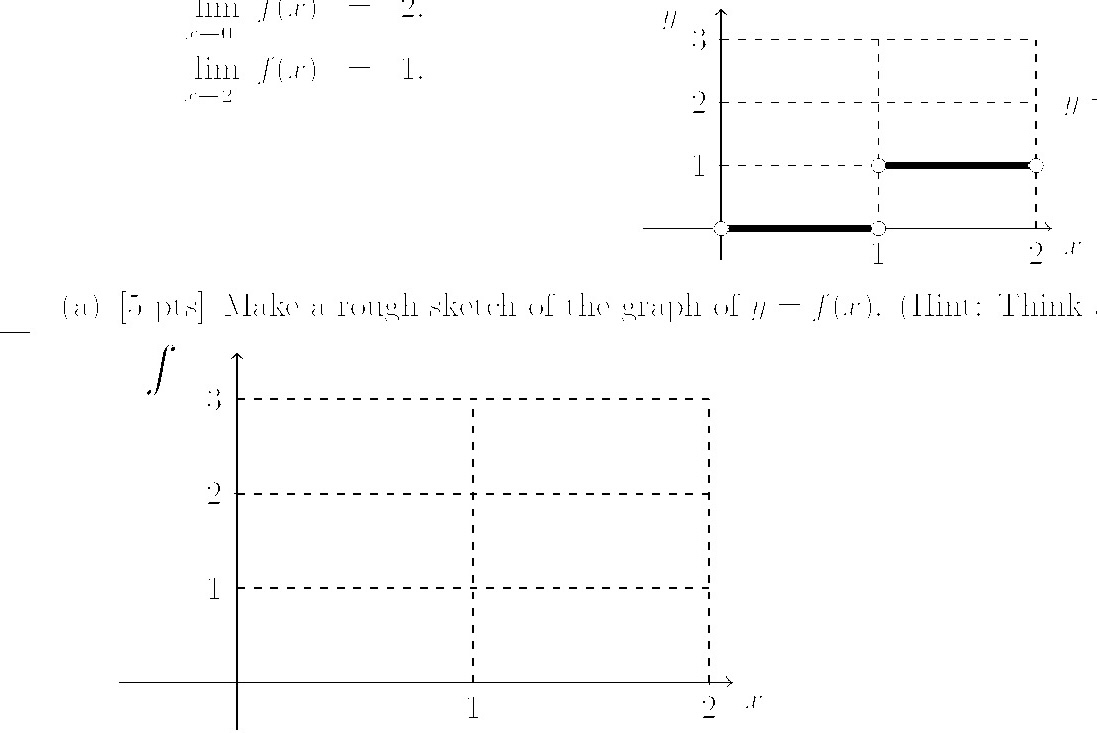
Solution: The scan is a little rough here, but the visible graph shows a step function: \(f(x)=0\) on \(0<x<1\) and \(f(x)=1\) on \(1<x<2\), with the endpoint values not clearly specified. On those open intervals, \(f'(x)=0\). Therefore a natural reading is: \[ \boxed{f(x)=\begin{cases}0,&0<x<1,\\1,&1<x<2,\end{cases}} \qquad \boxed{f'(x)=0\text{ on }(0,1)\cup(1,2),} \] with \(f'\) undefined at the jump point \(x=1\). Then \[ F(x)=\int_0^x f(t)dt=\begin{cases}0,&0\le x\le1,\\x-1,&1\le x\le2,\end{cases} \] so \(\boxed{F(2)=1}\). If the intended graph indeed has a jump at \(x=1\), then \(F'(1)\) does not exist in the ordinary sense because \(f(1)\) is not clearly defined in the scan. The source image is ambiguous there, so the solution copy records the mathematically consistent interpretation instead of inventing a point value.