Determine the first derivative of each of the following functions. Print your answer in the box provided. You do not have to simplify your answers.
- \(\displaystyle g(x) = 3x^5 - \frac{20}{x^2} - 900\).
- \(\displaystyle h(r) = 5r \cos(r - 3) - 4r + 10\)
- \(\displaystyle f(t) = \arctan(t)\)
- \(\displaystyle R(x) = 5x - \frac{e^x}{x^2 - 1}\)
- \(\displaystyle P(x) = 5x^2 \tan\left(\sqrt{x} - 1\right)\)
Determine the the most general anti-derivative of each of the following expressions. Print your answer in the box provided.
- \(\displaystyle 10x^2 + 4x - 100\)
Most general anti-derivative:
- \(\displaystyle 4\sin(t) - 8\)
Most general anti-derivative:
- \(\displaystyle x \cos \left(x^2 + 1\right)\)
Most general anti-derivative:
out of a possible 5 points
Evaluate the following definite integrals. Print your answer in the box provided.
- \(\displaystyle \int_{1}^{2} (e^{t} - t^{-1}) dt\)
Value:
- \(\displaystyle \int_{0}^{\pi / 8} \sec^{2}(2x) dx\)
Value:
- \(\displaystyle \int_{0}^{1/2} \frac{x}{\sqrt{1 - x^{4}}} dx\)
Value:
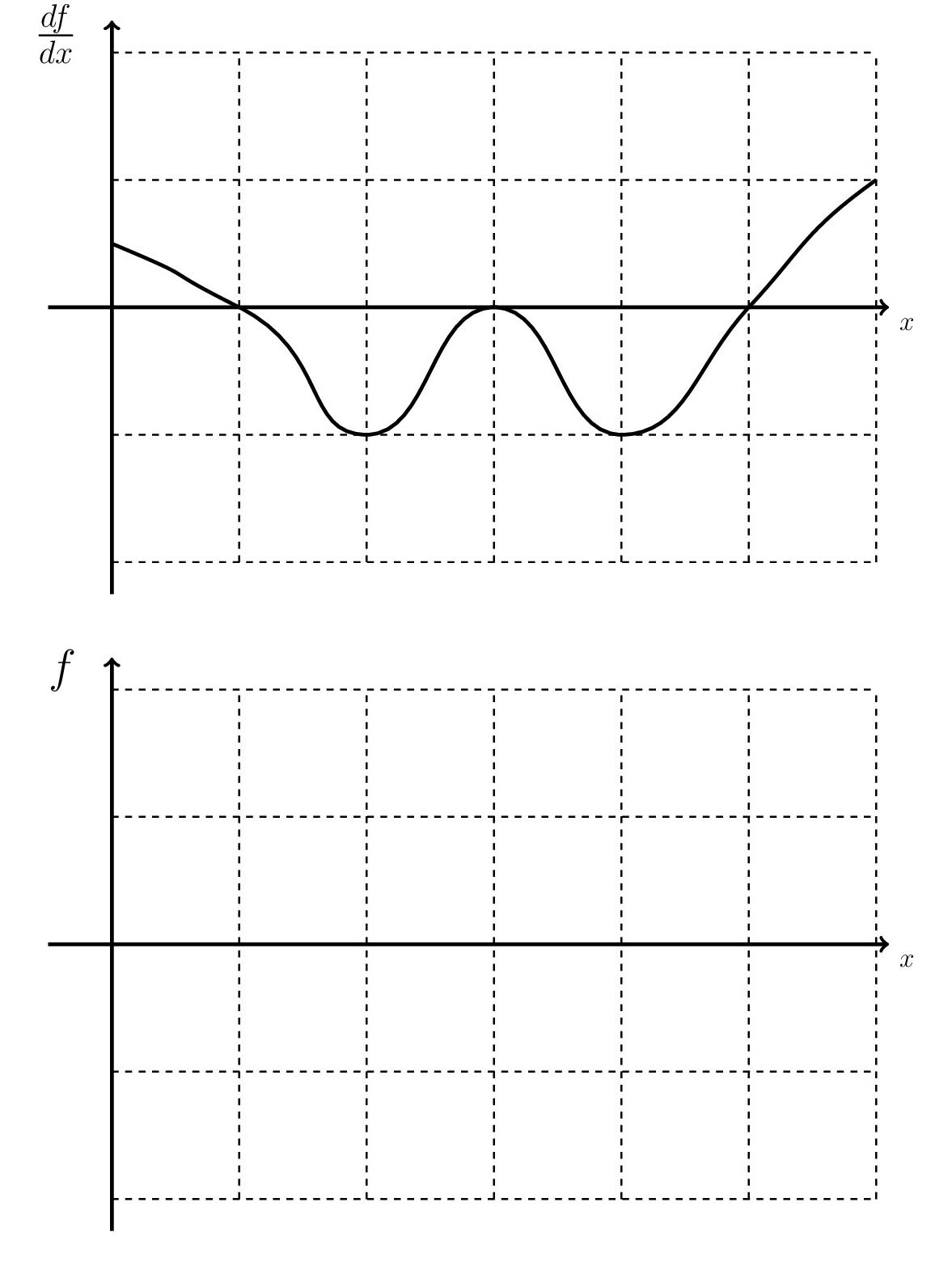
Make a sketch of \(\displaystyle f(x)\) given that \(\displaystyle f(0) = 1\), where the graph of \(\displaystyle \frac{df}{dx}\) is shown below.
(The grid lines are one unit apart.)
(Graph of \(\displaystyle \frac{df}{dx}\) vs \(\displaystyle x\) with a wavy curve and labeled axes)
(Empty grid for sketching \(\displaystyle f\) vs \(\displaystyle x\) with labeled axes)
IMAGE
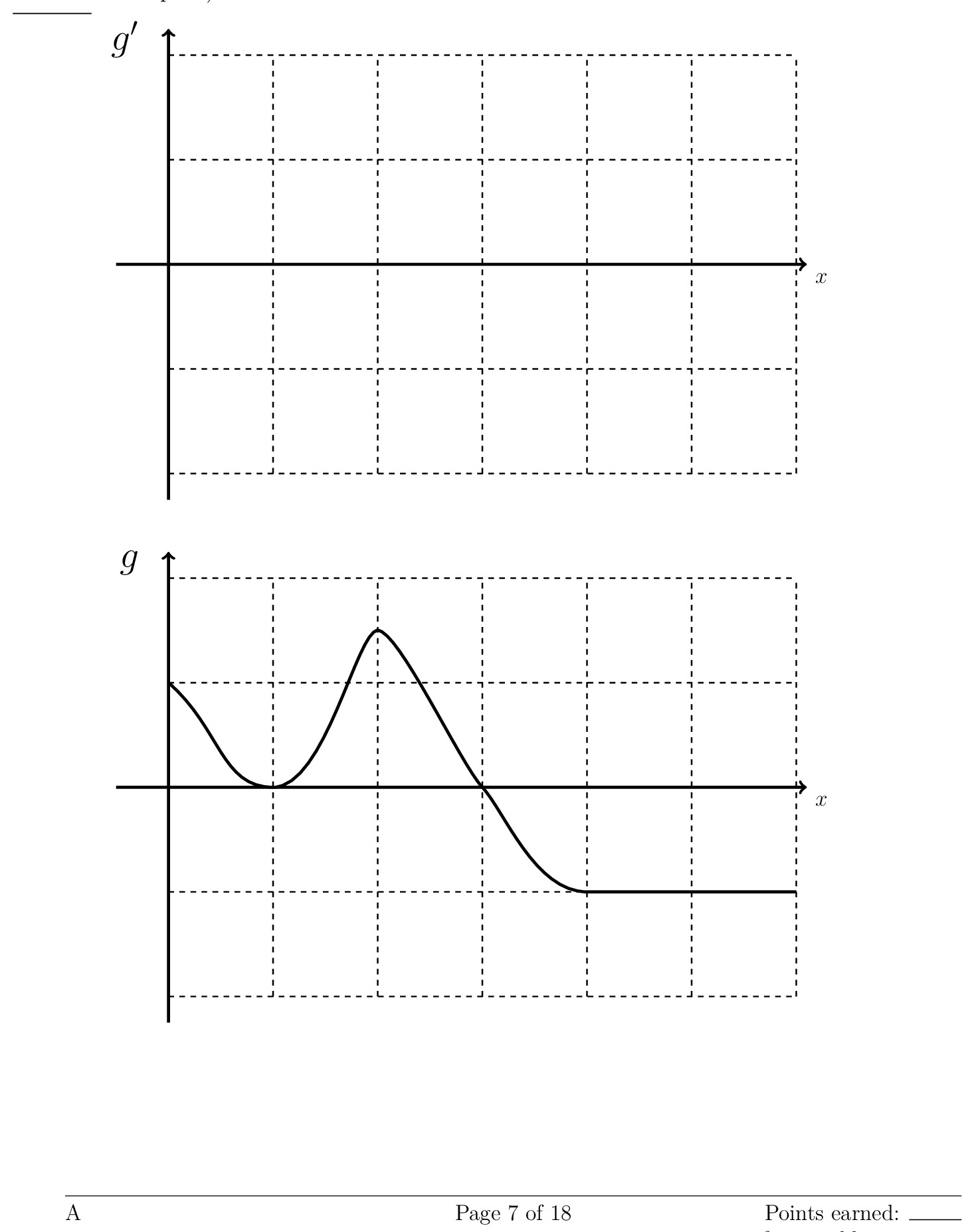
Make a sketch of \(\displaystyle g'(x)\) where the graph of \(\displaystyle g\) is shown below. (The grid lines are one unit apart.)
Graph grid labeled \(\displaystyle g'\) vs \(\displaystyle x\) (empty for student to sketch).
Graph grid labeled \(\displaystyle g\) vs \(\displaystyle x\) with a plotted curve (specific to the problem).
IMAGE
The derivatives of two different functions are described in parts (a) and (b).
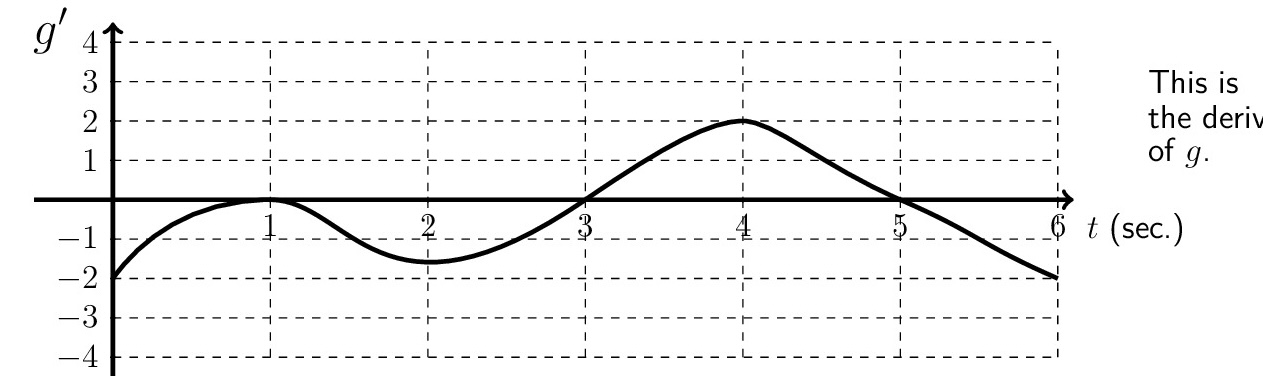
- The graph of the derivative of a function, \(\displaystyle g\), is given below. Determine all values of \(\displaystyle t\) where a local maximum or a local minimum occurs for the original function. **Provide a brief justification for each value of \(\displaystyle t\) you give.**
This is the derivative of \(\displaystyle g\).
\(\displaystyle t\) (sec.)
- The derivative of a function, \(\displaystyle h\), is given by
where \(\displaystyle x\) is any real number. Determine all values of \(\displaystyle x\) where a local maximum or a local minimum occurs for the original function. **Give a brief justification for each value of \(\displaystyle x\).**
IMAGE
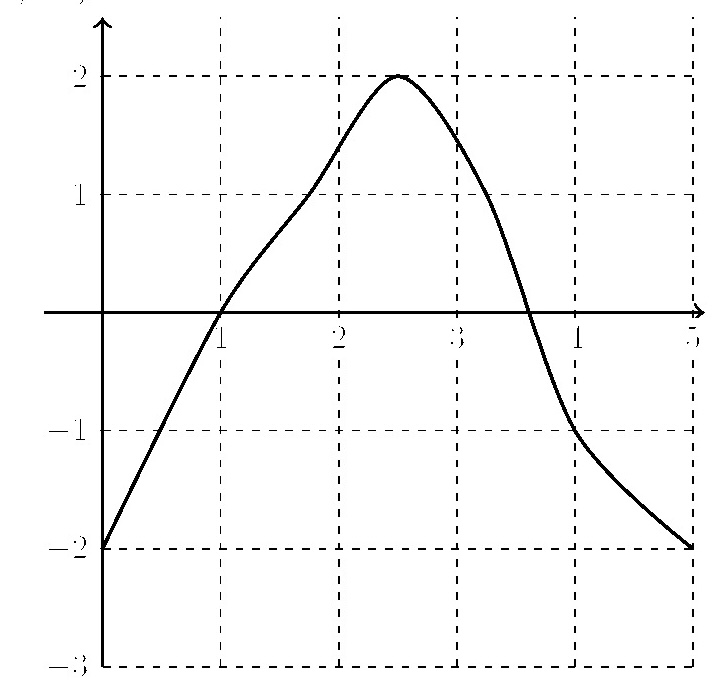
A car moves along a straight track. The car starts at the origin and has an initial velocity of 2 m/sec. The car’s acceleration is
where \(\displaystyle t\) is the time in seconds and \(\displaystyle t \geq 0\).
- Determine the position of the car at time \(\displaystyle t\) where \(\displaystyle t \geq 0\).
- What is the car’s position after a very long time?
Information about two functions and their derivatives are given in the tables below. Use the information to determine the values of each of the quantities below.
| t | f(t) |
|---|---|
| 0 | 4 |
| 1 | 8 |
| 2 | 3 |
| 3 | 1 |
| t | f'(t) |
| 0 | 7 |
| 1 | 6 |
| 2 | 4 |
| 3 | 0 |
| t | g(t) |
| 0 | 2 |
| 1 | 3 |
| 2 | 5 |
| 3 | 7 |
| t | g'(t) |
| 0 | 3 |
| 1 | 8 |
| 2 | 2 |
| 3 | 1 |
- \(\displaystyle \frac{d}{dt} \left( 2f(t) - 4g(t) \right)\) at \(\displaystyle t = 1\).
- \(\displaystyle \frac{d}{dt} \left( 2f(t) \cdot g(t) \right)\) at \(\displaystyle t = 3\).
- \(\displaystyle \frac{d}{dt} \left( -g(f(t)) \right)\) at \(\displaystyle t = 2\).
Answer the questions below for the graph of the equation \(\displaystyle y = 2 \cos (y - \pi x)\).
- Determine \(\displaystyle \frac{dy}{dx}\).
- Determine an equation of the tangent line to the curve at the point \(\displaystyle \left( \frac{1}{2}, 0 \right)\).
- Find a point, \(\displaystyle (x, 2)\), on the curve where the tangent line is horizontal.
[Graph appears here]
An experiment is performed by dropping two identical steel balls simultaneously from the same height onto different surfaces, as shown below. One bounces off the steel plate; the other remains in contact with the carpet.
(Image: Table with two balls labeled "Steel Plate" and "Carpet")
Will the impulse delivered to the steel ball by the steel plate be greater than, less than, or equal to the impulse delivered to the steel ball by the carpet? Explain your answer.
IMAGE
IMAGE
A rectangle is inscribed in a circle of radius two centered at the origin. Determine the dimensions of the rectangle with the largest possible area, and determine the largest possible area. (Use calculus to show that the dimensions really give the largest possible area.)
Determine the values of each of the limits given below.
- \(\displaystyle \lim_{x \to 5} (x^3 - 7x + 10)\)
- \(\displaystyle \lim_{x \to \infty} \frac{7|x| - 3}{4x - 12}\)
- \(\displaystyle \lim_{x \to 0^+} (\sin(x))^{8x}\)
The power in an electrical circuit is given by
where \(\displaystyle P\) is the power (Watts), \(\displaystyle I\) is the current (Amps) and \(\displaystyle R\) is the resistance (Ohms) in the circuit. The circuit will be designed to have a constant resistance of \(\displaystyle R = 5,000\) Ohms.
- Determine the linearization of the power in terms of the current for a level of 0.1 Amps of current.
- For the final design the power should be about 50 Watts, but it can vary by \(\displaystyle \pm 0.1\) Watts. Use the linearization or the differential to estimate the possible change in the current.