Determine the first derivative of each of the following functions. Print your answer in the box provided.
- \(\displaystyle f(x) = e^{3x} + 5x^2 + 2001\).
- \(\displaystyle h(x) = x^2 \cos(x) + 42\).
- \(\displaystyle G(r) = \frac{r + 4}{3r^2 + 7}\).
- \(\displaystyle M(x) = \arctan(3x)\).
- \(\displaystyle Q(s) = (1+s)^{\frac{1}{4}}\).
Solution:
- \(\displaystyle \frac{d}{dx}(e^{3x}+5x^2+2001)=\boxed{3e^{3x}+10x}\).
- By the product rule, \(\displaystyle \frac{d}{dx}(x^2\cos x)=\boxed{2x\cos x-x^2\sin x}\).
- Using the quotient rule, \[ G'(r)=\frac{(3r^2+7)-6r(r+4)}{(3r^2+7)^2}=\boxed{\frac{-3r^2-24r+7}{(3r^2+7)^2}}. \]
- \(\displaystyle \frac{d}{dx}\arctan(3x)=\boxed{\frac{3}{1+9x^2}}\).
'(s) =
\]
Solution: This line is the continuation of Problem 1 after the OCR split the item in two. For \(Q(s)=(1+s)^{1/4}\), the power rule gives \[ Q'(s)=\frac14(1+s)^{-3/4}=\boxed{\frac{1}{4(1+s)^{3/4}}}. \]
Determine the most general anti-derivative indicated in each of the following expressions. Print your answer in the box provided.
- \(\displaystyle \int (5x + 3)\ dx\).
Anti-Derivative:
- \(\displaystyle \int (\cos(4x) + e^{2x} + 9)\ dx\).
Anti-Derivative:
- \(\displaystyle \int \frac{x}{3 - x^2} dx\).
Anti-Derivative:
- \(\displaystyle \int \sin(x) \cos(x) dx\).
Anti-Derivative:
Solution:
- \(\displaystyle \int(5x+3)dx=\boxed{\frac52x^2+3x+C}\).
- \(\displaystyle \int(\cos 4x+e^{2x}+9)dx=\boxed{\frac14\sin 4x+\frac12e^{2x}+9x+C}\).
- With \(u=3-x^2\), \(du=-2x\,dx\), so \(\displaystyle \int\frac{x}{3-x^2}dx=\boxed{-\frac12\ln|3-x^2|+C}\).
- Since \(\dfrac{d}{dx}(\sin^2x)=2\sin x\cos x\), we get \(\displaystyle \int\sin x\cos x\,dx=\boxed{\frac12\sin^2x+C}\).
Determine the value of each of the following limits. Indicate if a limit approaches \(\displaystyle \infty\) or \(\displaystyle -\infty\) otherwise print DNE if the limit does not exist. **Show all of your work and justify your conclusions.**
- \(\displaystyle \lim_{x \to 0} \frac{\sin^2(x)}{1 - \cos(x)}\).
- \(\displaystyle \lim_{x \to 1} f(x)\) where
Solution:
- Use the identity \[ \sin^2x=(1-\cos x)(1+\cos x). \] Then \[ \frac{\sin^2x}{1-\cos x}=1+\cos x \] whenever the denominator is nonzero. Now let \(x\to0\): \[ 1+\cos x\to 1+1=2. \] Therefore \[ \boxed{2}. \]
- To find \(\lim_{x\to1}f(x)\), compare the one-sided limits. From the left, \[ \lim_{x\to1^-}f(x)=\lim_{x\to1^-}(x+2)=3. \] From the right, \[ \lim_{x\to1^+}f(x)=1. \] Since the left-hand and right-hand limits are different, the two-sided limit does not exist. Hence \[ \boxed{\lim_{x\to1}f(x)\text{ does not exist}}. \]
Use the following tables to answer each of the questions below.
| x | 1 | 2 | 3 | 4 | 5 | 6 | 7 | 8 |
|---|---|---|---|---|---|---|---|---|
| f(x) | 4 | 3 | 5 | 8 | 6 | 7 | 1 | 2 |
| f'(x) | 3 | 2 | 1 | 6 | 4 | 5 | 8 | 7 |
| x | 1 | 2 | 3 | 4 | 5 | 6 | 7 | 8 |
| g(x) | 6 | 5 | 1 | 2 | 8 | 7 | 4 | 3 |
| g'(x) | 1 | 4 | 2 | 9 | 3 | 6 | 8 | 5 |
- Determine the value of \(\displaystyle p'(2)\) where \(\displaystyle p(x) = f(x) \cdot g(x)\).
- Determine the equation for the tangent line of \(\displaystyle p(x) = f(x) \cdot g(x)\) at \(\displaystyle x = 2\).
Tangent Line:
Solution:
- For \(p(x)=f(x)g(x)\), the product rule gives \[ p'(2)=f'(2)g(2)+f(2)g'(2)=2\cdot5+3\cdot4=\boxed{22}. \]
- We also have \(p(2)=f(2)g(2)=3\cdot5=15\). Hence the tangent line at \(x=2\) is \[ \boxed{y-15=22(x-2)}. \]
The following questions refer to the limit definition of the derivative.
- State the limit definition of the derivative of a function, \(\displaystyle f(x)\).
- Use the \textbf{limit definition of the derivative} to show that
Solution:
- The limit definition is \[ f'(x)=\lim_{h\to0}\frac{f(x+h)-f(x)}{h}, \] provided the limit exists.
- For \[ f(x)=\frac{x}{x+1}, \] the difference quotient is \[ \frac{f(x+h)-f(x)}{h} =\frac{\frac{x+h}{x+h+1}-\frac{x}{x+1}}{h}. \] Put the two fractions in the numerator over a common denominator: \[ \frac{(x+h)(x+1)-x(x+h+1)}{h(x+h+1)(x+1)}. \] Now expand the numerator: \[ (x+h)(x+1)=x^2+x+xh+h, \] and \[ x(x+h+1)=x^2+xh+x. \] Subtracting gives simply \[ h. \] So the quotient becomes \[ \frac{h}{h(x+h+1)(x+1)}=\frac{1}{(x+h+1)(x+1)}. \] Now let \(h\to0\): \[ f'(x)=\lim_{h\to0}\frac{1}{(x+h+1)(x+1)}=\frac{1}{(x+1)^2}. \] Therefore \[ \boxed{f'(x)=\frac{1}{(x+1)^2}}. \]
Evaluate
Solution: Apply the Fundamental Theorem of Calculus together with the chain rule. If \[ F(x)=\int_0^{x^2}\frac{\sin t}{1+t}\,dt, \] then \[ F'(x)=\frac{\sin(x^2)}{1+x^2}\cdot(2x)=\boxed{\frac{2x\sin(x^2)}{1+x^2}}. \]
The efficiency of a Carnot heat engine is defined to be
where \(\displaystyle C\) is the temperature of the surrounding environment in Kelvin, and \(\displaystyle T\) is the temperature of the heat source. For the following questions assume that \(\displaystyle C = 300\) Kelvin is a constant.
- Determine the linearization of \(\displaystyle E(T)\) at \(\displaystyle T = 500\text{K}\).
- Use the linearization to approximate the change in \(\displaystyle E\) if \(\displaystyle T = 500 \pm 20 \text{K}\).
IMAGE
Solution:
- With \(C=300\), the efficiency function is \[ E(T)=1-\frac{300}{T}. \] The linearization at \(T=500\) has the form \[ L(T)=E(500)+E'(500)(T-500). \] Compute the needed values: \[ E(500)=1-\frac{300}{500}=1-\frac35=\frac25, \] and \[ E'(T)=\frac{300}{T^2}, \qquad E'(500)=\frac{300}{500^2}=\frac{3}{2500}. \] Therefore \[ \boxed{L(T)=\frac25+\frac{3}{2500}(T-500)}. \]
- The linearization estimates the change in \(E\) by \[ \Delta E\approx E'(500)\,\Delta T. \] If \(T\) changes by \(\pm20\) K, then \[ \Delta E\approx \frac{3}{2500}(\pm20)=\pm\frac{3}{125}. \] So the efficiency changes by approximately \[ \boxed{\pm\frac{3}{125}}, \] which is about \(\pm0.024\).
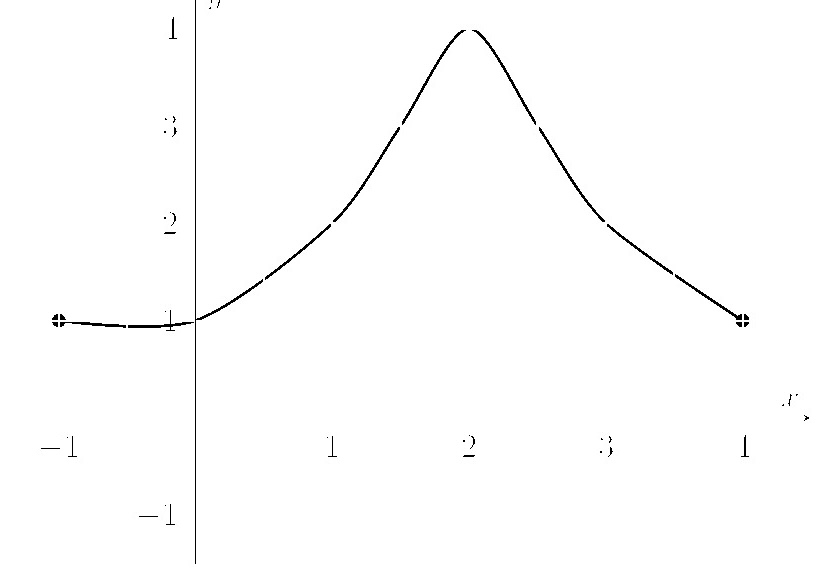
(10 points) The graph of y = f(x) is sketched below.
[Graph image]
- (5 points) On the graph above, sketch the graph of \(\displaystyle y = f'(x)\).
- (5 points) On the graph above, sketch the graph of \(\displaystyle y = f''(x)\). Be sure to clearly label your sketches.
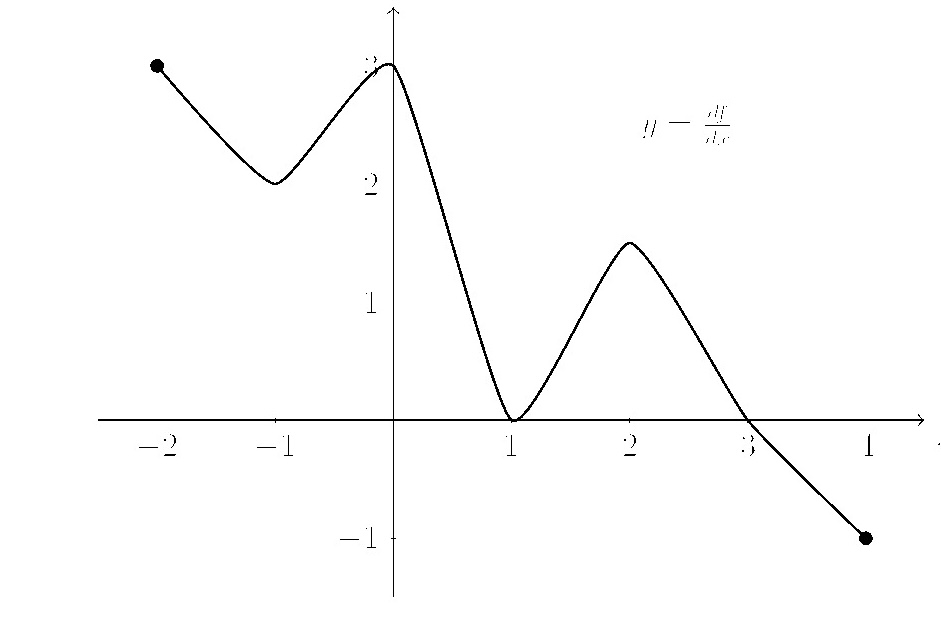
Let \(\displaystyle f\) be a function with domain \(\displaystyle [-2,2]\) and range \(\displaystyle [-2,2]\) whose graph is shown in the figure above.
- On what interval(s) is \(\displaystyle f\) increasing?
- On what interval(s) is \(\displaystyle f\) decreasing?
- For what value(s) of \(\displaystyle x\) does \(\displaystyle f(x) = 0\)?
- For what value(s) of \(\displaystyle x\) does \(\displaystyle f\) have a local maximum?
- For what value(s) of \(\displaystyle x\) does \(\displaystyle f\) have a local minimum?
IMAGE
IMAGE
IMAGE
Solution: From the visible graph, \(f\) decreases on \((-2,-1)\), increases on \((-1,0)\), decreases on \((0,1)\), increases on \((1,2)\), and then decreases again to the right. So a correct sketch of \(f'\) must be negative, then positive, then negative, then positive, then negative, with zeros at the visible local extrema of \(f\), namely near \(x=-1,0,1,2\). Likewise, a sketch of \(f''\) must reflect the changes in concavity of the given curve. Reading the same graph, the increasing intervals are approximately \(\boxed{(-1,0)\cup(1,2)}\), the decreasing intervals are \(\boxed{(-2,-1)\cup(0,1)\cup(2,4)}\), the zeros are \(\boxed{x=1\text{ and }x=3}\), the local maxima occur at \(\boxed{x=0\text{ and }x=2}\), and the local minima occur at \(\boxed{x=-1\text{ and }x=1}\). The scan is imperfect, so these values are read directly from the plotted graph.
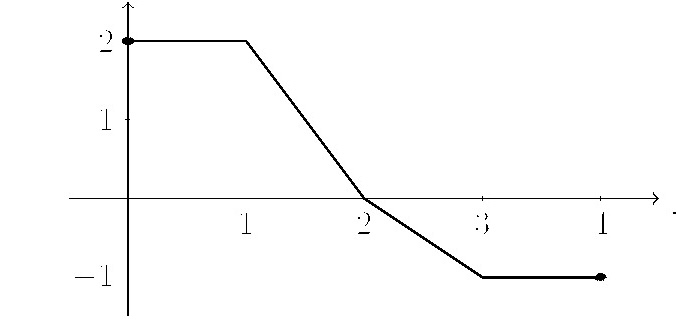
(5 points) The velocity vs. time graph of a 3.0 kg object is shown below.
[graph shown]
- What is the acceleration of the object during the time interval \(\displaystyle 0 < t < 2\) s?
- What is the net force on the object during the time interval \(\displaystyle 0 < t < 2\) s?
- What is the displacement of the object during the time interval \(\displaystyle 0 < t < 5\) s?
IMAGE
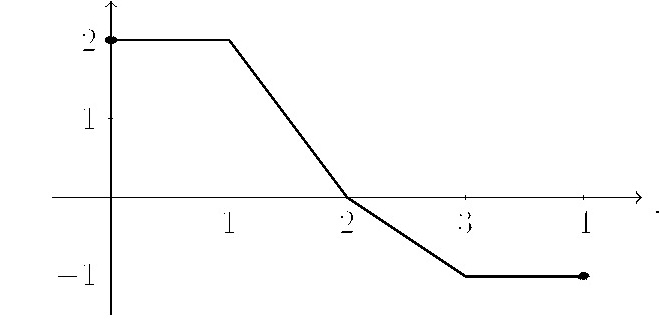
Solution:
- The acceleration is the slope of the velocity graph. From \(0<t<1\), the graph is horizontal, so \(a=0\). From \(1<t<2\), the line goes from \((1,2)\) to \((2,0)\), so the slope is \(-2\). Thus the acceleration is not constant on the whole interval \((0,2)\): \(\boxed{a(t)=0\text{ on }(0,1),\ a(t)=-2\text{ on }(1,2)}\).
- Using \(F=ma\) with mass \(3.0\) kg, the net force is \(0\) N on \((0,1)\) and \(3(-2)=\boxed{-6\text{ N}}\) on \((1,2)\).
- The scan asks for displacement on \((0,5)\), but the visible graph only runs to \(t=4\). Over the displayed interval \([0,4]\), the displacement is the signed area: \[ 2\cdot1+\frac12(1)(2)-\frac12(1)(1)-1\cdot1=2+1-\frac12-1=\boxed{\frac32}. \] So the graph shown gives a displacement of \(\boxed{3/2}\) units from \(0\) to \(4\); the original PDF is likely clearer about the intended endpoint.
A car is moving North at 65 miles per hour. A person is walking due East on a different road. Determine how fast the person is moving at the moment when the person is 50 miles West and 70 miles South of the car and the distance between the person and the car is increasing at a rate of 55 miles per hour.
Solution: Let \(x\) be the east-west separation and \(y\) the north-south separation between the person and the car. At the instant in question, \(x=50\), \(y=70\), and \[ z=\sqrt{x^2+y^2}=\sqrt{50^2+70^2}=10\sqrt{74}. \] We are told \(dz/dt=55\) and the car moves north at \(dy/dt=65\). If the person walks due east, then \(dx/dt\) is the person’s speed. Differentiate \(z^2=x^2+y^2\): \[ 2z\frac{dz}{dt}=2x\frac{dx}{dt}+2y\frac{dy}{dt}. \] Hence \[ 50\frac{dx}{dt}+70(65)=10\sqrt{74}(55). \] Therefore \[ \frac{dx}{dt}=11\sqrt{74}-91\approx\boxed{3.62\text{ mph}}. \]
A component of an engine will be connected to a heat sink by a cylindrical rod of length 8 cm with radius \(\displaystyle r\). The rate of heat flow through the rod is given by
where \(\displaystyle \mu > 0\) is the thermal conduction coefficient. The cost to make the rod is equal to the radius plus the thermal conduction coefficient. If $30 is allocated to produce the rod, determine the radius, \(\displaystyle r\), and thermal conduction coefficient, \(\displaystyle \mu\), of the rod that will maximize the rate of heat flow.
Solution: The budget constraint is \(r+\mu=30\), so \(\mu=30-r\). Then the heat flow becomes \[ G(r)=\frac18\mu r^2=\frac18(30-r)r^2. \] Differentiate: \[ G'(r)=\frac18(60r-3r^2)=\frac{3r(20-r)}{8}. \] The positive critical point is \(r=20\). Since \(G(0)=0\), \(G(30)=0\), and the interior critical point gives a larger value, it yields the maximum. Therefore \[ \boxed{r=20\text{ cm},\qquad \mu=10}. \]
Find all points, other than (0,0), where the curve
has a vertical tangent line. Your answer(s) should be in the form of coordinate pairs.
Solution: For the curve \(x^3+xy+y^3=0\), implicit differentiation gives \[ 3x^2+y+xy'+3y^2y'=0, \] so \[ y'=-\frac{3x^2+y}{x+3y^2}. \] A vertical tangent occurs when the denominator is zero but the numerator is not. Thus we require \[ x+3y^2=0\quad\text{and}\quad x^3+xy+y^3=0. \] Substitute \(x=-3y^2\) into the curve equation: \[ (-3y^2)^3+(-3y^2)y+y^3=-27y^6-2y^3=-y^3(27y^3+2)=0. \] Besides \(y=0\), which gives the excluded point \((0,0)\), we obtain \(y^3=-\dfrac{2}{27}\), hence \(y=-\dfrac{\sqrt[3]{2}}{3}\). Then \[ x=-3y^2=-\frac{\sqrt[3]{4}}{3}. \] Therefore the nonzero point where the curve has a vertical tangent is \[ \boxed{\left(-\frac{\sqrt[3]{4}}{3},-\frac{\sqrt[3]{2}}{3}\right)}. \]