Determine the first derivative of each of the following functions. Print your answer in the box provided.
- \(\displaystyle f(x) = e^{3x} + 5x^2 + 2001\).
- \(\displaystyle h(x) = x^2 \cos(x) + 42\).
- \(\displaystyle G(r) = \frac{r + 4}{3r^2 + 7}\).
- \(\displaystyle M(x) = \arctan(3x)\).
- \(\displaystyle Q(s) = (1+s)^{\frac{1}{4}}\).
'(s) =
\]
Determine the most general anti-derivative indicated in each of the following expressions. Print your answer in the box provided.
- \(\displaystyle \int (5x + 3)\ dx\).
Anti-Derivative:
- \(\displaystyle \int (\cos(4x) + e^{2x} + 9)\ dx\).
Anti-Derivative:
- \(\displaystyle \int \frac{x}{3 - x^2} dx\).
Anti-Derivative:
- \(\displaystyle \int \sin(x) \cos(x) dx\).
Anti-Derivative:
Determine the value of each of the following limits. Indicate if a limit approaches \(\displaystyle \infty\) or \(\displaystyle -\infty\) otherwise print DNE if the limit does not exist. **Show all of your work and justify your conclusions.**
- \(\displaystyle \lim_{x \to 0} \frac{\sin^2(x)}{1 - \cos(x)}\).
- \(\displaystyle \lim_{x \to 1} f(x)\) where
Use the following tables to answer each of the questions below.
| x | 1 | 2 | 3 | 4 | 5 | 6 | 7 | 8 |
|---|---|---|---|---|---|---|---|---|
| f(x) | 4 | 3 | 5 | 8 | 6 | 7 | 1 | 2 |
| f'(x) | 3 | 2 | 1 | 6 | 4 | 5 | 8 | 7 |
| x | 1 | 2 | 3 | 4 | 5 | 6 | 7 | 8 |
| g(x) | 6 | 5 | 1 | 2 | 8 | 7 | 4 | 3 |
| g'(x) | 1 | 4 | 2 | 9 | 3 | 6 | 8 | 5 |
- Determine the value of \(\displaystyle p'(2)\) where \(\displaystyle p(x) = f(x) \cdot g(x)\).
- Determine the equation for the tangent line of \(\displaystyle p(x) = f(x) \cdot g(x)\) at \(\displaystyle x = 2\).
Tangent Line:
The following questions refer to the limit definition of the derivative.
- State the limit definition of the derivative of a function, \(\displaystyle f(x)\).
- Use the \textbf{limit definition of the derivative} to show that
Evaluate
The efficiency of a Carnot heat engine is defined to be
where \(\displaystyle C\) is the temperature of the surrounding environment in Kelvin, and \(\displaystyle T\) is the temperature of the heat source. For the following questions assume that \(\displaystyle C = 300\) Kelvin is a constant.
- Determine the linearization of \(\displaystyle E(T)\) at \(\displaystyle T = 500\text{K}\).
- Use the linearization to approximate the change in \(\displaystyle E\) if \(\displaystyle T = 500 \pm 20 \text{K}\).
IMAGE
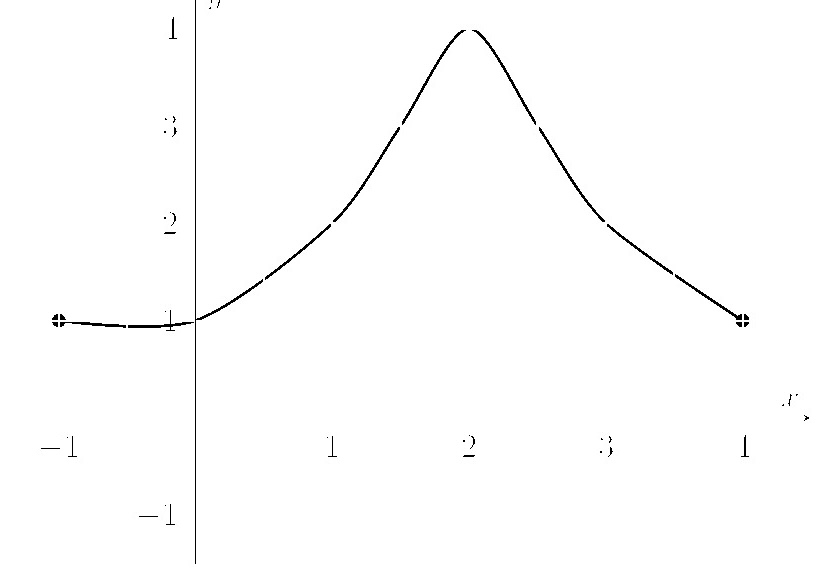
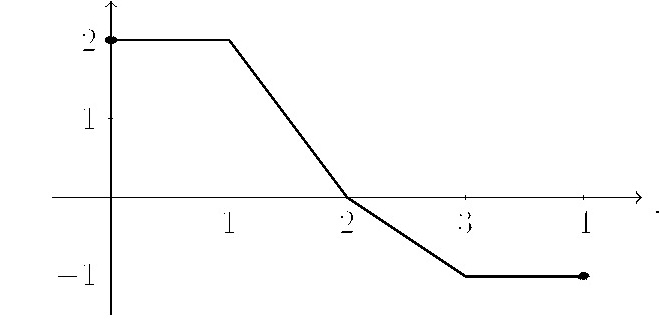
(10 points) The graph of y = f(x) is sketched below.
[Graph image]
- (5 points) On the graph above, sketch the graph of \(\displaystyle y = f'(x)\).
- (5 points) On the graph above, sketch the graph of \(\displaystyle y = f''(x)\). Be sure to clearly label your sketches.
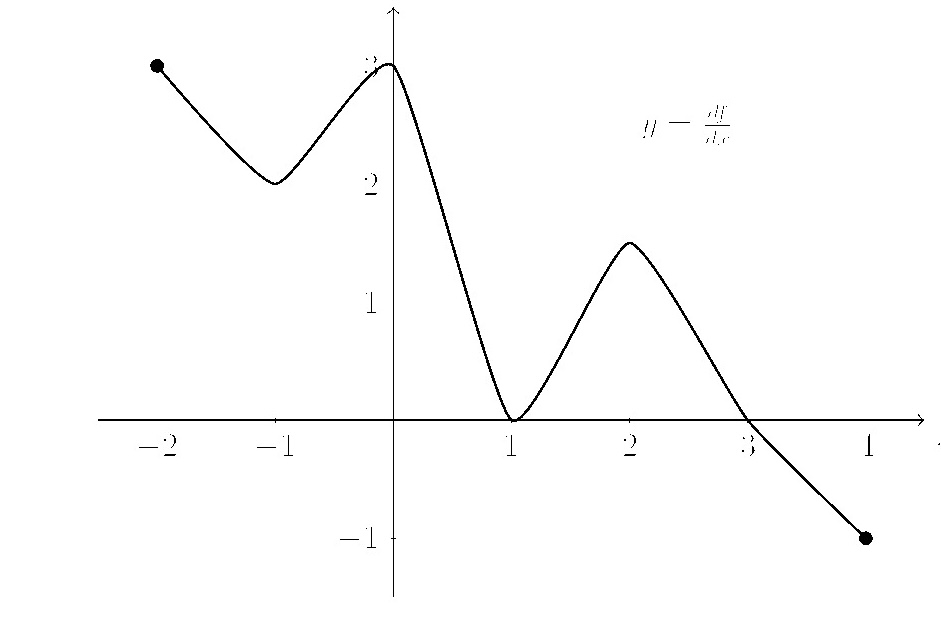
Let \(\displaystyle f\) be a function with domain \(\displaystyle [-2,2]\) and range \(\displaystyle [-2,2]\) whose graph is shown in the figure above.
- On what interval(s) is \(\displaystyle f\) increasing?
- On what interval(s) is \(\displaystyle f\) decreasing?
- For what value(s) of \(\displaystyle x\) does \(\displaystyle f(x) = 0\)?
- For what value(s) of \(\displaystyle x\) does \(\displaystyle f\) have a local maximum?
- For what value(s) of \(\displaystyle x\) does \(\displaystyle f\) have a local minimum?
IMAGE
IMAGE
IMAGE
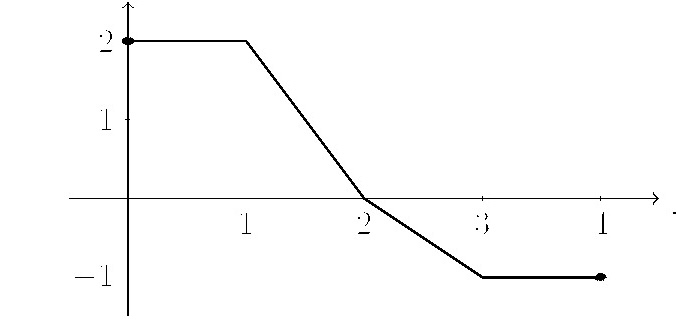
(5 points) The velocity vs. time graph of a 3.0 kg object is shown below.
[graph shown]
- What is the acceleration of the object during the time interval \(\displaystyle 0 < t < 2\) s?
- What is the net force on the object during the time interval \(\displaystyle 0 < t < 2\) s?
- What is the displacement of the object during the time interval \(\displaystyle 0 < t < 5\) s?
IMAGE
A car is moving North at 65 miles per hour. A person is walking due East on a different road. Determine how fast the person is moving at the moment when the person is 50 miles West and 70 miles South of the car and the distance between the person and the car is increasing at a rate of 55 miles per hour.
A component of an engine will be connected to a heat sink by a cylindrical rod of length 8 cm with radius \(\displaystyle r\). The rate of heat flow through the rod is given by
where \(\displaystyle \mu > 0\) is the thermal conduction coefficient. The cost to make the rod is equal to the radius plus the thermal conduction coefficient. If $30 is allocated to produce the rod, determine the radius, \(\displaystyle r\), and thermal conduction coefficient, \(\displaystyle \mu\), of the rod that will maximize the rate of heat flow.
Find all points, other than (0,0), where the curve
has a vertical tangent line. Your answer(s) should be in the form of coordinate pairs.