Determine the first derivative of each of the following functions. Print your answer in the box provided.
- \(\displaystyle f(x) = x \cos(5x) + x^2 + 8\).
- \(\displaystyle g(t) = e^{3t^2} \cdot \ln(8t + 1) + 2001\).
- \(\displaystyle F(y) = \frac{y}{y^2 + 1}\).
- \(\displaystyle H(u) = \arccos \left( \frac{u}{2} \right)\).
- \(\displaystyle h(x) = (5x^2 + 1)^{4x}\).
Determine the most general anti-derivative for each of the following expressions. Print your answer in the box provided.
- \(\displaystyle \int (10x^4 - e^x + 2001)\ dx\).
Anti-Derivative:
- \(\displaystyle \int \left( \cos(8x) - \frac{1}{x} \right)\ dx\).
Anti-Derivative:
- \(\displaystyle \int x \sin(4x^2 - 1)\ dx\).
Anti-Derivative:
- \(\displaystyle \int \frac{x}{\sqrt{1+x^2}} dx\).
- \(\displaystyle \int \frac{e^{\sqrt{x}}}{\sqrt{x}} dx\).
Determine the value of each of the following limits. Show all of your work and justify your conclusions. Indicate if a limit approaches \(\displaystyle \infty\) or \(\displaystyle -\infty\) otherwise print DNE if the limit does not exist.
(a)
(b)
The following questions refer to the limit definition of the derivative.
- State the limit definition of the derivative of the function \(\displaystyle f(x)\) at the point \(\displaystyle x_0\).
- Use the \textbf{limit definition of the derivative} to show that the derivative of \(\displaystyle f(x) = 3x^2 - 4x + 10\) at \(\displaystyle x_0\) is \(\displaystyle f'(x_0) = 6x_0 - 4\).
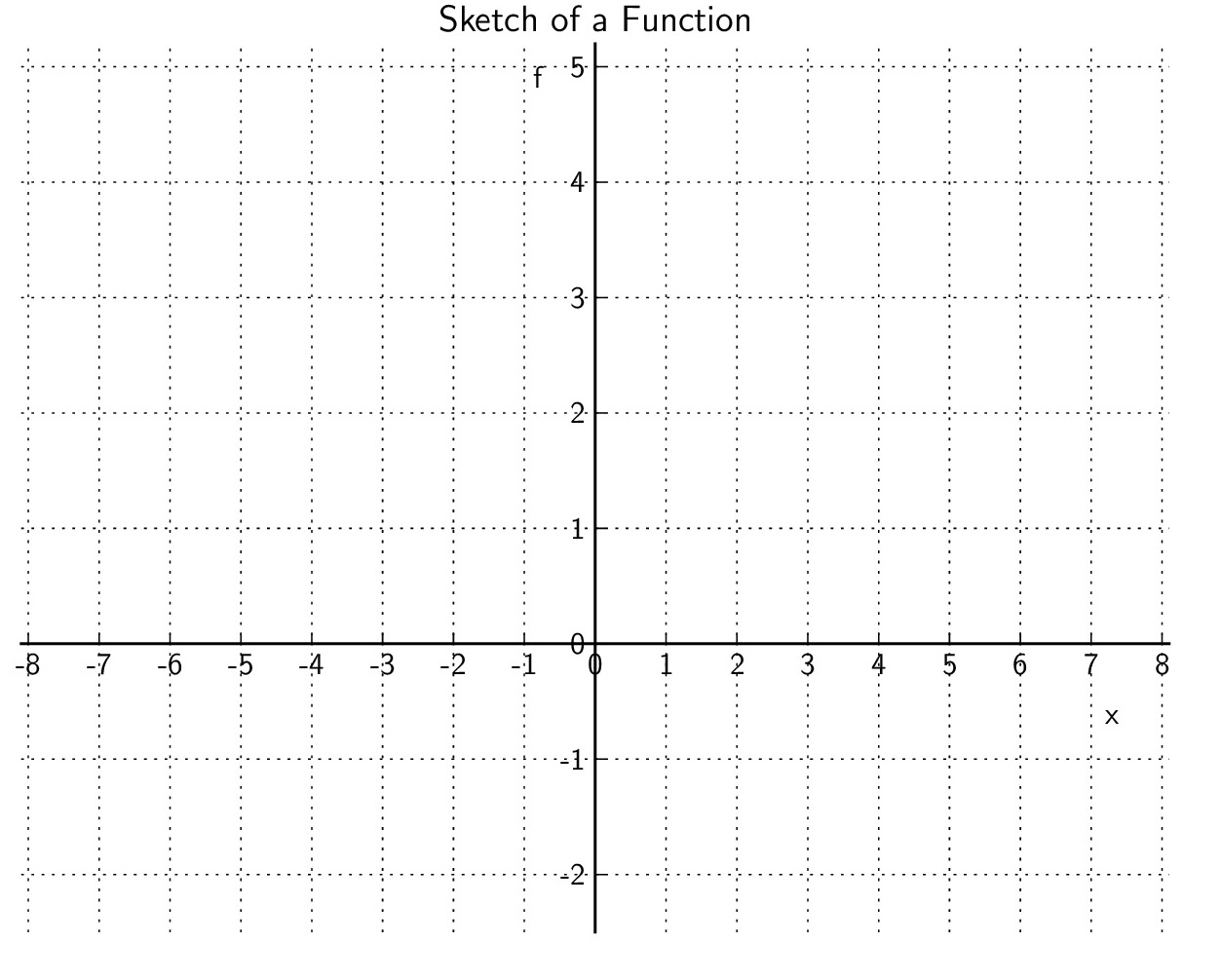
Use the axes below to make a sketch of the graph of a function whose domain is \(\displaystyle (-\infty, \infty)\) that satisfies all of the following criteria:
\(\displaystyle f(x)\) is \(\displaystyle \textbf{not}\) differentiable at \(\displaystyle x = 4\).
Sketch of a Function
[A set of axes with labeled gridlines for sketching the graph]
IMAGE
Popeye and Olive Oyl will be sailing away from the same dock on the small island they call home. Popeye will sail directly East at 5 knots starting at 1pm. (One knot is one nautical mile per hour.) One hour later (2pm) Olive Oyl will leave the island sailing directly South at 4 knots. Determine the rate of change of the distance between them at 3pm.
Determine the absolute minimum and absolute maximum of the function
over the interval \(\displaystyle -2 \leq x \leq 2\).
A function, \(\displaystyle f(x)\), and its derivative, \(\displaystyle f'(x)\), are both defined and continuous on the interval \(\displaystyle 0 \leq x \leq 4\). They satisfy the following criteria:
\(\displaystyle f'(0) = 0\), and \(\displaystyle f'(3) = 0\).
\(\displaystyle f'(x)\) is strictly increasing on the interval \(\displaystyle 0 \leq x < 2\).
\(\displaystyle f'(x)\) is strictly decreasing on the interval \(\displaystyle 2 < x \leq 4\).
\(\displaystyle f(0) = -2\).
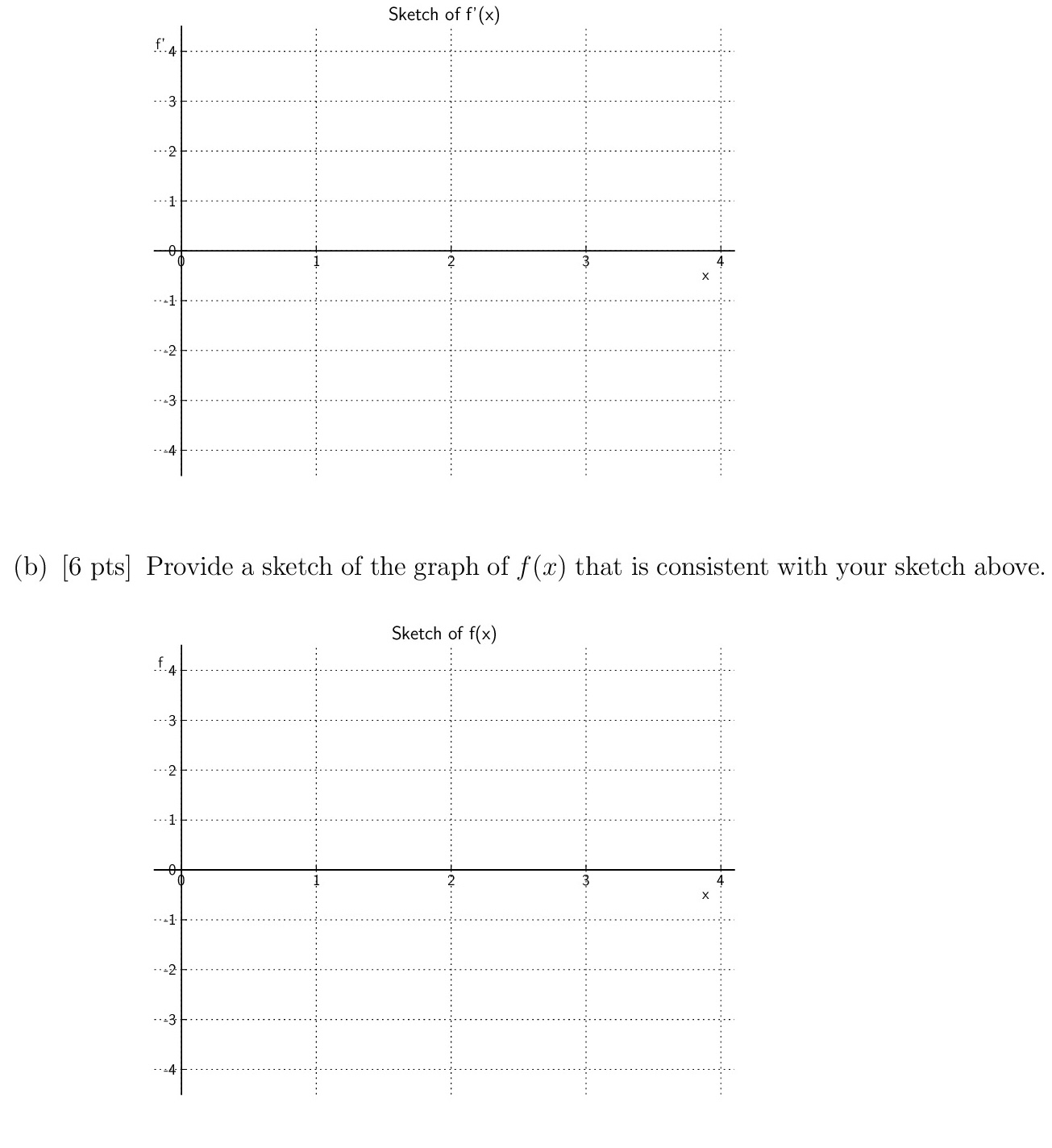
- Provide a sketch of the graph \(\displaystyle f'(x)\) that is consistent with the conditions above.
Sketch of \(\displaystyle f'(x)\)
- Provide a sketch of the graph of \(\displaystyle f(x)\) that is consistent with your sketch above.
Sketch of \(\displaystyle f(x)\)
IMAGE
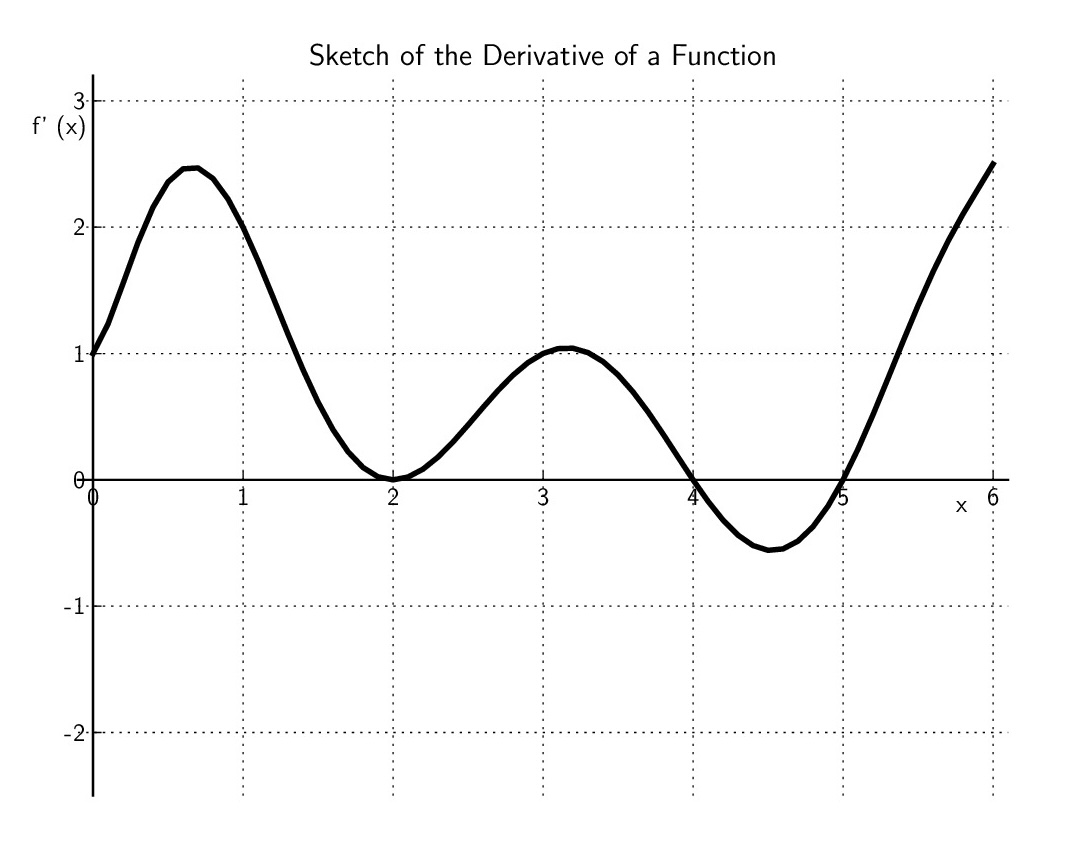
The graph of the derivative, \(\displaystyle f'(x)\), of a function is given below. Use the graph to answer each of the questions below. For each question provide a brief, one sentence justification for your answer.
Sketch of the Derivative of a Function
- Values of \(\displaystyle x\) where \(\displaystyle f(x)\) is increasing.
- Values of \(\displaystyle x\) where \(\displaystyle f(x)\) is decreasing.
- Value(s) of \(\displaystyle x\) where \(\displaystyle f(x)\) has a local maxima or minima.
Max: ________________
Min: ________________
IMAGE
Consider the region that is bounded on the left by \(\displaystyle x = 1\), bounded on the right by \(\displaystyle x = 4\), bounded above by \(\displaystyle f(x) = x^2\), and bounded below by \(\displaystyle g(x) = -x\).
- Make a sketch of the region.
- Construct an estimate of the area of the region using a Riemann sum with four rectangles of equal length. Do not provide the number but provide an expression that can be directly plugged into a calculator. Also, state if the sum is a left sided sum, right sided sum, or mid-point sum for your estimate.
- Generalize the estimate for the area to a Riemann sum with \(\displaystyle N\) rectangles of equal width.
IMAGE

The velocity of a particle is
where the unit for \(\displaystyle t\) is seconds, and the units for the velocity are meters per second. Determine the displacement from \(\displaystyle t = 0\) to \(\displaystyle t = 60\).
Two small vehicles are placed on opposite sides of a straight track facing each other. The track is 100 meters long. An experiment is conducted in which the cars move toward each other with constant velocities until they crash into one another. The cost of fuel for the first car is four times the square of the distance it moves. The cost of fuel for the second car is two times the square of the distance it moves. The experimenters want to minimize the fuel costs. How far should the first car travel? Justify that your answer is a minimum.
Consider the ellipse given by
- Determine the equation of the tangent line to the curve at the point \(\displaystyle (\sqrt{2}, 0)\).
- Determine all points on the ellipse which have a horizontal tangent line.
How well do you think your score will be on this test compared to the other students? Circle the percentage below that corresponds to your rank. A 100% means that you will have the best score, and a 50% means that your score will be in the middle of all of the scores.
0 5 10 15 20 25 30 35 40 45 50 55 60 65 70 75 80 85 90 95 100
out of a possible 12 points