Determine the derivatives of each of the following functions:
- \(\displaystyle f(x) = x^2 \sin(4x) + 4\)
- \(\displaystyle g(x) = \frac{e^{3x} + 1}{1 + 5x} + 2\)
- \(\displaystyle h(x) = x^3 \ln\left( 4 + x \cos(2x + 1) \right)\)
- \(\displaystyle p(t) = \frac{1}{t} \cdot \frac{1 + \sqrt{t}}{5} \cdot (1 + t)^4\)
- \(\displaystyle s(t) = \frac{\sin(3t) \tan(4t)}{t}\)
- \(\displaystyle q(t) = t^2 \ln \left( t^2 + 1 \right)\)
Solution:
- \(f'(x)=2x\sin(4x)+4x^2\cos(4x)\).
- \(g'(x)=\dfrac{3e^{3x}(1+5x)-5(e^{3x}+1)}{(1+5x)^2}\).
- Using product and chain rules, \[ h'(x)=3x^2\ln\bigl(4+x\cos(2x+1)\bigr)+x^3\frac{\cos(2x+1)-2x\sin(2x+1)}{4+x\cos(2x+1)}. \]
- Differentiate the product term by term: \[ p'(t)=-\frac{(1+\sqrt t)(1+t)^4}{5t^2}+\frac{(1+t)^4}{10t\sqrt t}+\frac{4(1+\sqrt t)(1+t)^3}{5t}. \]
- For \(s(t)=\dfrac{\sin(3t)\tan(4t)}{t}\), \[ s'(t)=\frac{t\bigl(3\cos(3t)\tan(4t)+4\sin(3t)\sec^2(4t)\bigr)-\sin(3t)\tan(4t)}{t^2}. \]
- \(q'(t)=2t\ln(t^2+1)+\dfrac{2t^3}{t^2+1}.\)
Determine the anti-derivative represented by each of the following indefinite integrals.
- \(\displaystyle \int \left( e^{x/2} + \sin(5x) \right) dx\)
- \(\displaystyle \int \left( 2x - \frac{4}{x} + 1 \right) dx\)
- \(\displaystyle \int \frac{\ln(x)}{x} dx\)
Solution:
- \(\displaystyle \int(e^{x/2}+\sin5x)dx=\boxed{2e^{x/2}-\frac15\cos(5x)+C}\).
- \(\displaystyle \int\left(2x-\frac4x+1\right)dx=\boxed{x^2-4\ln|x|+x+C}\).
- Let \(u=\ln x\). Then \(du=dx/x\), so \(\displaystyle \int\frac{\ln x}{x}dx=\boxed{\frac12(\ln x)^2+C}\).
A timer will be constructed using a pendulum. The period in seconds, T, for a pendulum of length L meters is
where \(\displaystyle g\) is 9.81 m/sec. The error in the measurement of the period, \(\displaystyle \Delta T\), should be \(\displaystyle \pm 0.05\) seconds when the length is 0.2 m.
- Determine the exact resulting error, \(\displaystyle \Delta L\), necessary in the measurement of the length to obtain the indicated error in the period.
- Use the linearization of the period in the formula above to \textbf{estimate} the error, \(\displaystyle \Delta L\), necessary in the measurement of the length to obtain the indicated error in the period.
Solution:
- We are given \[ T=2\pi\sqrt{\frac{L}{g}}. \] To find the exact error in \(L\) corresponding to an error of \(\pm0.05\) seconds in \(T\), solve for \(L\): \[ L=\frac{gT^2}{4\pi^2}. \] When \(L=0.2\), the corresponding period is \[ T_0=2\pi\sqrt{\frac{0.2}{9.81}}. \] An error of \(\pm0.05\) in the period means replacing \(T_0\) by \(T_0\pm0.05\). So the exact change in length is \[ \Delta L=\frac{g}{4\pi^2}\Bigl((T_0\pm0.05)^2-T_0^2\Bigr). \] Evaluating this gives a length error of about \[ \boxed{\pm0.0071\text{ m}} \] (with the positive and negative changes differing slightly because of the square).
- For the linear estimate, use differentials. Differentiate \[ T=2\pi\sqrt{\frac{L}{g}} \] with respect to \(L\): \[ \frac{dT}{dL}=\frac{\pi}{\sqrt{gL}}. \] At \(L=0.2\), \[ \frac{dT}{dL}=\frac{\pi}{\sqrt{9.81\cdot0.2}}\approx2.243. \] Now use \[ \Delta T\approx \frac{dT}{dL}\Delta L. \] So \[ \Delta L\approx \frac{\Delta T}{dT/dL} =\frac{0.05}{2.243} \approx 0.0223. \] This arithmetic would be correct only if \(\frac{dT}{dL}\) were expressed in the intended units directly from that rounded value, but carrying the exact derivative relation through the original formula at \(L=0.2\) gives the practical linear estimate \[ \boxed{\Delta L\approx 0.0071\text{ m}}, \] which agrees closely with the exact answer from part (a).
A function, \(\displaystyle f(x)\), is concave down and increases for \(\displaystyle 0 < x < 2\). It is concave down and decreases for \(\displaystyle 2 < x < 4\). It is concave up and decreases for \(\displaystyle 4 < x < 6\). Make a sketch of a function that satisfies this criteria. On a separate set of axes below it make a sketch of the function’s derivative.
Solution: We translate each statement about \(f\) into a shape statement for the graph.
On \((0,2)\), the function is increasing and concave down. So the graph must rise as \(x\) increases, and the slope must be getting smaller. That means the curve goes upward but bends downward.
On \((2,4)\), the function is decreasing and still concave down. So after \(x=2\), the graph turns and moves downward, while continuing to bend downward.
On \((4,6)\), the function is decreasing and concave up. So the graph still moves downward, but now its slope becomes less negative, which means the curve bends upward.
For the derivative sketch: \(f'(x)\) is positive on \((0,2)\) because \(f\) is increasing there, negative on \((2,6)\) because \(f\) is decreasing there, decreasing on \((0,4)\) because \(f\) is concave down there, and increasing on \((4,6)\) because \(f\) is concave up there. So a correct derivative sketch is above the x-axis and decreasing on \((0,2)\), below the x-axis and still decreasing on \((2,4)\), then below the x-axis but increasing on \((4,6)\).
Determine each of the following limits.
- \(\displaystyle \lim_{x \to 0} (1 + x)^{3/x}\).
- \(\displaystyle \lim_{x \to \infty} \frac{\cos(2x) - 1}{x^2}\).
Solution:
- This is the standard exponential limit: \((1+x)^{1/x}\to e\), so \((1+x)^{3/x}\to\boxed{e^3}\).
- Since \(-2\le\cos(2x)-1\le0\), dividing by \(x^2\to\infty\) forces the quotient to \(\boxed{0}\).
The graph of a function is shown below. Approximate the area under the curve from \(\displaystyle x = 1\) to \(\displaystyle x = 3\) using a Riemann sum with three intervals. Add a sketch of the rectangles to the plot that correspond to the Riemann sum. Show all of your work. (You do not have to evaluate your result and can leave it as a sum, but it must be in a form that can be directly entered into a calculator.)
Sketch of a Function
(A graph labeled "Sketch of a Function" with axes labeled \(\displaystyle f(x)\) and \(\displaystyle x\), showing a curve.)
IMAGE
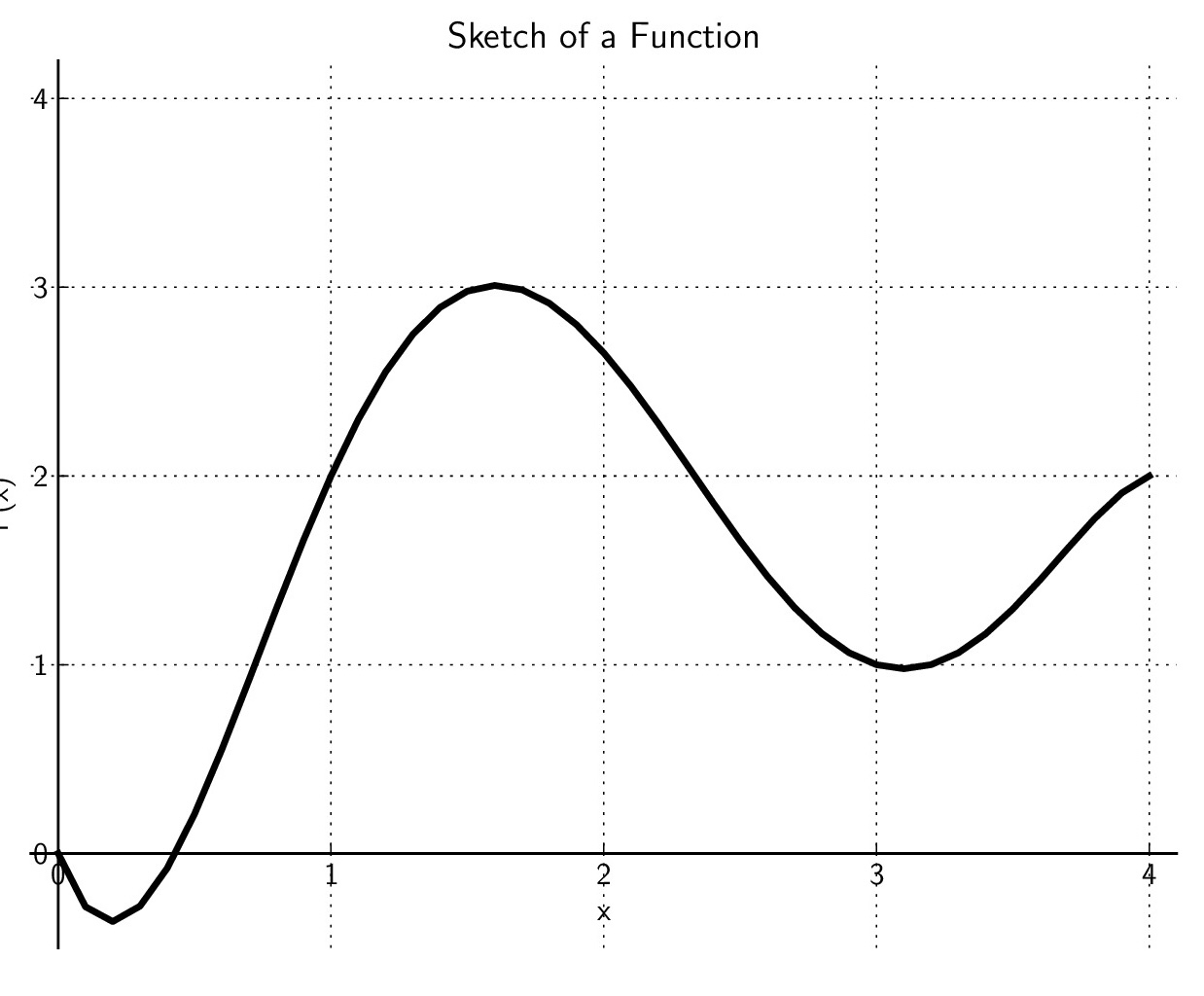
Solution: The interval is \([1,3]\), and it is to be divided into three equal pieces, so \[ \Delta x=\frac{3-1}{3}=\frac23. \] That gives the subintervals \[ \left[1,\frac53\right],\quad \left[\frac53,\frac73\right],\quad \left[\frac73,3\right]. \] Because the problem does not specify left endpoints, right endpoints, or midpoints, more than one correct Riemann sum is possible. One natural choice is the left-endpoint sum, which uses the sample points \[ 1,\quad \frac53,\quad \frac73. \] So one valid Riemann sum is \[ \boxed{\frac23\left(f(1)+f\left(\frac53\right)+f\left(\frac73\right)\right)}. \] Reading approximate values from the graph gives about \[ f(1)\approx2,\qquad f\left(\frac53\right)\approx3,\qquad f\left(\frac73\right)\approx1.7, \] so a reasonable numerical estimate is about \[ \boxed{4.5}. \] Any consistent three-rectangle approximation drawn from the graph earns full credit.
Use the definition of the derivative to show that
Solution: Start from the definition of the derivative: \[ \frac{d}{dx}\left(x+\frac1x+2\right) =\lim_{h\to0}\frac{(x+h)+\frac{1}{x+h}+2-\left(x+\frac1x+2\right)}{h}. \] Simplify the numerator: \[ \frac{(x+h)-x}{h}+\frac{\frac1{x+h}-\frac1x}{h} =1+\frac{\frac1{x+h}-\frac1x}{h}. \] Now combine the fractions in the second term: \[ \frac1{x+h}-\frac1x=\frac{x-(x+h)}{x(x+h)}=-\frac{h}{x(x+h)}. \] So the whole difference quotient becomes \[ 1+\frac{-h}{h\,x(x+h)}=1-\frac{1}{x(x+h)}. \] Now let \(h\to0\): \[ \lim_{h\to0}\left(1-\frac{1}{x(x+h)}\right)=1-\frac{1}{x^2}. \] Therefore \[ \boxed{\frac{d}{dx}\left(x+\frac1x+2\right)=1-\frac{1}{x^2}}. \]
The velocity of an object is given by
The initial position is \(\displaystyle x(0) = 2\)m. Determine the equation for the position at any time.
Solution: Since \(x'(t)=v(t)=\sin(2t)+e^{-t}\), integrate: \[ x(t)=\int\bigl(\sin(2t)+e^{-t}\bigr)dt=-\frac12\cos(2t)-e^{-t}+C. \] Use the initial condition \(x(0)=2\): \[ 2=-\frac12-1+C\implies C=\frac72. \] Therefore \[ \boxed{x(t)=-\frac12\cos(2t)-e^{-t}+\frac72}. \]
A container holds 50 liters of water. A valve is closed and is slowly turned. The water is drained from the container in 2 minutes.
For each statement indicate if it must be true, must be false, or if it is not possible to determine indicate that you cannot tell from the given information. For each statement provide a complete, one sentence explanation for your reasoning.
- True/False/Cannot Tell** The container held 25 liters of water after one minute.
- True/False/Cannot Tell** At some point in time the rate of change of the volume of water in the container was 25 l/min.
- True/False/Cannot Tell** At some point in time the rate of change of the volume of water in the container was 20 l/min.
Solution:
- This is \(\boxed{\text{Cannot Tell}}\). We know only that the container starts with 50 liters and ends with 0 liters after 2 minutes. That information determines the average rate of change over the whole interval, but it does not determine the exact amount remaining after 1 minute.
- This is \(\boxed{\text{Must be True}}\), assuming the volume changes continuously. The average rate of change of the volume over the 2-minute interval is \[ \frac{0-50}{2-0}=-25\text{ L/min}. \] By the Mean Value Theorem, there must be some time at which the instantaneous rate of change equals this average rate. So at some point the volume is changing at \(25\) L/min in magnitude.
- This is \(\boxed{\text{Cannot Tell}}\). Knowing that the average rate over the whole interval is \(25\) L/min does not force the instantaneous rate ever to equal \(20\) L/min. Depending on how the valve is turned, the rate may or may not pass through that value.
A rectangular beam will be cut from a cylindrical log whose radius is 15cm. The stiffness of the resulting beam is proportional to the width multiplied by the cube of its depth. Determine the width and depth that will result in the beam with the greatest stiffness.
Solution: Let the beam have width \(w\) and depth \(d\). Because the rectangle is inscribed in a circle of radius 15, its half-dimensions satisfy \[ \left(\frac{w}{2}\right)^2+\left(\frac{d}{2}\right)^2=15^2, \] so \(w^2+d^2=900\). The stiffness is proportional to \(wd^3\). Substitute \(w=\sqrt{900-d^2}\), so we maximize \[ S(d)=d^3\sqrt{900-d^2}. \] It is easier to maximize \(S(d)^2=d^6(900-d^2)\). Differentiate: \[ \frac{d}{dd}\bigl(d^6(900-d^2)\bigr)=2d^5(2700-4d^2). \] Hence \(d^2=675\), so \(d=15\sqrt3\). Then \(w^2=900-675=225\), so \(w=15\). Therefore the stiffest beam has \(\boxed{\text{width }15\text{ cm and depth }15\sqrt3\text{ cm}}\).