Determine the derivatives of each of the following functions:
- \(\displaystyle f(x) = 4x + 8x^{0.2}\)
- \(\displaystyle g(x) = \frac{x}{1+x}\)
- \(\displaystyle h(x) = (x^2 + 1)^2 \cdot \sin(2x)\)
- \(\displaystyle u(x) = \frac{1}{\sqrt[3]{x}} + e^{-x^2+1}\)
- \(\displaystyle u(x) = \cos(\ln(2 + (x^2-1)^3))\)
- \(\displaystyle v(x) = \frac{\tan(x^5+1)}{x+1}\)
Solution:
- Differentiate term by term. The derivative of \(4x\) is \(4\), and the power rule gives \[ \frac{d}{dx}\bigl(8x^{0.2}\bigr)=8(0.2)x^{-0.8}=\frac85x^{-4/5}. \] Therefore \[ \boxed{f'(x)=4+\frac85x^{-4/5}}. \]
- We use the quotient rule with numerator \(N(x)=x\) and denominator \(D(x)=1+x\). Then \(N'(x)=1\) and \(D'(x)=1\). So \[ g'(x)=\frac{N'D-ND'}{D^2} =\frac{1(1+x)-x(1)}{(1+x)^2} =\frac{1}{(1+x)^2}. \] Hence \[ \boxed{g'(x)=\frac{1}{(1+x)^2}}. \]
- This is a product of \((x^2+1)^2\) and \(\sin(2x)\), so we use the product rule. First, \[ \frac{d}{dx}(x^2+1)^2=2(x^2+1)(2x)=4x(x^2+1) \] by the chain rule, and \[ \frac{d}{dx}\sin(2x)=2\cos(2x). \] Therefore \[ h'(x)=4x(x^2+1)\sin(2x)+2(x^2+1)^2\cos(2x). \] So \[ \boxed{h'(x)=4x(x^2+1)\sin(2x)+2(x^2+1)^2\cos(2x)}. \]
- Differentiate each term separately. Since \(x^{-1/3}=\dfrac{1}{\sqrt[3]{x}}\), \[ \frac{d}{dx}\left(x^{-1/3}\right)=-\frac13x^{-4/3}. \] For the exponential term, apply the chain rule: \[ \frac{d}{dx}\left(e^{-x^2+1}\right)=e^{-x^2+1}(-2x). \] Hence \[ \boxed{u'(x)=-\frac13x^{-4/3}-2xe^{-x^2+1}}. \]
- Set \[ w(x)=2+(x^2-1)^3. \] Then \(u(x)=\cos(\ln w(x))\). We now differentiate from the outside inward. The derivative of \(\cos(\cdot)\) is \(-\sin(\cdot)\), the derivative of \(\ln w(x)\) is \(\dfrac{w'(x)}{w(x)}\), and \[ w'(x)=3(x^2-1)^2(2x)=6x(x^2-1)^2. \] Therefore \[ u'(x)=-\sin(\ln w(x))\cdot\frac{w'(x)}{w(x)} =-\sin(\ln w(x))\cdot\frac{6x(x^2-1)^2}{w(x)}. \] Substituting back for \(w(x)\), we get \[ \boxed{u'(x)=-\sin\!\left(\ln\!\bigl(2+(x^2-1)^3\bigr)\right)\frac{6x(x^2-1)^2}{2+(x^2-1)^3}}. \]
- This is a quotient, so we use the quotient rule. Let \[ N(x)=\tan(x^5+1),\qquad D(x)=x+1. \] Then \[ N'(x)=\sec^2(x^5+1)\cdot 5x^4 \] by the chain rule, and \(D'(x)=1\). Thus \[ v'(x)=\frac{N'D-ND'}{D^2} =\frac{5x^4\sec^2(x^5+1)(x+1)-\tan(x^5+1)}{(x+1)^2}. \] So \[ \boxed{v'(x)=\frac{5x^4\sec^2(x^5+1)(x+1)-\tan(x^5+1)}{(x+1)^2}}. \]
Determine the anti-derivative represented by each of the following integrals.
- \(\displaystyle \int x^3 - \sqrt{x} dx\)
- \(\displaystyle \int e^{2x} dx\)
Solution:
- Rewrite \(\sqrt{x}\) as \(x^{1/2}\), then integrate term by term: \[ \int (x^3-\sqrt{x})\,dx=\int \left(x^3-x^{1/2}\right)dx =\frac{x^4}{4}-\frac{x^{3/2}}{3/2}+C. \] Since dividing by \(3/2\) is the same as multiplying by \(2/3\), we obtain \[ \boxed{\int (x^3-\sqrt{x})\,dx=\frac{x^4}{4}-\frac23x^{3/2}+C}. \]
- We know that \[ \frac{d}{dx}\left(e^{2x}\right)=2e^{2x}, \] so an antiderivative of \(e^{2x}\) is \(\dfrac12e^{2x}\). Therefore \[ \boxed{\int e^{2x}\,dx=\frac12e^{2x}+C}. \]
Evaluate the derivative
Solution: This is a direct application of the Fundamental Theorem of Calculus. If \[ F(x)=\int_0^x f(t)\,dt, \] then \[ F'(x)=f(x), \] provided \(f\) is continuous. Here the integrand is \[ f(t)=t\sec(5t). \] Therefore we replace the variable \(t\) by \(x\) after differentiating: \[ \frac{d}{dx}\int_0^x t\sec(5t)\,dt=x\sec(5x). \] Hence \[ \boxed{\frac{d}{dx}\int_0^x t\sec(5t)\,dt=x\sec(5x)}. \]
Determine the maximum and the minimum values of the function
where \(\displaystyle 0 \leq x \leq 3\).
Solution: Since the problem asks for absolute maximum and minimum values on the closed interval \([0,3]\), we use the closed-interval method: find critical points in the interval, then compare the function values at those critical points and at the endpoints.
Let \[ f(x)=xe^{x-x^2}. \] Differentiate using the product rule: \[ f'(x)=e^{x-x^2}+xe^{x-x^2}(1-2x)=e^{x-x^2}(1+x-2x^2). \] Because the exponential factor is never zero, the critical points come from \[ 1+x-2x^2=0. \] This is equivalent to \[ 2x^2-x-1=0=(2x+1)(x-1), \] so the critical points are \(x=1\) and \(x=-\dfrac12\). Only \(x=1\) lies in the interval \([0,3]\).
Now evaluate \(f\) at the endpoints and at the interior critical point: \[ f(0)=0,\qquad f(1)=1,\qquad f(3)=3e^{-6}. \] Since \(3e^{-6}\) is positive but much smaller than \(1\), the smallest of these values is \(0\) and the largest is \(1\). Therefore the absolute minimum is \[ \boxed{f(0)=0}, \] and the absolute maximum is \[ \boxed{f(1)=1}. \]
Find the equation of the tangent line to
at the point \(\displaystyle (x, y) = (-\sqrt{2}, 1)\).
Solution: Because the equation is given implicitly, we first find the slope by implicit differentiation. Start with \[ x^2-y^2=y. \] Differentiate both sides with respect to \(x\): \[ 2x-2yy'=y'. \] Now solve for \(y'\). Move the \(y'\)-terms to the same side: \[ 2x=y'+2yy'=y'(2y+1). \] Therefore \[ y'=\frac{2x}{2y+1}. \] At the point \((x,y)=(-\sqrt2,1)\), the slope is \[ m=\frac{2(-\sqrt2)}{2(1)+1}=-\frac{2\sqrt2}{3}. \] Now use the point-slope form of the tangent line through \((-\sqrt2,1)\): \[ \boxed{y-1=-\frac{2\sqrt2}{3}(x+\sqrt2)}. \]
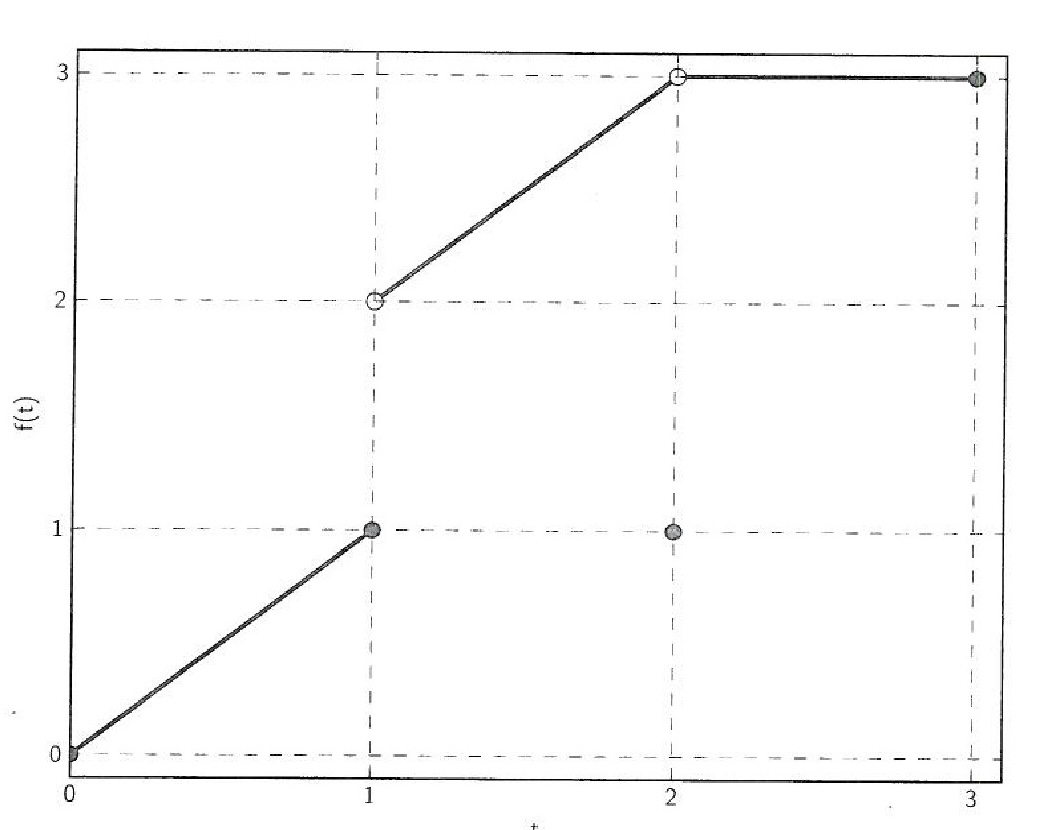
A function, \(\displaystyle f(t)\), is shown in the plot below. Determine the value of each of the following quantities. Briefly state the reason for your result in one or two complete sentences.
- \(\displaystyle \lim_{t \to 1} f(t) =\)
- \(\displaystyle f(1) =\)
- \(\displaystyle \lim_{t \to 2} f(t) =\)
- \(\displaystyle f(2) =\)
out of a possible 10 points
IMAGE
Solution:
- To find \(\lim_{t\to1}f(t)\), we compare the left-hand and right-hand limits. From the graph, as \(t\to1^-\), the function approaches \(1\), while as \(t\to1^+\), the function approaches \(2\). Since the one-sided limits are different, the two-sided limit does not exist. Therefore \[ \boxed{\lim_{t\to1}f(t)\text{ does not exist}}. \]
- The value \(f(1)\) is read from the filled point on the graph at \(t=1\). That filled point is at height \(1\), so \[ \boxed{f(1)=1}. \]
- To find \(\lim_{t\to2}f(t)\), again compare both sides. From the graph, as \(t\to2^-\), the function approaches \(3\), and as \(t\to2^+\), it also approaches \(3\). Since the left-hand and right-hand limits agree, the two-sided limit exists and equals \(3\). Thus \[ \boxed{\lim_{t\to2}f(t)=3}. \]
- The actual value \(f(2)\) is given by the filled point at \(t=2\), not by the open circle that shows the limiting behavior. The filled point is at height \(1\), so \[ \boxed{f(2)=1}. \]
Approximate the integral
using a Riemann sum with three intervals. The intervals should be equal length and use a left hand sum. (You do not have to evaluate your result and can leave it as a sum, but it must be in a form that can be directly entered into a calculator.)
Solution: We divide the interval \([0,2]\) into three equal pieces, so \[ \Delta x=\frac{2-0}{3}=\frac23. \] The subintervals are \[ \left[0,\frac23\right],\qquad \left[\frac23,\frac43\right],\qquad \left[\frac43,2\right]. \] Because the problem asks for a left-hand sum, we use the left endpoints \[ 0,\qquad \frac23,\qquad \frac43. \] Therefore the Riemann-sum approximation is \[ \boxed{\frac23\left(\cos(0)+\cos\left(\frac{2\pi}{3}\right)+\cos\left(\frac{4\pi}{3}\right)\right)}. \]
Use the definition of the derivative to show that
(hint: the quotient can be broken into two parts, one for each function.)
Solution: We start from the definition of the derivative: \[ \frac{d}{dx}\left(3x^2-\frac1x\right) =\lim_{h\to0}\frac{3(x+h)^2-\frac1{x+h}-\left(3x^2-\frac1x\right)}{h}. \] Now separate this into the part coming from \(3x^2\) and the part coming from \(-\dfrac1x\): \[ \lim_{h\to0}\left(\frac{3(x+h)^2-3x^2}{h}-\frac{\frac1{x+h}-\frac1x}{h}\right). \] We handle the two pieces one at a time. \[ \frac{3(x+h)^2-3x^2}{h} =3\cdot\frac{x^2+2xh+h^2-x^2}{h} =3\cdot\frac{2xh+h^2}{h} =3(2x+h). \] As \(h\to0\), this tends to \(6x\). For the second piece, combine the fractions in the numerator: \[ \frac1{x+h}-\frac1x =\frac{x-(x+h)}{x(x+h)} =-\frac{h}{x(x+h)}. \] Therefore \[ \frac{\frac1{x+h}-\frac1x}{h} =\frac{-h}{x(x+h)}\cdot\frac1h =-\frac{1}{x(x+h)}. \] As \(h\to0\), this tends to \(-\dfrac1{x^2}\). But in the original difference quotient, this entire term is being subtracted, so the total limit is \[ 6x-\left(-\frac1{x^2}\right)=6x+\frac1{x^2}. \] Hence \[ \boxed{\frac{d}{dx}\left(3x^2-\frac1x\right)=6x+\frac1{x^2}}. \]
A sketch of the derivative of a function, \(\displaystyle f'(x)\), is shown in the plot below. Make a sketch of the original function, \(\displaystyle f(x)\), given that \(\displaystyle f(0) = 0\).
(Please double check the labels on the plots.)
A Function And Its Derivative
[A plot with two graphs, one above the other. The top plot is labeled \(\displaystyle f'(x)\) on the y-axis and shows the derivative of a function. The bottom plot is labeled \(\displaystyle f(x)\) on the y-axis and is blank, for the student to sketch \(\displaystyle f(x)\). The x-axis is labeled \(\displaystyle x\) and runs from 0 to 4.]
out of a possible 10 points
IMAGE
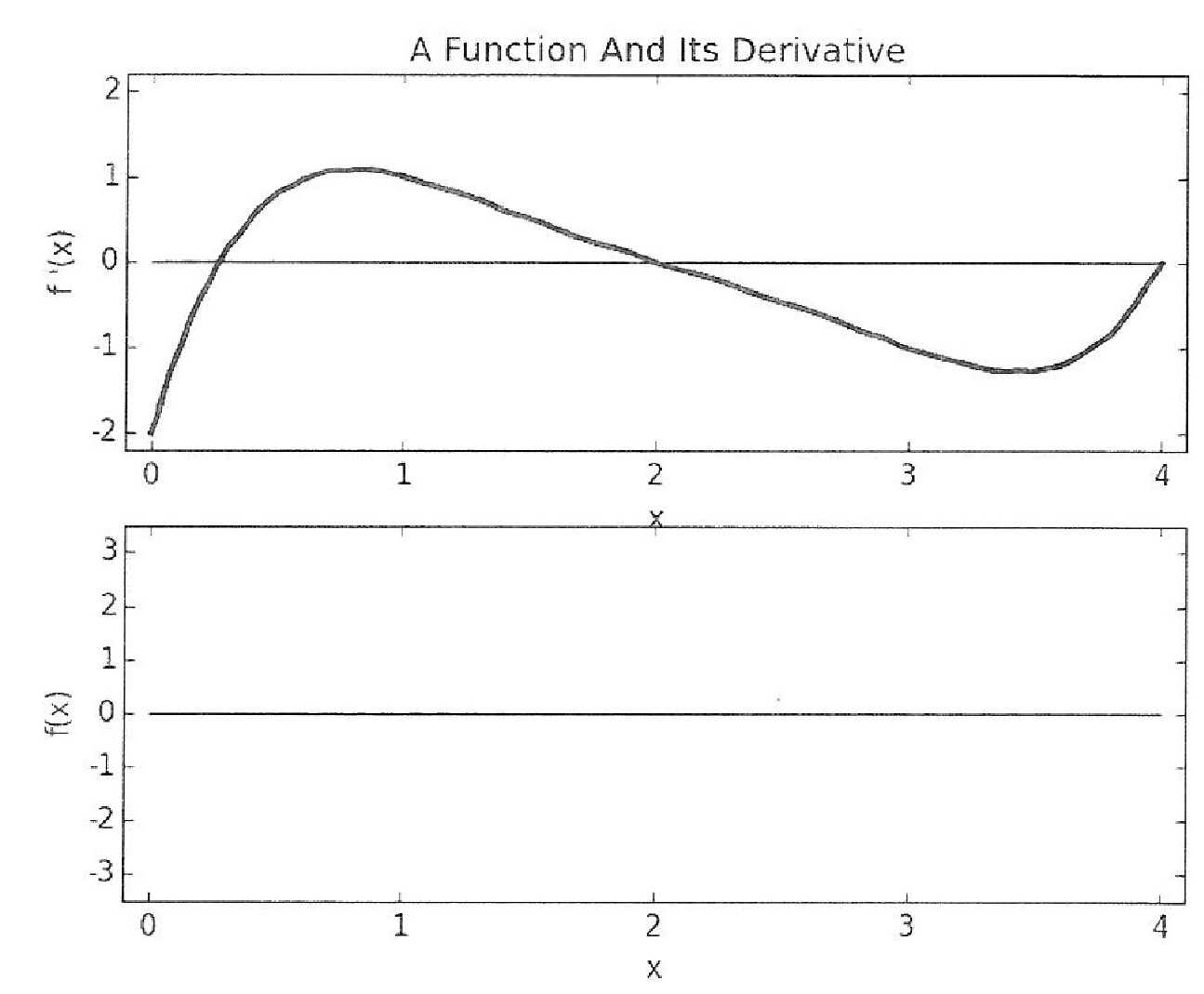
Solution: We are given the graph of \(f'(x)\), so we reconstruct the shape of \(f(x)\) from the sign of the derivative.
First, \(f(0)=0\), so the graph of \(f\) must pass through the point \((0,0)\).
Next, \(f\) is increasing where \(f'(x)>0\) and decreasing where \(f'(x)<0\). From the graph of \(f'\), the derivative is negative near \(x=0\), so \(f\) begins by decreasing. Then \(f'\) crosses the x-axis and becomes positive, so \(f\) changes from decreasing to increasing; therefore \(f\) has a local minimum at that first zero of \(f'\).
The graph of \(f'\) stays positive until about \(x=2\), so \(f\) keeps increasing on that interval. When \(f'\) crosses from positive to negative near \(x=2\), the function \(f\) changes from increasing to decreasing, so \(f\) has a local maximum there.
After that, \(f'\) is negative for a while, so \(f\) decreases again. Finally \(f'\) becomes positive near the right end of the interval, so \(f\) changes from decreasing to increasing once more, giving another local minimum before \(x=4\).
Thus a correct sketch starts at \((0,0)\), decreases at first, rises after the first critical point, reaches a local maximum near \(x=2\), then decreases, and finally turns upward again near the right-hand side. The exact heights are not determined, but this increasing/decreasing behavior and the location of the turning points must match the sign changes of \(f'\).
A road has two lanes going north and south, and the lanes are separated by a distance of 0.1 miles. One car, traveling North, is traveling at a constant 80 miles per hour. Another car, traveling South is traveling at constant 70 miles per hour. What is the rate of change of the straight line distance between the two cars when they are approaching one another and the straight line distance between the cars is one mile? What is the rate of change of the straight line distance at the moment when they pass each other?
Solution: Let \(y\) be the north-south separation of the cars and let \(z\) be the straight-line distance between them. The lanes stay \(0.1\) mile apart, so the east-west separation is constant and we may write \[ z^2=y^2+0.1^2. \] While the cars are approaching each other, one moves north at \(80\) mph and the other moves south at \(70\) mph, so the north-south separation is decreasing at the combined rate \[ \frac{dy}{dt}=-(80+70)=-150\text{ mph}. \] Differentiate the relation \(z^2=y^2+0.1^2\) with respect to time: \[ 2z\frac{dz}{dt}=2y\frac{dy}{dt}. \] Now consider the instant when the straight-line distance is \(z=1\). Then \[ 1^2=y^2+0.1^2, \] so \[ y=\sqrt{1-0.01}=\sqrt{0.99}. \] Substitute this into the related-rates equation: \[ \frac{dz}{dt}=\frac{y}{z}\frac{dy}{dt}=-150\sqrt{0.99}\approx\boxed{-149.25\text{ mph}}. \] The negative sign means the distance between the cars is decreasing at that moment.
At the instant when the cars pass each other, their north-south separation is \(y=0\). Substituting \(y=0\) into \[ 2z\frac{dz}{dt}=2y\frac{dy}{dt} \] gives \[ 2z\frac{dz}{dt}=0. \] Since \(z=0.1\neq0\) at that instant, it follows that \[ \boxed{\frac{dz}{dt}=0}. \] So at the moment they pass each other, the straight-line distance is neither increasing nor decreasing.
Sketch a plot of the function
Label your axes and indicate the values of all \(\displaystyle x\)-intercepts, \(\displaystyle y\)-intercepts, and asymptotes including for \(\displaystyle x \to -\infty\) as well as \(\displaystyle x \to \infty\).
Solution: We identify the key features one by one.
First, for the intercepts: the x-intercepts occur where the numerator is zero and the denominator is not zero. Since \[ 2x=0 \quad\Longrightarrow\quad x=0, \] and the denominator at \(x=0\) is \(-4\neq0\), the graph crosses the x-axis at \((0,0)\). This is also the y-intercept, since \[ f(0)=\frac{2(0)}{0^2-4}=0. \]
Next, the vertical asymptotes occur where the denominator is zero and the numerator is nonzero: \[ x^2-4=0 \quad\Longrightarrow\quad x=\pm2. \] Since the numerator is \(2x\), which is not zero at \(x=2\) or \(x=-2\), we have vertical asymptotes at \[ \boxed{x=-2 \quad\text{and}\quad x=2}. \]
For end behavior, compare degrees. The numerator has degree \(1\), while the denominator has degree \(2\), so \[ f(x)=\frac{2x}{x^2-4}\to0\quad\text{as }x\to\pm\infty. \] Thus the horizontal asymptote is \[ \boxed{y=0}. \]
Finally, for the sketch, the graph has three branches separated by the vertical asymptotes \(x=-2\) and \(x=2\), it passes through the origin, and it approaches the x-axis as \(x\to-\infty\) and as \(x\to\infty\).
A car starts from rest at a stop light. At the end of 10 seconds its position is 100 meters beyond the light. Three statements are given below. For each statement indicate if it must be true, must be false, or if it is not possible to determine indicate that you cannot tell from the given information. For each statement provide a complete, one sentence explanation for your reasoning.
- True/False/Cannot Tell Its final speed is 10 meters per second
- True/False/Cannot Tell At some point in time its speed was 10 meters per second.
- True/False/Cannot Tell It did not move faster than 10 meters per second at any time.
Solution:
- This is \(\boxed{\text{Cannot Tell}}\). The data tell us only that the car traveled \(100\) meters in \(10\) seconds, so the average velocity is \(10\) m/s. That does not determine the final speed at \(t=10\); the final speed could be less than, equal to, or greater than \(10\) m/s.
- This is \(\boxed{\text{Must be True}}\), assuming the position function is differentiable on \((0,10)\) and continuous on \([0,10]\), which is the standard calculus model for motion. Since the car moves from \(0\) meters to \(100\) meters in \(10\) seconds, the average velocity is \[ \frac{100-0}{10-0}=10\text{ m/s}. \] By the Mean Value Theorem, there must be some time \(c\in(0,10)\) such that the instantaneous velocity equals the average velocity, so \(v(c)=10\) m/s.
- This is \(\boxed{\text{Cannot Tell}}\). Knowing the average velocity is \(10\) m/s does not force the speed to stay at or below \(10\) m/s the whole time. For example, the car could travel faster than \(10\) m/s during part of the interval and slower than \(10\) m/s during another part, while still ending up with average velocity \(10\) m/s overall.
A cistern for storing water will be constructed. Its shape is a right circular cylinder with radius \(\displaystyle R\) and height \(\displaystyle H\). It must be able to hold \(\displaystyle 1000 \ m^3\) of water. The cost of the materials is related to the surface area. It is \$8 per square meter for the sides and is \$10 per square meter for the bottom. (The top of the cistern is open.) What dimensions for the cistern will minimize the cost of the materials?
\hrule
\newline
out of a possible 10 points
Solution: Let the cylinder have radius \(R\) and height \(H\).
Because the cistern must hold \(1000\text{ m}^3\), we have the volume constraint \[ \pi R^2H=1000\implies H=\frac{1000}{\pi R^2}. \] The top is open, so the material cost comes from the lateral surface and the bottom only. The lateral area is \(2\pi RH\), and it costs \$8 per square meter, so that part costs \[ 8(2\pi RH)=16\pi RH. \] The bottom area is \(\pi R^2\), and it costs \$10 per square meter, so that part costs \[ 10(\pi R^2)=10\pi R^2. \] Therefore the total cost as a function of \(R\) and \(H\) is \[ C(R)=8(2\pi RH)+10(\pi R^2)=16\pi RH+10\pi R^2. \] Now use the volume constraint to eliminate \(H\): \[ C(R)=\frac{16000}{R}+10\pi R^2. \] So we have reduced the problem to minimizing a one-variable function for \(R>0\). Differentiate: \[ C'(R)=-\frac{16000}{R^2}+20\pi R. \] Set the derivative equal to zero to find critical points: \[ 20\pi R^3=16000\implies R^3=\frac{800}{\pi}. \] So \[ \boxed{R=\left(\frac{800}{\pi}\right)^{1/3}}. \] Then \[ H=\frac{1000}{\pi R^2}=\frac54R, \] so \[ \boxed{H=\frac54\left(\frac{800}{\pi}\right)^{1/3}}. \] To justify that this critical point gives a minimum, compute the second derivative: \[ C''(R)=\frac{32000}{R^3}+20\pi. \] Since \(R>0\), both terms are positive, so \(C''(R)>0\) for every admissible \(R\). Therefore the cost function is concave up, and this critical point gives the minimum cost.
Thus the least expensive cistern has \[ \boxed{R=\left(\frac{800}{\pi}\right)^{1/3},\qquad H=\frac54\left(\frac{800}{\pi}\right)^{1/3}}. \]